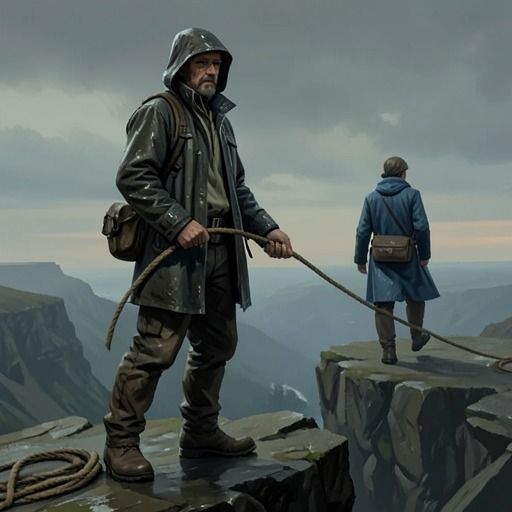
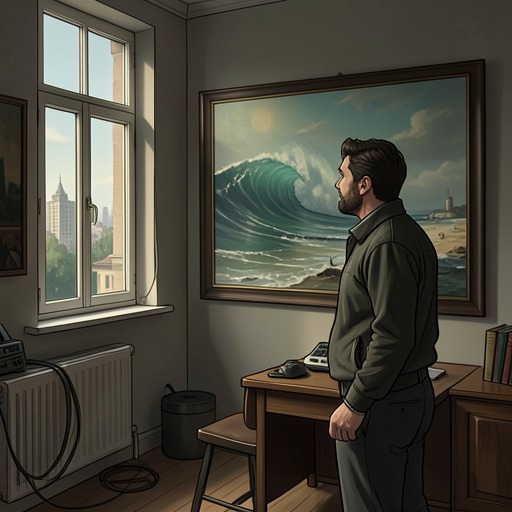
K's watercolor painting
Blind Willow, Sleeping WomanK’s watercolors are paintings that K made and gave to his childhood friend, the narrator. Preserved among the narrator’s childhood belongings, they return to him more than forty years after K is swept away by a wave. Their importance lies not only in what they depict, but in how looking at them alters the narrator’s memory: the pictures first reopen his fear, then help him see K’s last expression differently and decide to return to the beach.
Origin and Rediscovery
The paintings were among the keepsakes found in a carton of the narrator’s childhood possessions. After the narrator’s father died and his brother sold the old family house, the brother sent the carton to him in Nagano. Most of its contents seemed useless, but a bundle of pictures by K stood apart: the narrator’s parents had apparently put them away to preserve his friend’s memory.
At first, that preservation intensifies rather than eases the narrator’s distress. The pictures make him feel as if K’s spirit might spring back to life, so he wraps them up again, intending to discard them. He cannot bring himself to throw them away. After several days of indecision, he opens the bundle and makes himself study the paintings. The delay matters: the pictures do not immediately console him; he has to choose to look.
What the Paintings Preserve
Most of the works are landscapes of the familiar shoreline and its surroundings: ocean, sand beach, pine woods, and town. The narrator recognizes the clarity and coloration characteristic of K’s hand. The watercolors have remained vivid over the years, and he judges them more skillfully executed than he remembered. Their surviving appearance makes the past newly present without changing the fact of K’s death.
As he looks through them, concrete places and shared childhood experiences return with force. He recognizes in the pictures the way K, as a boy, had looked openly at the world, and realizes that his own younger vision had been much the same. The paintings therefore preserve more than a record of scenery: they lead him back to a version of himself that fear had obscured. Their effect is gradual and bodily in the narrator’s account; he feels that something in the pictures is permeating him.
A Daily Practice and a Revised Memory
After the first viewing, the narrator makes a habit of studying one painting at his desk each evening after work. He can spend hours with a single picture, finding in each another landscape of a childhood he had shut out of memory. Repetition changes the paintings’ role: what initially seemed dangerous to keep becomes a sustained means of approaching the memories attached to K.
About a week into this practice, the narrator considers that he may have misunderstood K’s expression during the wave’s attack. He no longer assumes that K looked at him with hatred or resentment, or meant to take him along. The expression that had seemed like a terrible grin may have resulted from angle, light, or shadow; K may already have lost consciousness, or may have been smiling as he parted from his friend. The narrator recognizes that his perception of hatred could instead have reflected the terror that had taken control of him.
The watercolors strengthen this reinterpretation. The longer he studies one of them, the more convinced he becomes that it contains a gentle, innocent spirit rather than any sign of accusation. The pictures cannot establish exactly what K felt in the final moment, but they loosen the narrator’s certainty that he had witnessed hostility. In that way, they do not erase the traumatic memory; they make room for a different reading of it.
From Looking to Return
The narrator remains at his desk through the evening and night, as darkness gives way to dawn. When the new day begins, he knows he must go back. The decision connects the quiet, repeated act of looking at K’s paintings to a concrete change in his conduct: after avoiding the shore and other deep water for over forty years, he is prepared to revisit the beach where K was taken by the wave.
The paintings thus function as both keepsakes and a route toward confronting what the narrator has avoided. Their landscapes restore the intimacy of the boys’ shared world, while their repeated study unsettles the fixed image of K as a threatening presence. Their significance rests in this double movement: they bring the past close enough to hurt, but also help the narrator approach it without treating fear as the only available truth.