Mizuki’s name tag theft and recovery
Blind Willow, Sleeping WomanThe theft and recovery of Mizuki’s name tags is the turning point in her struggle to remember who she is: the practical return of two stolen objects brings her married and maiden names back into reach, while a startling disclosure forces her to face the family rejection she had kept at a distance. A monkey has taken both Mizuki’s and Yuko Matsunaka’s name tags, and the Sakakis recover them; the monkey’s confession and account of Mizuki’s childhood make the recovery more than a simple solution to a memory problem.
The Names Behind the Theft
Mizuki’s name exists in several everyday forms. Her married name is Mizuki Ando, taken when she married Takashi Ando three years before, but the change initially felt awkward: she had to repeat and sign the new name before it began to feel like hers. At work she continued to use her maiden name, Mizuki Ozawa, because updating the company’s records would have meant doing the paperwork herself. Her business cards, name tag, time card, and colleagues’ familiar ways of addressing her all maintained that earlier name. Her husband knew and did not object; to him, her workplace name was a matter of convenience.
That ordinary division between a married name at home and a maiden name at work becomes consequential when Mizuki begins to forget her own name. The episodes start about a year before the investigation and grow from roughly monthly occurrences to at least once a week. She can remember other people’s names, her address, phone numbers, birthday, and passport number. The failure strikes when her own name is suddenly demanded or she is in a hurry; if she knows the question is coming, she can answer. Her purse, with her identification inside, can reassure her, but without it she fears the prospect of being a woman without a name. The book distinguishes this recurring blank from total amnesia: she remains herself in many practical ways, yet the lapse unsettles her sense of being socially identifiable.
The two recovered tags make the names material. One bears Mizuki Ozawa, the name she still uses at work; the other bears Yuko Matsunaka, her friend’s name. Mrs. Sakaki lays them on a desk and explains that they were stolen and that their recovery has addressed Mizuki’s difficulty remembering her name. Seeing the pair, Mizuki pales, returns to the sofa, and presses both hands to her mouth. The objects connect her private memory failure to an actual intrusion into her home, and place Yuko’s name beside her own in the mystery.
The Investigation and the Monkey
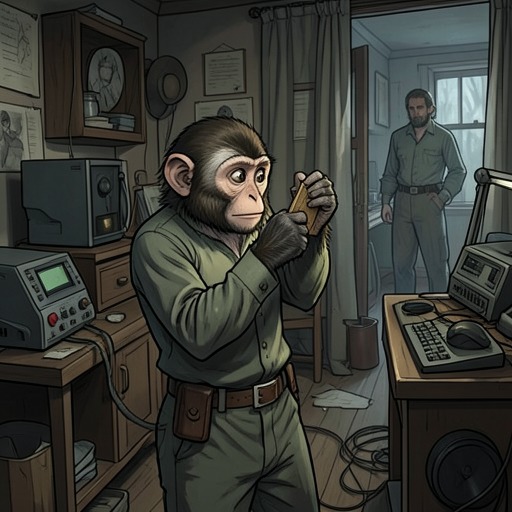
Mrs. Sakaki identifies the thief as a monkey found hiding in Shinagawa’s sewers. She had asked her husband, the Public Works section chief, to have his young colleagues catch it; their authority over the sewers made the search possible. Sakurada, one of the colleagues, says the monkey used a hideout beneath Takanawa as a base for foraging across Tokyo. When Mizuki sees the captive, he is tied to a chair in a small storage room, his long tail drooping to the floor. The scene makes the explanation as strange and concrete as the recovered tags: a monkey, not a human intruder, has taken the names.
Asked why he stole them, the monkey calls it a sickness. When he sees a person’s name that attracts him, he says, he cannot stop himself from wanting it; he sneaks into homes to take such names, though he knows this is wrong. He apologizes for stealing Mizuki’s tag as well as Yuko’s. Mrs. Sakaki’s account supplies the practical chain of events—sewer hiding place, Public Works search, capture, and recovery—while the monkey’s confession gives the theft its peculiar motive. The tags are returned, but the explanation does not end with the mystery of how they disappeared.
The Revelation About Mizuki’s Family
The monkey tells Mizuki that her mother has never loved her and that her older sister also dislikes her. He says her mother sent her away to school in Yokohama because she wanted to get rid of her, while her father, though not a bad person, lacked the forcefulness to stand up for her. In his account, Mizuki grew up without enough love and learned to avert her eyes from that painful reality, shutting it away rather than acknowledging it. He connects that defensive habit to her difficulty loving anyone else unconditionally.
The revelation lands as a second kind of identity crisis. Mizuki sinks to the floor with her eyes closed; she feels as though her skin, insides, and bones are coming apart, and hears only her own breathing. Sakurada dismisses the monkey’s words as outrageous and wants to beat him, but Mizuki stops him. She says the account is true: she has known it for a long time, avoided it, and closed her eyes and ears to it. The thief has taken her names, but his accusation exposes a truth she recognizes as her own.
Release and Return
Mizuki asks the Sakakis to take the monkey to the mountains and let him go. Her decision does not excuse the theft: she says she is willing to forgive him so long as she gets her name back. Rather than respond to the disclosure with violence, she acknowledges its truth and chooses what should happen next to the animal who caused her suffering. The request redirects the scene from punishment toward release, without suggesting that the damage or the family history has vanished.
At home, she places the Mizuki Ozawa name tag together with a bracelet engraved with Mizuki (Ozawa) Ando inside a plain brown business envelope, then puts it in a cardboard box in her closet. The gesture keeps the two forms of her name together rather than forcing one to erase the other. She has her name back and can resume a normal life, but the ending stays deliberately tentative: things might work out, or they might not. What she has recovered is not certainty about the future, but possession of a name she can call her own.