Mr. Kurumizawa
Blind Willow, Sleeping WomanMr. Kurumizawa is a forty-year-old stockbroker whose unexplained disappearance breaks the ordinary geography of his life: he leaves his apartment on the twenty-sixth floor to visit his mother two floors below, but never arrives home. Twenty days later, he is found asleep in a waiting room at Sendai Station, unable to remember how he traveled there or what happened in the intervening days. He returns to Tokyo physically intact but without the missing stretch of his memory, leaving the investigator who searched for him to imagine that the search itself may continue in another form.
Identity and Background
Mr. Kurumizawa works as a stockbroker at Merrill Lynch and lives with his wife on the twenty-sixth floor of a condominium in Shinagawa. His mother lives alone in another unit in the same building, on the twenty-fourth floor. She had lived at a temple with her husband, a Jodo priest, but moved into the condominium after he died and another priest took over. Mr. Kurumizawa was his father’s only son, but, more interested in stock trading than Buddhism, did not succeed him as head priest.
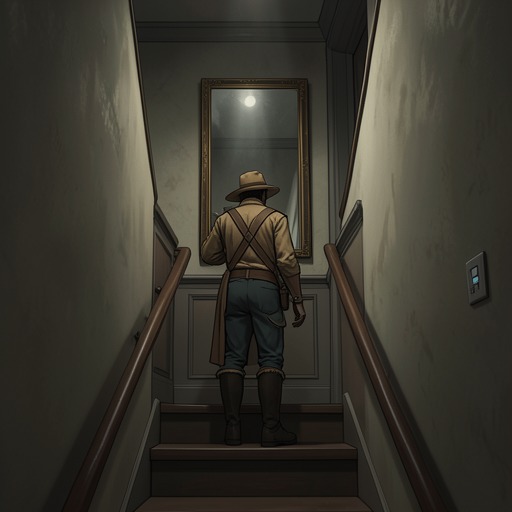
At the time of the disappearance, Mr. Kurumizawa is forty and due to turn forty-one the following month. His wife describes him as nearsighted and says he wears metal-framed Armani glasses. He dislikes elevators and always takes the stairs, a habit that makes the building’s stairwell a natural route through his daily life—and the last place where anyone knows he was.
The Morning He Vanishes
The disappearance begins on September 3, a rainy Sunday. Mr. Kurumizawa had planned to play golf, but heavy rain since dawn forced him to cancel. At ten that morning, his mother called to say she was having trouble breathing, felt dizzy, and could not stand. He dressed without shaving and went downstairs to her apartment, telling his wife he would not be long and asking her to prepare breakfast.
His clothes are described with unusual precision: cream-colored chinos and a dark-gray, short-sleeved polo shirt, both bought from the J.Crew catalogue; gray New Balance shoes; and no socks. His wife was about to make her customary Sunday pancakes, which he particularly liked with crisp bacon. Twenty-five minutes after leaving, he phoned from his mother’s apartment. He said she had settled down, that he was on his way upstairs, and that he was hungry and wanted breakfast ready when he returned. His wife heated the frying pan and maple syrup, cooked the pancakes and bacon, and waited. The food cooled on his plate, but he did not come home.
When his wife called his mother, she learned that he had already left. Mr. Kurumizawa had disappeared somewhere between the twenty-fourth and twenty-sixth floors. He had gone down to his mother empty-handed: no wallet, driver’s license, credit cards, or watch. His unfinished shaving, the clothes he wore, and especially his call asking for pancakes all contradict the police suggestion that he might have abruptly left his life behind. His established dislike of elevators further points to the stairs as his route, but does not explain what happened there.
The Search and the Stairwell
Mr. Kurumizawa’s wife contacted the police when he had not returned by one o’clock. A patrolman visited but, finding no indication of a violent crime, made little effort to investigate and advised her to file a missing-person report if her husband had not come back in two days. She rejected the idea that he had simply walked away: someone intending to run off, she argued, would not leave without money or identification after calling home to ask for breakfast.
The narrator, a volunteer investigator, takes the case seriously and tries to establish who uses the building’s stairs. A runner who lives on the seventeenth floor recognizes Mr. Kurumizawa. He has spoken with him once and sometimes passed him on the staircase while running; he has also seen him sitting on the sofa. The runner confirms the defining habit already reported by his wife: Mr. Kurumizawa is one of the residents who avoids the elevator. The stairs, however, are not private or deserted. Other residents use them regularly, some for exercise, and the runner says he and two others run up them because the neighborhood offers no good jogging course. The well-lit, spacious, clean stairwell accommodates routine passage, yet it yields no account of the missing man’s passage through it.
Twenty Days Lost
The case ends abruptly when Mr. Kurumizawa’s wife calls the narrator on a Saturday morning. Police have found her husband asleep on a bench in a waiting room at Sendai Station. He has no money or identification, but eventually remembers his name, address, and telephone number. His wife flies to Sendai and identifies him. He has no idea how he reached the station: he simply woke as a railroad employee shook his shoulder. He cannot explain how he traveled all the way to Sendai without money or how he ate during the twenty days he was missing.
He is wearing the same clothes in which he left the condominium. He has grown a beard, lost more than twenty pounds, and lost his glasses. At the hospital in Sendai, doctors perform a CAT scan, X-rays, and neurological examinations. His wife reports that he appears mentally well and has no physical problem, but his memory of the twenty days is gone. He remembers leaving his mother’s apartment and walking up the stairs; after that, there is nothing. The disappearance is thus resolved in one narrow sense—Mr. Kurumizawa is alive and found—but not explained. The journey has an endpoint, while its cause, route, and experience remain inaccessible to him and to those investigating.
Relationships and the Unanswered Mystery
The narrator, speaking aloud after the case closes, describes Mr. Kurumizawa’s world as a triangle with three sides: his mother, prone to panic attacks; his wife, whose high heels he likens to ice picks; and Merrill Lynch. The formulation turns the ordinary ties of family and work into the boundaries of a compact, recognizable life. Yet that familiar triangle cannot account for his sudden absence from it. His mother’s call, his wife’s breakfast preparations, and his own phone call create an unusually clear chain of circumstances immediately before he vanishes, without supplying the missing link.
Mr. Kurumizawa’s return does not restore the continuity that disappeared with him. His wife ends the investigation because he has been found, but the narrator resists treating the practical resolution as the end of searching. He wonders whether the thing being sought might be shaped like a door, an umbrella, a doughnut, or an elephant, and hopes the search will take him where he is likely to find it. Mr. Kurumizawa’s case therefore stands both as a mystery with a confirmed survivor and as an emblem of what remains beyond the facts: a person can return to the world without returning with an explanation of where he has been.