Sharpie Crows–Sharpie Cake Company relationship
Blind Willow, Sleeping WomanThe Sharpie Crows–Sharpie Cake Company relationship is built around a peculiar arrangement: when company directors cannot agree whether a contestant’s creation qualifies as a Sharpie Cake, they submit it to a captive flock whose food habits determine the competition’s outcome. The crows are both living judges and products of the company’s world, raised for centuries on Sharpie Cakes alone. Their apparent ability to recognize the genuine article is treated as decisive, even when the test produces chaos rather than a clear ruling.
The company’s unusual arbiters
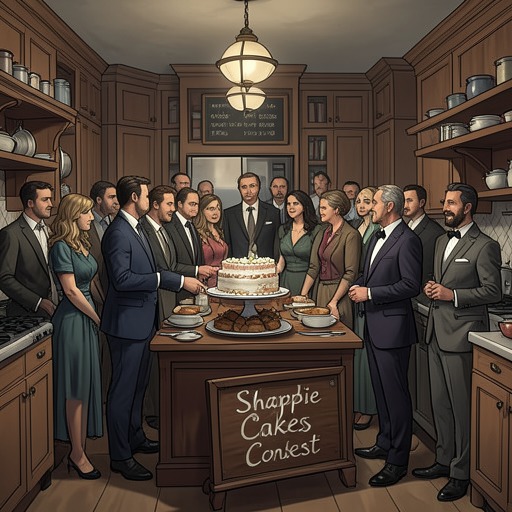
The board of directors turns to the Sharpie Crows after disagreement among senior employees over whether a contestant’s cake is truly a Sharpie Cake. The managing director presents the decision as belonging to the birds, whom he calls Their Holinesses, granting an animal feeding test the authority to settle a company dispute over definition and quality.
The crows live in a restricted room on the sixth floor, behind a large iron door guarded by a security officer. The managing director explains that they are a special family of birds that have eaten nothing but Sharpie Cakes for centuries. The elaborate access controls mark the flock as a protected institutional secret, while their diet supplies the rationale for using them: they are presumed to know the product through exclusive, inherited familiarity.
A test of authenticity
The director first scatters genuine Sharpie Cakes on the floor, and the birds rush to them. He then presents a rejected competition recipe resembling the company’s cakes. The crows initially descend on it, but spit it out once they recognize that it is not genuine, crying out for Sharpies. The director takes this response as proof that they will eat only the authentic product and refuse an imitation.
He next uses the contestant’s new Sharpie Cakes as the decisive test: if the flock eats them, the contestant wins; if not, the contestant loses. The rule makes the crows’ appetite a substitute for an institutional judgment, collapsing a contested question of classification into a binary outcome. Yet the flock does not respond as one. Some birds eat the new cakes enthusiastically; others reject them, while birds unable to reach the food turn on those that are eating. The test therefore produces conflicting signals instead of a clean verdict.
The verdict and its significance
The feeding trial becomes a violent free-for-all, and the birds’ competing responses make the competition’s premise unstable. The crows are meant to distinguish genuine Sharpie Cakes from substitutes, but the contestant’s recipe divides them: acceptance by some is accompanied by rejection from others. The company has delegated judgment to a supposedly infallible authority without providing a way to interpret disagreement among its judges.
The episode makes authenticity appear both absolute and absurdly precarious. The rejected recipe is dismissed by the birds, while the new cakes provoke both consumption and refusal; the flock’s behavior does not resolve the distinction so much as dramatize its stakes. For the company, the crows’ appetite is the final standard. For the reader, the spectacle exposes how an apparently objective test can become a disorderly contest of competing reactions, even when everyone involved treats the answer as a matter of life and death.