The Seventh Man and K’s Friendship
Blind Willow, Sleeping WomanThe Seventh Man and K’s Friendship shapes both the disaster that divides the two boys and the long struggle that follows it. K is the Seventh Man’s closest companion, loved as a brother; when a gigantic wave strikes during a typhoon, fear sends the Seventh Man toward safety while K is swept away. K’s disappearance leaves no body to bury, and the survivor carries the conviction that he could have tried to save his friend. Only much later does he begin to see K not as an accusing presence, but as the gentle, innocent boy he remembers.
Childhood Companions
The Seventh Man grows up in a small seaside town, where his father is the local doctor and his childhood is comparatively comfortable. His own brother is six years older, and their age and personality differences leave them less close than he wishes. That brotherly affection instead settles on K, who lives nearby and is a year behind him at school. The boys walk to school together and spend their free time together; across their long friendship, they never quarrel. The Seventh Man describes K not simply as a friend but as the person who occupied the place of a brother in his life.
K is slight and frail, with a speech impediment that can lead strangers to underestimate him. The Seventh Man, bigger and athletic, acts as his protector at home and at school, where other children look up to him. Yet their closeness is not only a matter of protection: the Seventh Man values K’s sweet nature and recognizes abilities that school does not measure well. K struggles with most subjects, but in art he is exceptional. His lively pictures earn prizes, and he spends long hours painting seascapes beside the shore. The Seventh Man watches the precise movement of his brush and remembers the talent with admiration. K’s art later becomes the means through which the survivor can reconsider the friend he lost.
The Typhoon and the Separation
In September, a typhoon forecast as the worst in ten years bears down on the town. The adults prepare for danger: schools close, shops shutter, the family secures the house, gathers emergency supplies, and packs important possessions in case evacuation is needed. For the children, the storm initially has the excitement of a spectacle. After the strongest winds begin, the Seventh Man’s family takes shelter together, listening to radio reports of damage and warnings against going outside. When the storm reaches its eye, the wind and rain stop temporarily. The Seventh Man’s father explains that the calm is only an interval before the winds return, and allows him to walk nearby on the condition that he come back at the first sign of wind.
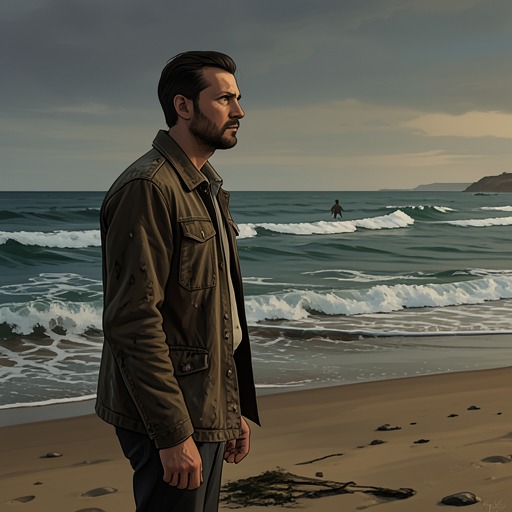
The Seventh Man goes toward the shore to see what the storm has left behind. Broken branches, shattered roof tiles, damaged cars, and scattered debris mark the road. K comes out after seeing him, and the boys continue to the beach, where they inspect objects washed ashore by the storm. The pause in the weather makes their excursion seem briefly safe, but the Seventh Man notices the water moving close to his feet and feels an immediate, inexplicable fear. Though the waves have seemed gentle, he believes they are alive and intend to seize him. He calls to K, who is absorbed in something he has found and does not respond.
As a rumbling sound grows, the Seventh Man recognizes that a great wave is coming. He thinks he should run to K and pull him away, but instead runs alone toward the breakwater. From there he finally shouts a warning that K hears. By then the wave is too close: it rises behind K and carries him away before he can escape. The Seventh Man survives behind the breakwater, where the water reaches him only as spray. When the wave retreats, he cannot find K or the dog on the emptied shore. He remains on the seawall, expecting more waves rather than going down to search. A second enormous wave arrives; he stays where he is, whether from fear or because he believes there is no point in fleeing after K has been taken.
Loss, Guilt, and the Memory of K
K’s body is never found, and neither is his dog. In the area, people who drown may be carried to a small inlet to the east, but that does not happen in K’s case. The local fishermen help search for a long time before the effort gradually ends. Without a body, there can be no funeral. K’s parents move between searching the beach and staying at home chanting sutras, while the Seventh Man falls seriously ill after the shock and is confined to bed for a week on a liquid diet.
K’s parents do not blame the Seventh Man for taking their son to the shore, and his own parents avoid discussing the disaster in front of him. Their silence does not free him from responsibility. He repeatedly believes that he might have reached K in time and that, overcome by fear, he chose to save himself instead. K appears in his nightmares, associated with the wave, and the memory of his friend becomes inseparable from the moment he ran away. The unspoken nature of the guilt intensifies it: nobody accuses him, but neither does anyone say aloud what he believes about his own choice.
Years later, the Seventh Man encounters K’s watercolors and studies them regularly. Their familiar coastal landscapes bring back the places and experiences the two boys shared, as well as the way K had looked at the world. Looking at the paintings leads him to question the image of K that has haunted him. He considers that K’s expression in the wave may not have been hatred or resentment, but an effect of angle and light, or a gentle farewell. The terror he remembers seeing on K’s face may have belonged instead to the Seventh Man himself, projected onto his friend in the instant of fear. In the paintings he finds not accusation, but K’s gentle and innocent spirit.
Return and Reconciliation
On returning to the shore decades after the typhoon, the Seventh Man sees an ordinary beach: people walking, the sea stretching to the horizon, and the late-afternoon light falling across the scene. The contrast between this familiar landscape and the catastrophe held in his memory makes the disaster seem almost unreal. Then he recognizes that the darkness he has carried inside him has vanished. He walks into the surf without removing his shoes or turning up his trousers, allowing the waves to wash over his feet. The water that once embodied terror now touches him without making him flee.
The return is not a claim that the past can be undone. As he stands at the water, the passage of forty years seems to collapse, and he loses his balance and falls into the waves. This time, he is not afraid. He later says that the nightmares and nights spent waking in terror have stopped, and that he is trying to begin life again, though he doubts he has much time left. His recovery is therefore qualified but real: he cannot recover K or erase his decision on the beach, but he can revise the meaning he has given K’s final image and live without surrendering the rest of himself to fear.
Significance of the Bond
The friendship gives the Seventh Man’s story its central moral and emotional tension. His role as K’s protector, established through years of ordinary care, is overturned in the disaster when his instinct to survive defeats his intention to help. The lasting wound comes not from a lack of affection but from the painful distance between loving K and failing him at the decisive moment. The fact that the families do not accuse him leaves that conflict to be carried privately, in illness, sleeplessness, and recurring dreams.
K remains present in the Seventh Man’s life through two contrasting forms of memory: the terrifying image associated with the wave and the landscapes preserved in his paintings. The first turns the friend into a possible judge; the second restores the sensitive boy whose perception and art the Seventh Man had cherished. His eventual reconciliation with the sea accompanies this change in memory. The friendship does not end with K’s disappearance: it continues as grief and guilt, then as an effort to see K with tenderness rather than through the survivor’s fear.