The firefly's release
Blind Willow, Sleeping WomanThe firefly’s release is a small, deliberate act with an expansive afterlife in memory. Alone on a dormitory water tower, an unnamed narrator sets a dim firefly free; its brief flight becomes an image of lost time and of a past whose traces remain vivid but unreachable.
The Firefly and Its Arrival
At the end of the month, the narrator’s roommate gives him a firefly in an instant-coffee jar. The improvised enclosure holds grass and a little water, and tiny holes have been punched in its lid. In the remaining daylight the insect looks like an ordinary black bug, but the narrator peers inside and recognizes it. It tries to climb the slippery glass, slipping back each time. The close encounter revives the presence of something he has not seen for a long while.
The roommate found the firefly in the courtyard. A hotel down the street had released a group as a publicity stunt, and this one apparently made its way to the dorm. As he packs a small suitcase for fieldwork’s end and the journey home, the roommate suggests giving it to a girl, reasoning that girls like fireflies. The narrator accepts the suggestion, but after sundown he takes the jar by himself to the roof instead. The insect’s release thus begins not as a gift to someone else but as a private encounter.
The Water Tower at Night
The roof is deserted. A forgotten white shirt hangs from the clothesline and sways in the evening breeze; the narrator climbs a rusty ladder to the top of the water tower and sits in its cramped space beside the railing. The tank remains warm from the day’s heat. From there he sees Shinjuku on one side and Ikebukuro on the other, with car headlights streaming between them beneath the city’s low, blended hum.
At the bottom of the jar, the firefly gives off a faint glow, weaker and less vivid than the narrator remembers. He wonders whether it is dying, then shakes the jar to see it fly. It bumps against the glass, but its light remains dim. The uncertainty shifts from the insect to the memory itself: perhaps fireflies never shone as brightly as he recalls; perhaps childhood darkness made their light seem stronger. He cannot remember when he last saw one. What he can summon instead is an earlier scene: water running at night beside an old brick sluice gate, a narrow stream veiled with plants, and hundreds of fireflies burning above still water and reflected in it.
On the tower, with his eyes closed, he breathes deeply and feels that the summer darkness might draw him in. It is his first climb up there after dark. The wind, though not strong, leaves a distinct trace as it passes, while night gradually envelops the earth and seems to overcome even the city lights. The scene makes darkness more than a backdrop: it is the element into which the insect will disappear, and against which its faint light will briefly register.
Release and Flight
The narrator opens the jar and places the firefly on the narrow projecting edge of the water tower. It seems unable to make sense of its surroundings. After circling a bolt awkwardly, it stretches a leg onto a patch of loose paint, tests one direction, turns back from a dead end, then climbs onto the bolt and crouches motionless. The narrator watches from the railing. For a long time neither moves; the wind passes like a stream, and the zelkova leaves rustle against one another in the dark.
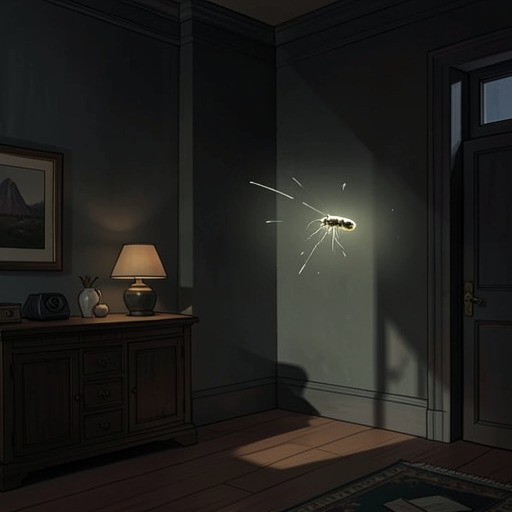
The firefly’s stillness makes the release uncertain rather than immediately triumphant. The narrator waits. At last, the insect suddenly spreads its wings and rises over the railing into the gathering dark, as though remembering something. It arcs beside the tower, pauses long enough for the trail of its light to blur, and flies east. The movement gives the scene its decisive change: a creature confined to glass and then stranded on a ledge finds its way into open air, while the watching narrator remains behind.
The Light That Remains
The insect disappears, but its light continues within the narrator. Behind his closed eyes, in the thick darkness, the glow wanders like a lost spirit. He repeatedly reaches his hand toward it and feels nothing; the light remains just beyond his grasp. The ending distinguishes release from recovery: he can let the firefly go and retain an impression of its passage, but he cannot hold that impression or return to the remembered past it evokes.
The remembered fireflies above the stream and the single dim firefly on the tower stand in contrast. One is an abundant childhood image, blazing over water; the other is fragile, enclosed first in a jar and then briefly motionless on a bolt. Yet the narrator is unsure whether this difference belongs to the fireflies, to changing darkness, or to the failures of memory. The scene does not resolve that uncertainty. Instead, its final image turns the insect’s brief light into a measure of distance: a trace can outlast its source, even when the person who remembers it cannot reach it again.