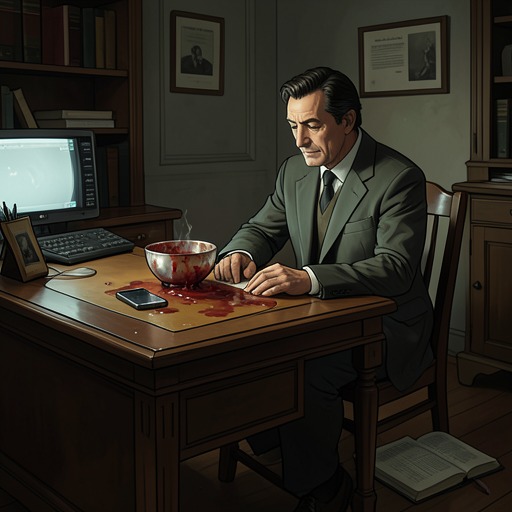
The illustrator decides to confront the harassment
Blind Willow, Sleeping WomanThe illustrator decides to confront the harassment after weeks of anonymous calls and unexplained vomiting convince him that neither medical institutions nor the police will intervene. His response is not to escape the conditions of the attacks but to resist them on their own terms: he refuses an answering machine, treats the vomiting as something he can endure, and commits himself to a contest of wills whose cost is measured in a sharply falling weight and a body reshaped by illness.
The failure of outside help
The illustrator seeks explanations for symptoms that seem to arrive together: phone calls that find him wherever he stays, and vomiting that continues alongside them. Psychiatrists at a university hospital tell him that they know of no link between schizophrenia and vomiting. They also decline to treat him, saying that their facilities cannot serve everyone with symptoms like his. Their advice divides the problem between an internist for the vomiting and the police for the calls, leaving him to navigate two systems that do not recognize the combination he is experiencing.
The police response is similarly dismissive. They regard crank calls as too common and petty to warrant intervention, and direct him to fill out a form and return if something worse happens. When he asks how the caller can know where he is, they do not take the question seriously. He also fears that insisting on the strange precision of the calls will make him seem crazy. The result is not a resolution but a narrowing of his options: in his view, doctors, police, and other people have all proved unable or unwilling to help.
Choosing to fight
By the twentieth day of the nausea-and-phone-call ordeal, the illustrator recognizes that he must deal with it himself. He asks himself whether he will continue suffering or change the shape of his life to avoid the attacks. Settling down with a girlfriend occurs to him as one possibility, but he rejects it. At twenty-seven, he considers himself old enough to settle down, yet he does not want to make that choice simply to escape an experience he regards as stupid and meaningless. He decides instead to fight until his physical and mental strength are spent.
That decision gives his conduct a deliberately combative logic. When asked why he does not install an answering machine, he says that doing so would amount to running away and admitting defeat. He imagines a war of wills in which either the caller runs out of steam or he dies. He does not establish who is calling, how the caller tracks him, or what the caller wants; the determination to resist takes shape in the absence of those answers.
The bodily cost of resistance
The calls and vomiting continue after the decision. The illustrator loses a tremendous amount of weight: he records 141 pounds on June 4, 134 on June 21, and 128 on July 10. His clothes no longer fit, and he has to hold up his pants when he walks. The sequence turns an abstract struggle of wills into a measurable physical decline.
He refuses to interpret the vomiting as a reason to retreat. Since he throws up whether or not he drinks, he resumes drinking, with beer at breakfast and whiskey after sunset. He recasts the vomiting as an ideal diet and reasons that, with cancer ruled out and his nutrition problem addressed, it is essentially harmless. He reports that he retains enough strength to work and manage his daily chores, although his account makes clear how far endurance has become a substitute for treatment or relief.
Rather than keep wearing clothes made for his former body, he takes money from his savings and has a suit and two pairs of trousers tailored to his new shape. In the tailor’s mirror, he likes the sight of himself so thin. This adjustment is not presented as an end to the harassment; it is a way of accommodating his changed body while continuing to hold his ground. His account places practical adaptation beside defiance: he changes his clothes, but not his decision to stay exposed to the calls.
What the decision resolves—and leaves open
The choice to confront the harassment is a turning point in the illustrator’s response, not a demonstrated cure. The evidence establishes that the calls and vomiting persist after he decides to fight, and that the episode extends through July 14; it does not establish that his resistance makes the caller stop or the vomiting end. The defining change is instead in his stance. Faced with an unexplained ordeal and institutions that will not take it on, he refuses the escape he associates with defeat and treats continued endurance as his remaining form of agency.