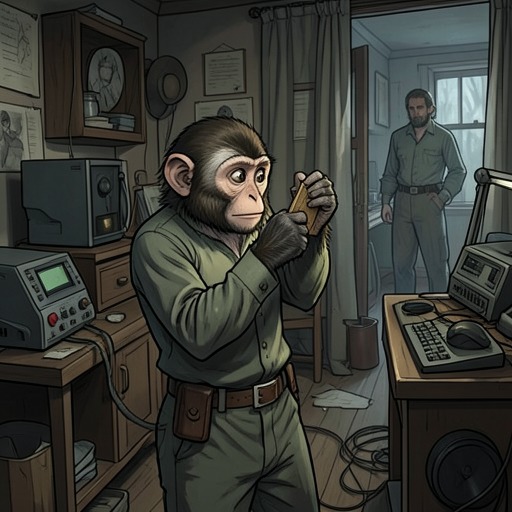
The monkey's compulsion to steal names
Blind Willow, Sleeping WomanThe monkey’s compulsion to steal names is an uncontrollable urge to take names that attract him, particularly personal names, from the people who bear them. It drives him to steal Yuko Matsunaka’s name tag and both Yuko’s and Mizuki Ando’s from their homes. The theft turns an eccentric appetite into a direct assault on another person’s sense of self: Mizuki’s name begins to disappear from her memory, while the monkey imagines possessing Yuko’s name as a substitute for being able to possess Yuko herself.
The Urge and Its Method
When confronted about the theft, the monkey speaks plainly about his habit. A name that catches his attention becomes something he feels compelled to have; he sneaks into people’s homes and takes it, even as he recognizes that the act is wrong. He describes the behavior as an illness that he cannot control. The explanation establishes both a pattern and a limit: the theft is deliberate in its means, but the desire behind it is presented as an overpowering compulsion rather than a calculated scheme.
The stolen objects are name tags, concrete items that carry names beyond the moment of introduction. The monkey’s fixation is not simply on hearing or remembering a name: he wants to possess its written form. That distinction gives the compulsion its peculiar force. A name can be used by others to identify someone, but here it can also be taken, hidden, and held by someone else.
Yuko Matsunaka and the Wish to Possess
The monkey’s attachment to Yuko Matsunaka provides the clearest account of what the stolen name means to him. He says he had never been so attracted to anyone, but knew that he could not make her his. Unable to resolve that desire through a relationship, he settled on having her name instead, imagining that possessing it would satisfy him. Before he could carry out his plan, Yuko died.
The monkey later tried to break into the dormitory to steal Yuko’s name tag, but he did not cause her suicide. He denies responsibility, and the account identifies her death as the result of an inner darkness that nobody could have overcome for her. The distinction matters: his desire connects him to Yuko’s story, but the evidence does not make him the cause of her death. His attempt to take her name is instead an unfulfilled effort to keep hold of a person he could not possess in life.
Mizuki Ando’s Name and Its Disappearance
In the spring of the previous year, the monkey learned that Yuko might have left her name tag with Mizuki. It took him a long time to trace Mizuki after she had married and become Mizuki Ando, and after she had moved to a condominium in Shinagawa. He eventually broke into her apartment and stole two tags: Yuko’s and Mizuki’s. He also admits taking two bananas from the table because he was hungry, an incidental theft that accompanies the more consequential act.
The name tag theft coincides with Mizuki’s growing difficulty remembering her own name. She can recall other people’s names and retain practical information such as her address, phone number, birthday, and passport number, yet her own name can vanish when she is hurried or unexpectedly asked. The episodes become more frequent, reaching at least once a week. The loss is not total amnesia: she continues to know that she exists and can recover her identity from her driver’s license. Still, the thought of being a woman without a name distresses her. The monkey’s theft therefore has a specific personal consequence, even though it does not erase her other memories.
Mizuki’s names already have a complicated everyday history. She became Mizuki Ando when she married Takashi Ando three years earlier, but continued to use her maiden name, Mizuki Ozawa, at work because changing the company records would require paperwork she kept postponing. Her business cards, time card, and name tag still identified her as Ozawa, and her colleagues used several familiar forms of address. At home, however, her married name had gradually become familiar to her. The monkey takes the tags against this background of names that remain in circulation in different settings, rather than from a life organized around one unchanging label.
Confession, Explanation, and Recovery
After the tags are recovered, Mrs. Sakaki tells Mizuki that they had been stolen and connects their return to her ability to recover her name. When Mizuki asks who took them, she is directed to ask the culprit. The monkey apologizes and confirms that he entered her apartment around the time her memory trouble began. He also confesses to the bananas, but his explanation for taking Mizuki’s tag is the same uncontrollable attraction he describes more generally: her name moved him, and he took it despite knowing he should not.
The monkey says that he had first pursued Yuko’s tag because he was deeply in love with her and wanted to possess her name when he could not possess her. His account links the two thefts without making them identical. Yuko’s tag represents an impossible attachment to someone who has died; Mizuki’s name becomes the object of a separate attraction, and its disappearance from her memory causes her suffering. Mrs. Sakaki’s explanation treats the return of the tags as the recovery of Mizuki’s name, giving the material objects a role in resolving what had seemed like an inexplicable failure of recall.
Names as Possessions and Signs of Self
The compulsion makes the story’s concern with names tangible. Names appear in several forms: the name bestowed on Tony Takitani by his father, the name Mizuki acquired through marriage, the maiden name she kept using at work, and the tags the monkey steals. These examples show that a name can be assigned, changed, retained for convenience, or carried on an object, and that its social use does not always match the person’s private sense of identity. For Mizuki, the married name took time to feel like her own; the old name remained active in her workplace; the stolen tags then give her difficulty recalling her name an external, physical counterpart.
The monkey’s behavior distorts the ordinary relation between a person and a name. He treats the name not as a label that refers to someone else, but as something he can acquire for himself. His inability to have Yuko becomes a wish to own the sign associated with her; his attraction to Mizuki’s name produces a theft that leaves her struggling to call herself back to mind. The compulsion thus joins desire, possession, and recognition, while the return of the name tags suggests that what can be taken from a person is not necessarily the whole of who that person is.