The synchronized nausea and phone calls
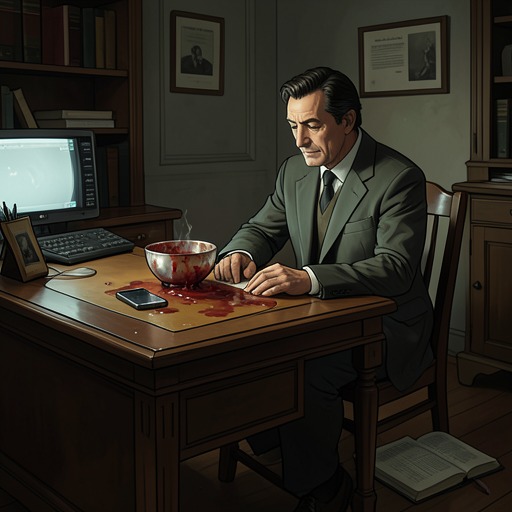
Blind Willow, Sleeping WomanThe synchronized nausea and phone calls are an unexplained forty-day episode in which an illustrator vomits daily while receiving one anonymous call a day. The symptoms overlap from June 4 to July 14, occur only when he is alone, and stop abruptly; the last caller asks whether the illustrator knows who he is. Neither the illustrator nor his friend can explain the connection, and the episode ends without identifying the caller or clarifying what caused either symptom.
The episode and its timing
The illustrator recounts the experience to a friend during a conversation that began with records and drinking. He describes vomiting every day for forty days, emphasizing the uninterrupted duration. The first episode comes on the morning of June 4, after a night of substantial whiskey and beer and an encounter with a friend’s wife. He vomits at eight o’clock, but does not feel ill afterward: he returns to his drawing with unusual vigor and has a healthy appetite by noon. At this point, the vomiting has an ordinary possible explanation, even if the illustrator says the larger forty-day pattern was not caused by illness or drinking.
A telephone call that day adds another element. A man says the illustrator’s name and hangs up. Beginning June 5, the same kind of call arrives every day through July 14: the caller says his name, then disconnects. The illustrator insists he has never heard the voice before and does not recognize it as belonging to any of the men whose wives he has slept with. The calls and vomiting thus share a span, but their initial circumstances do not establish why they coincide.
Connection and uncertainty
The relationship between the two symptoms becomes harder to dismiss when the illustrator is staying in a hotel. After a call, he says, he vomits all the food in his stomach, including fish and rice, as if the call had opened a passage for nausea. He considers two explanations for the call: someone may be playing a malicious trick, or he may have imagined the ring and the voice. The hotel cannot resolve the doubt, since its records track outgoing calls but not incoming ones.
That night marks a change in how seriously he treats the episode. He no longer feels able to dismiss the nausea and calls as separate nuisances, though he remains unsure whether they are connected wholly, partly, or at all. Returning to his apartment does not stop them. Nor does staying with friends: calls and vomiting continue when he is alone in their homes. He imagines an invisible presence that knows when to call and when to force the nausea on him, then worries that thinking this way may be a sign of schizophrenia. The experience becomes frightening not because he can identify an attacker, but because its apparent precision gives him no dependable explanation.
Solitude as a pattern
A period with a woman interrupts both symptoms. While her husband is away on business in the Philippines for two weeks, the illustrator spends time with her and recalls receiving no calls; he does not think he vomited, either. This absence leads him to consider not just when the symptoms occur, but the shape of his daily life. He estimates that he is alone for a little over twenty-three hours a day: he lives alone, sees few people through work, handles much of his business by telephone, and has relationships with women who belong to other men. He also eats out most of the time, swims by himself, listens to old records alone, and needs solitude to do his work.
This inventory gives solitude a concrete place in the episode’s pattern, but it does not explain it. The calls do not follow him indiscriminately; by his account, they arrive only when he is alone. Yet neither the woman’s company nor the interruption in symptoms reveals who might be calling or how anyone could be arranging the coincidence. What appears to be a clue remains an observation about circumstance, not a solution.
Abrupt ending and unresolved return
The illustrator keeps a diary precise enough to record the final day. His last vomiting episode occurs at 9:30 on the morning of July 14, when he brings up toast, tomato salad, and milk. The last call comes at 10:25 that night, while he listens to Erroll Garner’s Concert by the Sea and drinks Seagram’s VO. After that, both symptoms stop; he never experiences either again. His weight returns to 140 pounds, while a suit and two pairs of trousers made for his thinner body remain in his closet as souvenirs of the episode.
The final call differs from all the others. After saying the illustrator’s name, the caller asks, “Do you know who I am?” He waits in silence for ten or fifteen seconds; the illustrator says nothing, and the caller hangs up. The question supplies no identity. The illustrator cannot place the voice among people he has dealt with over the previous five or six years, and can only speculate that it might belong to someone from childhood or to a person he barely knew. His sexual history gives him reasons to imagine resentment, but he says he would recognize the voices of the men involved.
His friend cautions that an episode that begins for no reason may end for no reason, and that the reverse may also be true: it could happen again. The illustrator is unsettled by this possibility because he had not considered it before. The narrative offers no verdict between a prank, an imagined call, and an inexplicable bodily response. Its measured dates and diary entries make the coincidence unusually specific, while the unanswered question at the end prevents precision from becoming explanation.