The volunteer investigator takes the disappearance case
Blind Willow, Sleeping WomanThe volunteer investigator takes the disappearance case when Kurumizawa’s wife asks him to find her husband. He accepts without charging a fee and goes at once to the condominium, where a well-lit staircase, a landing sofa, and a spotless mirror become the setting for a patient search. Rather than treating the building as an empty backdrop, he studies it as a shared space whose ordinary traces may disclose how the missing stockbroker disappeared.
The Case and Its Setting
Kurumizawa’s wife explains the circumstances of her husband’s absence and asks whether the investigator will take the case. He has been hoping for precisely this kind of assignment, but he performs a brief show of checking his schedule so that an immediate acceptance will not make the client suspect an ulterior motive. He agrees to begin that day, asks to be taken to the last place she saw her husband, and makes clear that he does not need payment. The decision is swift; the work that follows is deliberately unhurried.
The wife leads him to the condominium’s twenty-sixth floor, where her apartment is number 2609; her mother-in-law lives two floors below, in apartment 2417. A broad staircase connects them, making the walk between the apartments a matter of only a few minutes. The husband had insisted on the stairs when choosing the building, calling them its backbone. Their width and good lighting distinguish them from the cramped, neglected staircases common in high-rise apartments, where developers instead spend money on conspicuous amenities such as a library or marble lobby.
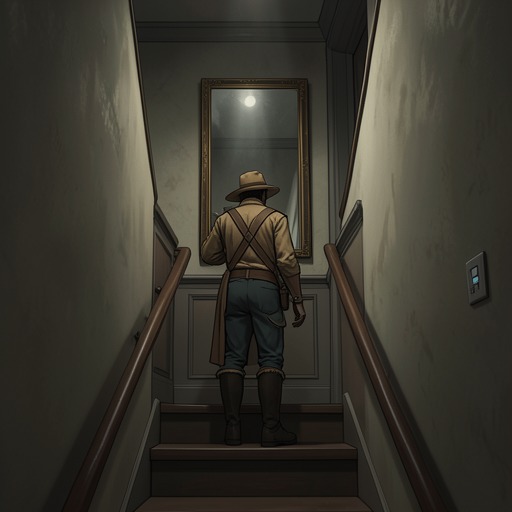
Between the twenty-fifth and twenty-sixth floors, the staircase opens into a landing arranged like a small lounge. Beside a picture window are a vinyl-covered sofa, a wall-length mirror, a standing ashtray, and a potted plant. The window looks onto bright sky and drifting clouds, but is sealed shut; the lounge is provided only on every fifth floor. This carefully designed pause in the building’s vertical passage becomes the investigator’s principal observation post.
Establishing a Method
The investigator wants to examine the building on his own. To prevent residents or staff from mistaking him for a thief casing the apartments, he asks the wife to tell the building superintendent that a man moving between the twenty-fourth and twenty-sixth floors is conducting an insurance investigation. Once she goes to speak with the superintendent, he is left alone to begin.
He walks from the twenty-sixth floor down to the twenty-fourth and back three times. The first circuit is at an ordinary pace; on the next two, he moves slowly and watches the surroundings with intense concentration. His working principle is that every event leaves traces, and his task is to draw them out. Yet the staircase appears almost unnaturally clean: there is no litter, stain, dent, or cigarette butt in the ashtray. The absence of visible evidence becomes the first fact of the search, not a reason to abandon it.
After the repeated climbs tire him, he rests on the landing sofa and studies the mirror opposite it. The sofa is inexpensive, but its placement suggests that the building’s management anticipated that someone might need a place to sit, even if few residents used it. The mirror is spotless and positioned to catch the window light. The investigator wonders whether Kurumizawa, pausing there during his own stair-climbing routine, might have looked at his reflection. The mirror does not yield a clue, but it makes the missing man’s ordinary habit imaginable within the precise space being investigated.
His own reflection turns the pause into a small test of perception: when he raises one hand, the mirror seems to raise the other, as a reflection should. He notices his untidy appearance and mismatched clothes, then returns his attention to the case. The moment establishes the mirror as both a physical feature of the landing and an object of scrutiny; it offers an image, but not an explanation for the disappearance.
Repetition, Access, and Patience
The investigator returns to the building around eleven each morning. By bringing the superintendent boxes of chocolates, he becomes friendly with him and obtains permission to roam freely. Over time he makes about two hundred round trips between the twenty-fourth and twenty-sixth floors. When tired, he rests on the sofa, looks through the window at the sky, and checks his reflection. He also gets a haircut and does his laundry, so that his repeated presence in the building no longer makes him look conspicuously unkempt.
The routine produces no decisive clue. He nevertheless refuses to equate a lack of results with a lack of evidence. Finding a key clue, he thinks, resembles training an uncooperative animal: the investigator needs patience, focus, and intuition. The contrast between strenuous repetition and the nearly static scene defines the early investigation. The stairs are traversed again and again, while the answer remains withheld.
Repeated visits also change what the investigator knows about the space. The first time, the stairwell is spotless; later, he finds candy wrappers, a Marlboro cigarette butt in the ashtray, and a discarded newspaper. These small objects reveal that the stairs are not an abandoned or exclusively private route. They are used by other people, whose movements can leave traces even when the building itself appears orderly.
The Stairwell’s Other Users
One Sunday, the investigator encounters a short, serious-looking man in his thirties running up the stairs. The runner wears a green jogging outfit, Asics shoes, and a large Casio watch. The investigator asks whether he lives in the building; the man says that he does, on the seventeenth floor. He then asks about Kurumizawa, identifying him as a forty-year-old stockbroker, about five feet eight, with metal-framed Armani glasses, who habitually takes the stairs.
The runner recognizes the description. He has spoken with Kurumizawa once, passed him while running, and seen him sitting on the landing sofa. He understands the stockbroker as someone who uses the stairs because he dislikes elevators. This testimony ties Kurumizawa to the very space the investigator has been examining and confirms that the sofa was part of the missing man’s routine, not merely a furnishing noticed by the searcher.
The runner also broadens the investigator’s picture of the building. A few residents use the stairs regularly because they dislike elevators; two others run there as he does, since the neighborhood offers no good jogging course; and some residents climb for exercise. In his view, the staircase attracts more users than those in most apartment buildings because it is spacious, clean, and well lit. He knows faces rather than names, a limitation that leaves the investigator with a community of possible witnesses but no ready-made list of identities.
Significance of the Acceptance
The case begins with a clear practical request—find a missing husband—but its first investigative turn is toward ordinary architecture and habitual movement. The husband’s insistence that the stairs were the building’s backbone gives the setting an unusual prominence: what might otherwise be a passage between floors is a route chosen, shared, and repeatedly occupied. Its sofa and mirror offer places to stop; its cleanliness initially conceals the evidence the investigator seeks; later litter makes the presence of other users visible.
The investigator’s acceptance therefore establishes both the case and its method. He does not claim an instant insight or force a solution from the first inspection. Instead, he secures access, returns at the same hour, repeats the same route, and asks a resident who knows Kurumizawa to supply a human recollection of the space. The opening investigation leaves the disappearance unresolved, but turns a seemingly featureless stairwell into a field of habits, traces, and overlapping lives.