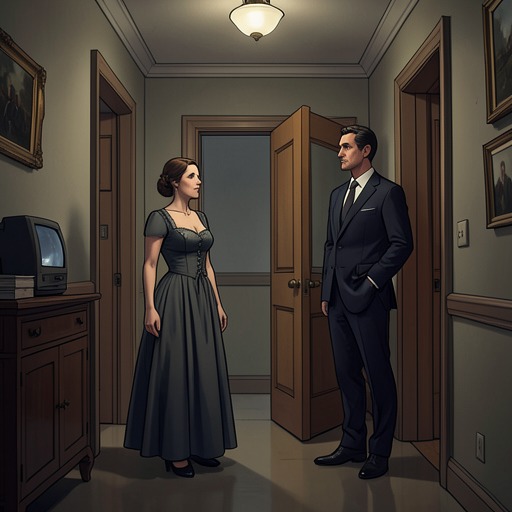
Yoshiko Fujisawa and her high-school boyfriend
Blind Willow, Sleeping WomanYoshiko Fujisawa and her high-school boyfriend are presented as unusually close first loves whose shared loneliness makes them seem almost like spiritual twins. Their relationship flourishes through long conversations, daily companionship, and a deliberate boundary around sex; it also becomes the site where Yoshiko’s independent ideas about marriage, womanhood, and the future collide with her boyfriend’s hope that love can preserve their life together. Years after they part, she keeps a promise made in adolescence, but their reunion confirms that fidelity to a promise cannot restore the future they once imagined.
Identity and Early Intimacy
Yoshiko and her boyfriend are both attractive, intelligent, affluent, and accustomed to being praised as leaders and high achievers. Their family lives also share a pattern of emotional absence: each has parents who do not get along, a father who keeps a mistress and stays away from home, and a mother who rules the household and expects the children to excel. Although both are popular, neither has a close circle of genuine friends. The account suggests that their loneliness and sense of being out of step with others help explain why they recognize one another so quickly.
Their boyfriend recalls Yoshiko as the first person with whom he could speak freely. He could tell her what he felt, and she understood; in her company, conversation seemed inexhaustible. They ate lunch together every day, walked home together, studied on Sundays, and spent their spare time talking about loneliness, loss, fears, and dreams. Being together offered a rare ease: each felt understood without having to explain the whole of their inner life.
Shared Routine and a Boundary Around Sex
Their closeness included physical affection, but Yoshiko insisted that they remain virgins until marriage. Their rule was that their clothes stayed on and they used only their hands. After a short period of kissing and touching, they would often sit at a desk and study. Yoshiko might call a halt and smooth her skirt before they returned to their books. Because their grades were nearly identical, studying became a friendly contest—who could solve a mathematics problem fastest—and a pleasure they shared rather than a burden.
Her boyfriend wanted their relationship to progress to intercourse, believing that physical union would deepen their understanding and make them feel more fully joined. Yoshiko loved him but did not regard love as a reason to abandon her decision. She made clear that, for her, love and sexual readiness were separate questions, and that she expected him to respect the life she had chosen. He did so, though his acceptance did not resolve his sense that something was missing. Their intimacy remained affectionate and carefully bounded, leaving them with a shared routine that appeared uncomplicated to classmates but remained a source of private tension for him.
Different Futures and Separation
The boyfriend seriously considered marriage and told Yoshiko that they could marry soon after college, perhaps becoming engaged earlier. She responded warmly to his affection but rejected the future he proposed. In her view, they were still sheltered teenagers: their love had not been tested by responsibility, and the world beyond school would change them. She believed that women matured and aged faster than men, and expected that she would marry a man a few years older while her boyfriend would marry a woman a few years younger. Her repeated insistence that love and the practical shape of a life were different things became a defining strain between them.
Their paths diverged after high school. In spring 1967, he entered the law department at the University of Tokyo, following the recommendations of his parents and teachers despite having no clear sense of what he wanted from life. Yoshiko chose a women’s college in Kobe. She could have attempted to enter a more prestigious university, but said she did not particularly want to pursue a career or enter the Ministry of Finance. She wanted to spend four years enjoying herself before marriage changed what she could do. Her boyfriend hoped that they would both move to Tokyo and begin again, and pleaded with her to join him; she refused. The relationship nevertheless continued in its established form until graduation, with library meetings, studying, and affection that stopped short of sex.
The Promise and the Return
During a later conversation about the possibility of their breaking up, Yoshiko told him that she would never forget him and that he was the first person she had loved. She also offered a startling promise: if he needed it, she would sleep with him someday, but only after she had married someone else. He initially could not understand what she meant and treated her words as a riddle rather than as a firm commitment. In retrospect, he understood that she meant to uphold her premarital abstinence while promising intimacy with him after marriage.
Years later, when Yoshiko was married and her husband was away on a business trip, she invited her former boyfriend to her home. After a long, unusually open conversation, she reminded him that she had not forgotten her promise. He had never expected her to treat the adolescent statement as binding. The promise thus returned not as a casual recollection but as a real obligation Yoshiko had chosen to honor.
A Farewell, Not a New Beginning
At Yoshiko’s apartment, the two held one another but did not have sex or undress. They repeated the restrained form of intimacy that had defined their youth. Her boyfriend understood this as the only way they could meet the past honestly in that moment. The possibility that they might once have grown closer through sex, or built a happy life together, seemed to him to belong to an earlier time—one that had closed beyond reopening.
He stayed for about an hour and left, recognizing the visit as their final farewell. Yoshiko stood in the doorway with her arms folded and appeared about to say something, but said nothing. He nevertheless understood the unspoken parting. He left feeling hollow and disoriented, and wanted to return, but knew he could not. That night, he paid for sex for the first time in his life. The starkness of this aftermath underscores the difference between the intimacy he had long imagined with Yoshiko and the relationship they actually chose: she kept her promise, but neither promise nor physical closeness could undo their separation.