Yuko Matsunaka
Blind Willow, Sleeping WomanYuko Matsunaka is a strikingly beautiful and admired student whose quiet, self-contained manner gives little away about her inner life. Her brief visit to Mizuki Ando, a conversation about jealousy, and the name tag she leaves behind become the last signs of a distress that her dormitory companions had not recognized. Her death remains unexplained, even after a monkey later claims to have loved her and sought to possess her name.
Identity and Place in the Dormitory
Yuko is a junior at a girls’ dormitory. She has fair skin, long hair, and doll-like features, and is described as the prettiest girl there. Her parents run a well-known Japanese inn in Kanazawa and are comparatively well-off. Although she is not in Mizuki’s class, Mizuki has heard that her grades are very good. Beauty, family standing, and academic promise make Yuko someone younger students look up to; she is conspicuous in several ways without acting superior.
Her public manner is friendly but reserved. She is quiet and does not display her feelings much, so Mizuki sometimes cannot tell what she is thinking. The younger students’ admiration does not appear to translate into close companionship: Mizuki doubts that Yuko has any close friends. That gap between being widely admired and being personally known shapes the uncertainty surrounding her final days.
Conversation with Mizuki
In October, before dinnertime, Yuko comes to Mizuki’s room while Mizuki is doing homework and listening to the radio. The two have never before had a private conversation. Yuko asks to speak, and Mizuki, surprised by the request, offers her a seat and makes tea using hot water from her thermos. Yuko then asks whether Mizuki has ever felt jealous.
Mizuki answers that she does not think she has experienced jealousy, despite having frustrations and lacking any claim to a particularly fortunate life. Yuko responds that jealousy does not follow a simple division between the fortunate and the unhappy. She compares it to a tumor that can grow within a person beyond reason, irrespective of outward circumstances. For her, jealousy is difficult to explain to someone who has not felt it, but exhausting to live with: a private, persistent torment. Mizuki listens, struck by how much Yuko is saying at once.
Yuko’s explanation is not an abstract aside. She is speaking from an experience she has not otherwise disclosed, yet she does not name its object or explain what has brought it about. Mizuki notices Yuko’s beauty and wonders whether it is simply a source of pride or also a burden, but she does not feel envious of her. The conversation thus sets Yuko’s outwardly enviable appearance beside an inward state Mizuki cannot share or fully understand.
The Name Tag and Disappearance
Yuko tells Mizuki that she must go home because a relative has died and she needs to attend the funeral. She says the dormitory master has given permission and that she expects to return by Monday morning. Before leaving, she asks Mizuki to look after her name tag. When Mizuki wonders why it cannot simply be put in a desk drawer, Yuko says she does not want a monkey to run off with it. Mizuki doubts there are any monkeys there; the unusual joke is out of character. Yuko leaves the tag, the untouched tea, and an unsettled absence in the room.
On Monday, Yuko has still not returned. The teacher responsible for her class contacts her parents and learns that she never came home: no relative had died, and there was no funeral. Her stated reason for leaving was a lie. Her body is found the following weekend, after Mizuki has gone home to Nagoya; Yuko has died by suicide in a wooded place. She left no note, and no clear motive is established. Her roommate says that she had seemed as usual and had not appeared troubled. The discrepancy between that ordinary appearance and her private conversation with Mizuki makes the meaning of her visit painfully uncertain.
The Monkey and the Limits of Explanation
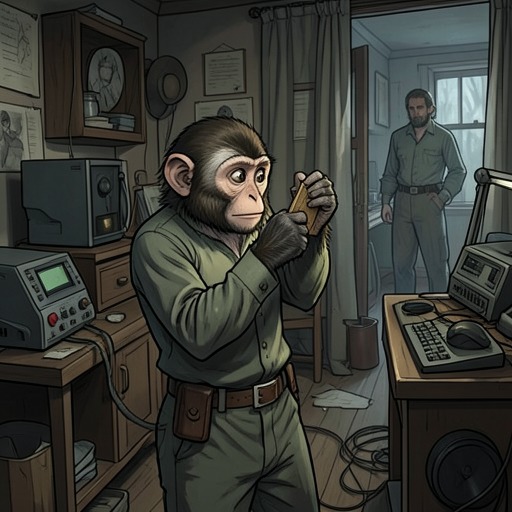
Later, a monkey admits that it steals people’s names, especially names that attract it, and says it cannot control the compulsion. Asked whether it had tried to enter the dormitory to take Yuko’s name tag, it confirms that it had. It says it was deeply in love with Yuko, had never been so attracted to anyone, and, unable to make her its own, wanted at least to possess her name. Yuko died before it could carry out the plan.
The monkey emphatically denies having anything to do with Yuko’s suicide. It attributes her death to an inner darkness that no one could have overcome. Its account connects Yuko’s name tag to a strange pursuit of identity and possession, but it does not establish why she died or explain the jealousy she described to Mizuki. Yuko remains more than the object of the monkey’s desire: the central fact about her is the distance between the suffering she briefly articulated and the explanation others were unable to find.