Yuko leaves her name tag with Mizuki before her suicide
Blind Willow, Sleeping WomanYuko Matsunaka’s final visit to Mizuki Ando turns an ordinary request to look after a name tag into an unresolved act of trust. Yuko speaks of jealousy, leaves Mizuki an object bearing her name, and disappears from the dormitory; after her suicide, Mizuki suspects the visit was an effort to disclose something she could not bring herself to say directly. Her silence and the name tag’s long afterlife preserve the encounter without resolving what Yuko intended.
The Visit and Its Conversation
In October, before dinner, Yuko came to Mizuki’s room while Mizuki was doing homework and listening to the radio. The girls were not close: although they lived in the same dormitory, they were in different grades and had never had a private conversation about personal matters. Yuko nevertheless chose Mizuki, a student representative in the dorm, as the person to approach. Mizuki welcomed her in, made tea with water from her thermos, and was taken aback when Yuko abruptly asked whether she had ever felt jealous.
Mizuki said she could not recall feeling that way. Yuko described jealousy through several forms of frustrated desire: loving someone who loves another person, wanting something another person takes, or finding that someone else can do with ease what one longs to do. When Mizuki asked whether Yuko herself had felt this, Yuko answered that she had felt it many times. The exchange gave jealousy a personal urgency, but Yuko did not explain whom or what she envied, or what had prompted her to raise the subject.
The Name Tag
Before leaving, Yuko said she was going home because a relative had died and she needed to attend the funeral. She expected to return by Monday morning and asked Mizuki to keep her name tag until then. When Mizuki wondered why Yuko could not simply put it in a desk drawer, Yuko said something was bothering her and she did not want to keep the tag in her own room. Her request was specific, but its reason remained unstated.
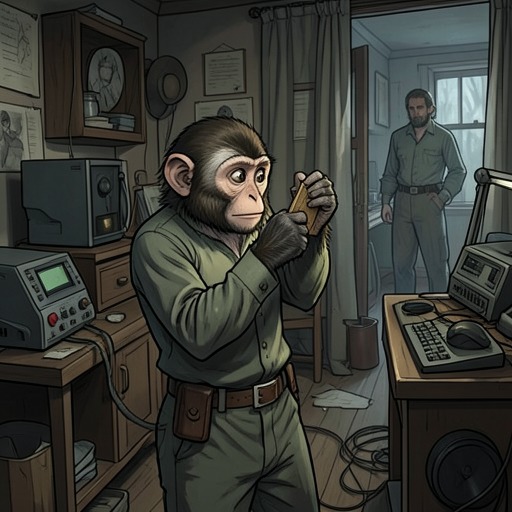
Yuko then said she did not want a monkey to run off with the tag. Mizuki replied lightly that she doubted there were any monkeys in the dorm. The joke struck her as unlike Yuko. Yuko left the tag behind, along with the untouched tea, and left Mizuki with the sense of a blank space where their brief, unexpected meeting had been. In retrospect, the tag’s handover makes the visit feel deliberate, though neither the object nor Yuko’s remarks explain what she hoped Mizuki would understand.
The Death and Mizuki’s Silence
Yuko did not return on Monday. The teacher responsible for her class contacted her parents, who confirmed that no relative had died and that there had been no funeral. Yuko had invented the reason for leaving and vanished; the following weekend, her body was found in a wooded place. She had died by suicide. She left no note, and those around her knew of no clear motive. Her roommate had thought she seemed as usual.
When Mizuki later recounted the encounter to Mrs. Sakaki, the counselor asked whether Yuko might have been trying to tell her something by discussing jealousy and leaving the tag. Mizuki acknowledged that, looking back, she thought Yuko may have wanted to speak to someone before she died. But she had not told anyone about the visit at the time. She feared that linking Yuko’s suicide to jealousy would only cause further confusion, invite speculation about why a girl like Yuko could be envious, and make people suspect something was wrong with Mizuki herself. In the charged atmosphere of the girls’ dormitory, she believed such disclosure would intensify rather than clarify what had happened.
The Name Tag’s Afterlife
Mizuki still has Yuko’s name tag when she speaks with Mrs. Sakaki. It is stored in a box at the back of her closet alongside her own. The commotion at school had deprived her of a natural opportunity to return it, and the longer she waited, the more difficult a casual return became. Yet she could not bring herself to throw it away. She came to wonder whether Yuko had wanted her to keep it, although she could not say why Yuko had selected her.
The encounter therefore remains suspended between an attempted disclosure and an unexplained practical request. Yuko’s words establish that jealousy mattered to her, but do not establish its object or prove it caused her death. Mizuki’s retention of the tag preserves both the relationship’s limits and its significance: the girls had not been confidantes, yet Yuko entrusted Mizuki with something personal at a moment that, in retrospect, was their last meeting.