Blackwood Farm
Blood CanticleBlackwood Farm is the ancestral home around which Quinn Blackwood’s household, family history, and many of the account’s later supernatural events gather. Its welcoming manor and self-sustaining grounds offer a place of refuge and belonging, but its rooms and cemetery also hold unresolved grief, ghosts, and secrets. As Quinn’s authority over the household changes, the estate’s continuity depends increasingly on the people who regard it as home.
Estate and Setting
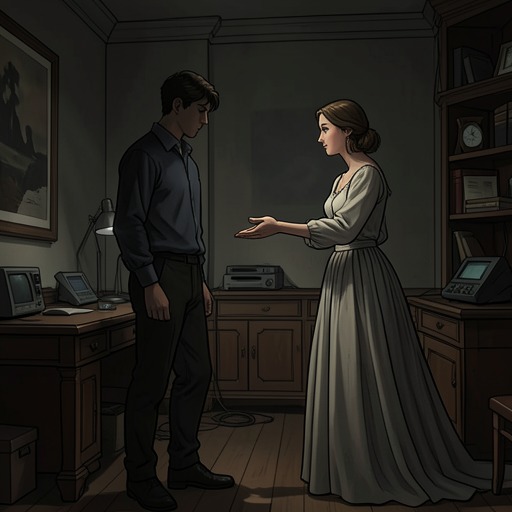
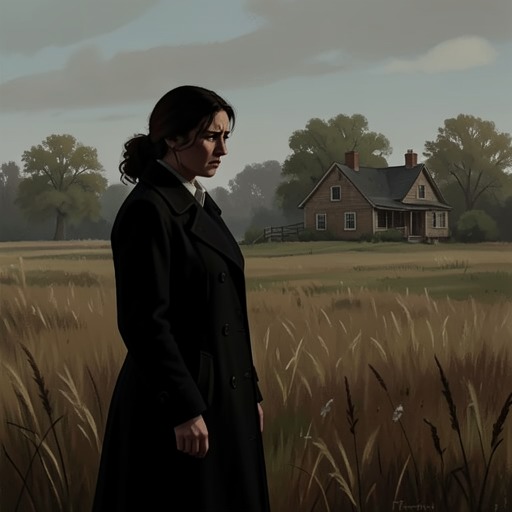
The central residence is a carefully proportioned Greek Revival mansion set on a rise above a long pecan-tree drive. Its white, two-story columns and many windows make it conspicuous in the rural landscape; inside, giant, meticulously maintained rooms combine mantel clocks, mirrors, portraits, Persian rugs, nineteenth-century mahogany, and reproductions in Hepplewhite and Louis XIV styles. The persistent air-conditioning also gives the house a practical kind of privacy, its mechanical drone masking conversation within the rooms.
The house is only one part of the estate. Broad lawns and tended flower beds extend toward a swamp and a small cemetery; four oaks stand around the graves, near a chapel and an iron fence. The grounds include working spaces as well as ceremonial ones: the shed is occupied by the Shed Men, and the kitchen remains a center of ordinary household labor. This mixture of expansive grounds, maintained domestic interiors, and nearby graves gives Blackwood Farm both the scale of a family seat and the intimacy of a lived-in home.
Household and Belonging
Quinn’s household includes people whose relationships to him do not fit a simple account of blood inheritance. Jasmine, his former lover and the mother of his young son Jerome, manages the household. Big Ramona, Jasmine’s grandmother, cooks and helps sustain its routines; her grandson Clem works at the estate. Quinn’s old tutor, Nash Penfield, is a continuing presence, while Tommy Blackwood—Quinn’s uncle by blood and adopted son in practice—has his own deep attachment to the family and its history. The household also includes the Shed Men, Allen and Joel.
The estate’s emotional life is visible in its everyday routines. Jerome runs through the house in oversized tennis shoes; Big Ramona cooks for the household; Nash sits with Tommy, who is grieving the death of Aunt Queen. The large mansion is not simply a showplace: its rooms host mourning, care, and familiar work. Jasmine and Big Ramona can manage the property and its guests, from meals to seasonal gatherings, and have the means to leave if they choose. Their decision to stay is bound to the fact that Blackwood Farm is their home, though Quinn recognizes that they also want a continuing Blackwood presence there.
Mona Mayfair’s arrival makes the house a refuge at a moment of crisis. After escaping Mayfair Medical Center, where she had been dying for more than two years, she takes the family limousine and gathers flowers from florists before reaching the manor in a hospital gown. She asks Jasmine, Clem, Allen, and Nash to carry the flowers to Quinn’s room and cover its four-poster bed. The household is frightened by her condition, but follows her instructions. Her presence reconnects her with Quinn, whose relationship with her had been interrupted when Aunt Queen took him to Europe for three years.
Disturbances and Family History
The manor’s rooms are also places where the dead make claims on the living. For years, the ghost of William Blackwood has appeared in the same room, pointing toward a French desk between the windows. Quinn, Jasmine, and Big Ramona have all seen him; whenever the desk was opened, however, it seemed to contain nothing. The household repeatedly locked it and returned its key to a cup in the kitchen, preserving the mystery in the form of a mundane habit.
The haunting intensifies after Quinn takes Mona away and his mother goes missing, leaving behind her medicine. William’s ghost begins appearing repeatedly, and Clem sees him too. Before the household can decide whether to search the desk again, Patsy’s ghost appears outside Jasmine’s window, calling to her and frightening her into fleeing with Jerome. The house’s supernatural activity is therefore not isolated from family history: the appearances follow absences and deaths, and draw domestic spaces—the room, desk, and bedroom window—into the household’s grief and uncertainty.
That history also gives the manor’s objects and rooms a practical role. When the desk’s key is lost, its central drawer contains Blackwood Farm notepaper; Lestat uses it to write to Tommy after missing his departure. The desk that had been the focus of William’s haunting thus becomes an ordinary means of communication, without erasing the mystery that had gathered around it.
Loss, Care, and Continuity
Aunt Queen’s death changes what Blackwood Farm represents to Quinn. She had shared responsibility for the estate with him while they were in Europe and, after their return, had served as a visible source of security and authority. With her gone, Quinn is unsure whether he can bear to remain there often. Mona points out that Jasmine and Big Ramona can run the household, but Quinn’s concern is not their competence: he understands that the residents want a Blackwood presence as well as a home they can manage themselves.
The estate’s continuity is carried by a wider circle than Quinn alone. Jasmine and Big Ramona remain committed to the household; Jerome is growing up there as Quinn’s son, and Tommy is growing up there as a Blackwood. Nash loves the place and is expected to grow old caring for it. Quinn has also helped Tommy’s mother, Terry Sue, and Tommy’s sister, Brittany, whose future and education are part of Big Ramona’s account of the family’s prospects. Her confidence that Blackwood Farm will endure contrasts with Lestat’s fear that the estate may be only a temporary moment.
Lestat’s own attachment becomes explicit in his later life on the property. After helping Patsy’s spirit depart, he returns to the house before dawn, where the Kitchen Committee is already making coffee and preparing dough. Jasmine and Big Ramona treat him not as a passing visitor but as someone who belongs: Big Ramona insists that he remove his muddy boots, sit down for breakfast, and stay in Aunt Queen’s room. When Quinn and Mona leave for a time, Jasmine tells Lestat that the room is where he belongs and prepares it for him. The house’s hospitality is practical and particular, expressed through food, a bed, clean clothes, and attention to its rooms.
The Farm as Refuge
Blackwood Farm offers Lestat a bounded place of safety during a period when he is reluctant to leave. He reads, walks the grounds, visits the swamp and cemetery, and admires the flower beds still tended after the death of Pops, who planted them. He usually goes out about three hours before dawn, and the cemetery—with its unnamed graves, four oaks, nearby swamp, and chapel—becomes his favored place. He remembers meeting Quinn there after Quinn killed Patsy and giving him blood to drink. The grounds therefore join present refuge to prior acts of grief and care.
Lestat expresses the strength of this attachment by identifying the farm’s boundaries with the boundaries of his soul. That declaration gives the estate a meaning beyond shelter: its landscape and household offer him a temporary sense of safety, welcome, and emotional attachment, even as he recognizes that the moment may pass. Blackwood Farm’s significance lies in this tension. It is a place shaped by inherited secrets and recurring loss, yet sustained by the people who continue to live, work, grieve, and care for one another there.