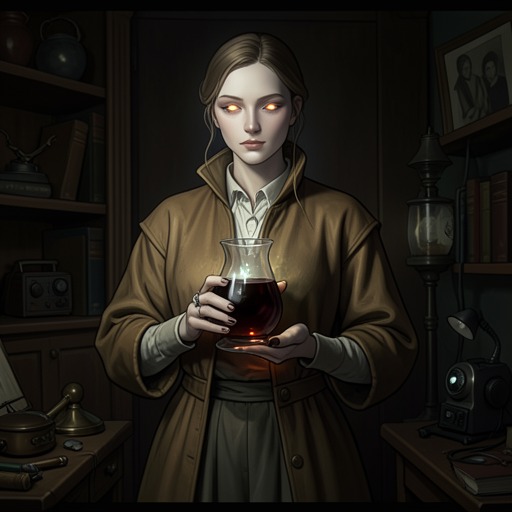
Dark Trick
Blood CanticleThe Dark Trick is the vampire transformation by which a mortal enters the Undead state. Lestat calls it the one kind of miracle he can work, but the phrase holds a tension: he has just rejected the fantasy of himself as a saint, yet still claims the power to alter the boundary between mortal life and vampiric existence. His turning of Mona Mayfair makes that power concrete—not as a cure without cost, but as a perilous exchange of blood that creates a maker and a fledgling.
Name and Nature
Lestat names the rite while resolving to act, dismissing his guilt as no reason to stand aside. His language briefly gives the transformation the shape of a miracle, but he identifies it as vampire work rather than divine intervention. The difference matters: the Dark Trick can change a dying person’s condition, yet Lestat describes himself as a vampire, not a saint, and the act does not erase the darkness or moral uncertainty surrounding his nature.
The transformation is not presented as a single, effortless gift. Lestat tells Quinn that he must first give Mona some of his blood, and Mona drinks from him. As the exchange continues, he gives her blood again, and she drinks until the change is accomplished. The rite therefore depends on a direct transfer from maker to fledgling; its consequence is not simply survival, but a new condition and a new relationship between the two vampires.
Why Lestat Performs It
Mona reaches Quinn’s room gravely ill, asking to die in his bed. Quinn cannot bear to let her go, but Lestat judges that Quinn has neither the experience nor the strength to transform her safely: he has never performed the Dark Trick, and Mona is too frail for him to attempt it without risking her death. Lestat goes to Quinn’s room to intervene, taking responsibility for the act himself.
Lestat’s decision also rests on prior experience. He remembers transforming his own mother in a bedroom on the Ile St.-Louis two hundred years earlier. Her old age and consumption receded as the Dark Blood took effect; then, as a novice compelled by love and fear, Lestat did not yet know the name of what he was doing. In Mona’s case, he acts with knowledge of the rite and offers the transformation as a way to reverse the damage to her body. The memory links his first, uncomprehending use of the power to a later act in which he deliberately chooses to wield it.
Mona’s Transformation
Lestat asks Quinn to let Mona go, then breaks the skin at his wrist and places his blood to her lips. He tells her she must take some of his blood first if he is to bring her through the change. Mona drinks, and Lestat gives her his blood again as the transformation proceeds. The scene turns on the physical dependence of the fledgling upon the maker: Lestat supplies what Mona needs, while she draws from him with an intensity that leaves him weakened.
The change reverses the bodily damage that had made Mona’s survival unlikely. Lestat sees her body growing stronger as she drinks, and understands that the transformation has taken hold when the bond between maker and fledgling brings a new limit: they can no longer read each other’s thoughts. The Dark Trick thus both joins them through the act of making and separates them through the loss of that former access. Lestat’s dream of Mona as a courageous vampire, lifted from misery and able to marvel without malice or lament, gives the change a future-facing meaning, while remaining Lestat’s vision of what she may become.
Limits and Consequences
The Dark Trick cannot simply retrieve someone who has died. After Merrick Mayfair solves the mystery of Goblin and enters the flames she has prepared, Lestat tries to revive her by pouring his blood over her burned remains. It does not work: her soul has already departed. The failure distinguishes transformation from resurrection and underscores that the rite has a limit, even for Lestat.
Merrick’s death also provides the immediate context for Lestat’s intervention on Mona’s behalf. Quinn has recently witnessed Merrick and her doppelganger spirit pass into the Light; Mona, by contrast, is still alive, though close to death. The contrast sharpens the stakes of Lestat’s choice. He cannot bring Merrick back, but he can offer Mona another form of existence before her mortal life ends.
Significance
The Dark Trick’s importance lies in its double character as rescue and irreversible change. For Mona, it answers an immediate mortal crisis by making her a vampire; for Lestat, it is a power rooted in blood and intimacy rather than sainthood. His recollection of his mother’s transformation, his judgment that Quinn cannot safely perform the rite, and his repeated giving of blood to Mona establish that the act carries knowledge, responsibility, and risk.
The episode also refuses to equate a successful transformation with uncomplicated salvation. Mona’s body grows stronger, but the change makes her a fledgling and alters her relation to Lestat; the blood bond has consequences that outlast the urgent scene in Quinn’s room. Set beside Merrick’s unrecoverable death, the rite marks a boundary rather than abolishing it: the Dark Trick can carry the living across into vampiric existence, but it cannot undo every loss.