French Quarter
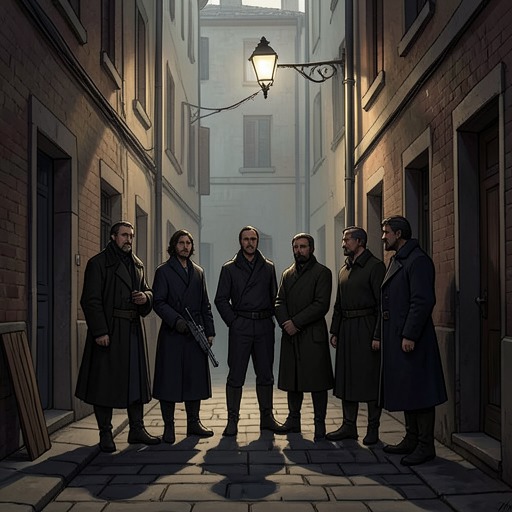
Blood CanticleThe French Quarter is both a lived-in urban district and a threshold between the contemporary world of Lestat’s adventures and the concealed histories of the Mayfair family. Lestat calls it the small world he prefers, but its streets also hold Tante Oscar’s crowded home and her account of the Blood Children, placing the Quarter at the intersection of ordinary city life, family memory, and the supernatural.
Setting and Place in the Narrative
The Quarter lies at the center of Lestat’s New Orleans experience. When Clem drops Lestat, Quinn, and Mona at a luxurious hotel on Canal Street, the location is described as a divide between the broad, shabby thoroughfare and the French Quarter entrance behind the hotel. That contrast makes the district feel like a distinct, familiar world that Lestat can enter from the city’s more public edge.
For Lestat, the Quarter belongs to the setting of his vampiric identity: he imagines himself moving through the stylish, sinister underworld of a city filled with human victims. Yet the district is not only a gothic backdrop. Its ordinary streets, shops, passersby, and vendors remain present in the same scenes as the supernatural characters, creating a tension between their extraordinary circumstances and the bustle of public life.
Mona, Quinn, and the Streets
After arriving at the hotel, Lestat and Quinn have to propel Mona to the elevator. The lobby’s onlookers notice the trio not for their supernatural plans but for their striking appearance, particularly Mona’s feathers, shimmering clothing, and high heels. The scene establishes a recurring contrast: the group is moving toward a dangerous task, but in public they are seen as conspicuously glamorous strangers.
Later, Lestat and Quinn have to drag Mona through the Quarter’s streets. She is absorbed by the sights around her, including the displays in Hurwitz Mintz and antique shops, while passing mortals and an elderly saxophone player become part of the scene. Lestat and Quinn give the musician money. Mona, who can no longer buy a hot dog, looks at it, smells it, and throws it away; the ordinary purchase becomes a clear sign of the change in her relation to mortal life.
Mona repeatedly breaks away, runs ahead, and circles back, while Lestat and Quinn catch up and keep her in their custody. Her movements interrupt the group’s progress through the district and make their passage unusually public. When they reach Lestat’s townhouse, Lestat tips his two mortal guards; only after he and Quinn have gone into the courtyard garden do they realize Mona has slipped away. The Quarter thus becomes the scene of both their effort to care for her and their loss of control over her movements.
Mayfair Memory and Tante Oscar
The French Quarter also holds a different kind of narrative history. Rowan recounts that Dolly Jean once took her downtown in a large car to visit Tante Oscar, an elderly Mayfair who lived in a flat three flights up, with a balcony overlooking the River. Tante Oscar was already over one hundred years old when Rowan described her, and Rowan emphasized the abundance of the apartment: furniture crowded the rooms, while telephones, photographs, tea services, and other domestic objects filled the space.
That remembered visit gives the Quarter a place within the Mayfair family’s lived history, not merely within Lestat’s present-day wanderings. Tante Oscar’s apartment is a densely furnished family interior, set apart from the streets below but still connected to the city through its balcony and the visitors who come to see her. The episode makes the district a repository of family knowledge passed through visits and conversation.
The Blood Children and the Quarter’s Hidden History
During Rowan’s account, Tante Oscar explains that the Blood Children had lived in the Quarter for two hundred years, feeding on people she describes as riffraff. She says that Merrick Mayfair has now joined them and will live forever. Her account presents Merrick’s transformation not as an isolated surprise but as the fulfillment of an earlier prediction: Oncle Vervain, a respected Voodoo doctor and Merrick’s old relative, had foreseen that she would one day walk with the Blood Children. Tante Oscar says he told no one else, and that the knowledge had broken his heart.
The revelation gives the Quarter a continuity that reaches back beyond the immediate action of the novel. The district is not simply a place where vampires pass through or where the Mayfairs maintain family connections; it is also the long-standing home of a hidden community. Through Tante Oscar’s testimony, the Quarter binds Merrick’s present condition to Oncle Vervain’s foreknowledge and to a two-century history of the Blood Children.
Narrative Significance
The district’s different roles are held together by movement between public street and private room. Lestat and Quinn lead Mona through shops and crowds, where their supernatural situation is invisible to most observers; Rowan’s recollection, by contrast, leads into Tante Oscar’s apartment, where family history and supernatural knowledge are spoken aloud. The Quarter can therefore accommodate both the distracting immediacy of a city walk and the disclosure of a history concealed within the family.
Its significance rests in that overlap. In Lestat’s present, the Quarter is a preferred refuge and the setting for Mona’s difficult passage away from mortal habits. In Rowan’s account, it is the place where Tante Oscar explains the Blood Children and Merrick’s future. The district connects the characters’ immediate movements to a longer, inherited world, making New Orleans city life and the Mayfair supernatural history occupy the same geography.