Ghosts
Blood CanticleGhosts are persistent presences in the novel’s supernatural world, but their significance lies less in a single set of rules than in the different needs they embody. Goblin remains hostile after Quinn’s transformation and must be driven away; Patsy wanders after death without understanding her condition; and Julien and Stella appear to Lestat with their own judgments and messages. These encounters turn the boundary between life and death into a moral problem: the living must decide whether a spirit needs to be resisted, guided, or simply heard.
Nature and Forms of Appearance
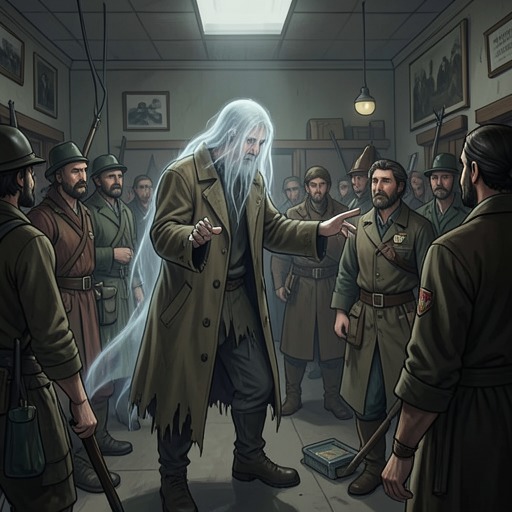
The novel distinguishes between spirits that remain entangled with the living and the dead who are ready to depart. After Merrick’s death, Lestat describes her as a vampire who had spent only three years among the Undead, and recalls how she came to Blackwood Farm to help exorcise Goblin, the ghost that had haunted Quinn since childhood. The spirit had not vanished when Quinn became a vampire; it had grown stronger and more malicious. Merrick solved the problem by setting a high altar of coal and wood alight, destroying Goblin’s corpse and entering the flames herself. The spirit was gone, but Merrick died as well. Lestat tried to pull her from the fire and poured his blood over her remains, yet could not revive her: the scene establishes that supernatural power over the dead has limits.
Other apparitions are not presented as hostile. Mona recalls seeing her dead parents when she was near death, but they did not speak to her; she understood them as waiting to take her across, while Kevin Mayfair told her it was not yet her time. Her account separates such waiting spirits from Julien, who had appeared to her long ago only in dreams when he wanted something, and who, she says, is in the Light and returns to Earth only for an important reason. The distinction is not merely between visible and invisible ghosts: it is between spirits with unresolved earthly business and the dead who have crossed beyond it.
Haunting, Recognition, and Exorcism
Goblin’s haunting is dangerous because it persists across Quinn’s change from mortal to vampire. Quinn sought Lestat’s help, and Lestat called on Merrick, whose earlier life as a scholar and sorceress seemed to make her suited to confront the spirit. Her success ended Goblin’s presence but cost her life, leaving the exorcism both a victory and an irreversible loss. The episode demonstrates that banishing a ghost does not necessarily mean the living can control what happens to the person who performs the rite.
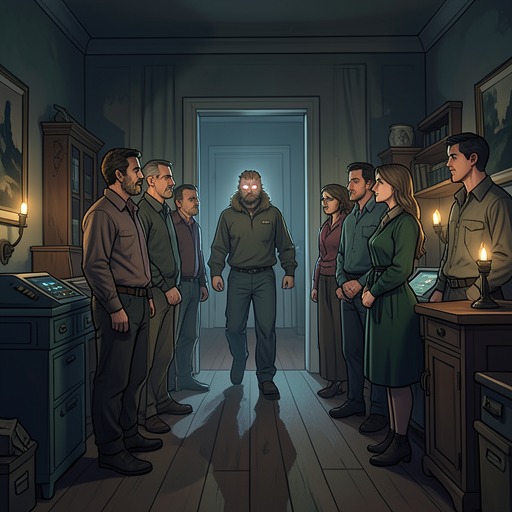
Patsy’s posthumous appearances demand a different response. After Quinn takes Mona away from Blackwood Farm and Patsy goes missing, the ghost of William Blackwood repeatedly points at the locked French desk in the house’s double parlor. The family has seen him there before, but searches of the desk have yielded nothing. The haunting becomes more frequent after Patsy’s disappearance: Big Ramona says that she, Jasmine, and even Clem see William pointing at it, and the repeated failure to understand his gesture leaves the family unsettled. The desk is at once a material focus for the apparition and a sign that the family has not yet interpreted what the dead are trying to communicate.
Patsy herself appears to Jasmine at a window while Jasmine is in bed with her young son, Jerome. Soaked and distressed, she calls Jasmine’s name and scratches at the glass; Jasmine takes Jerome and runs from the house. Big Ramona stresses that Jasmine had been the only person on the property kind to Patsy. This detail complicates the frightening appearance: Patsy’s visitation is alarming, but it is directed toward someone who had shown her kindness, and the ghost seems lost rather than intent on harm. Big Ramona connects the problem to Goblin’s exorcism, when Quinn and the others told the spirit he was dead and he moved on. Quinn agrees to tell Patsy the same, believing that no full séance will be needed.
Lestat, Patsy, and the Light
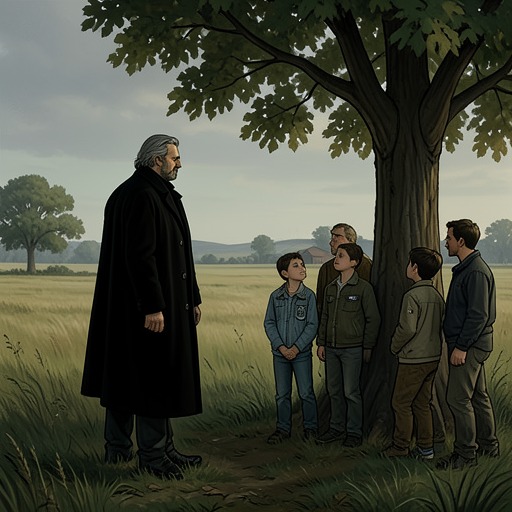
When Lestat later enters the swamp, Quinn and Mona follow behind him. Lestat senses an external chill and sees Patsy close by, caught among moss and vines beside a cypress tree. She appears silent and suffering, and Quinn, standing nearby, asks where she is. The encounter makes Patsy’s condition concrete for Lestat, but does not make her able to explain it herself. Earlier, Mona had recognized the essential problem: Patsy did not know she was dead. That recognition changes Lestat’s response from observing a ghost to taking responsibility for helping her leave the Earth.
Lestat draws Patsy’s spirit toward the Light, despite the danger and struggle involved. When Quinn later asks why he went alone, Lestat gives several possible reasons: for Quinn, for Jasmine, or for Patsy herself. He explains that Quinn and Mona are new to the Blood and have seen little of the Earthbound Dead or the void between realms; Patsy’s ignorance of her death convinced him that he had to act. The passage does not reduce his choice to one motive. It presents compassion as mixed with loyalty and protection, while showing that experience of the dead brings an obligation the younger vampires have not yet learned to carry.
The act also unsettles Lestat’s judgment of himself. He wonders whether he has done something good, contrasting the successful exorcism of Goblin with his uncertainty about what he can do for Mona and Quinn. When Julien later accuses him of selfishness, Lestat rejects the accusation in part by invoking his intervention for Patsy: he argues that Julien did not care for her soul, despite her descent from Julien’s line. The haunting thus becomes part of a broader conflict over whether Lestat’s actions are merely expressions of vanity or can genuinely serve another person. Patsy’s passage to the Light gives him evidence of good he can claim, without resolving his larger doubts about evil and moral responsibility.
The Dead Who Return to the Living
Julien and Stella’s appearances show that a ghost can also bring judgment or reassurance rather than require rescue. After Lestat wakes in Aunt Queen’s room, Julien sits at her little round table in a dinner jacket, smoking a small black cigarette, while Stella sits on the couch with one of Aunt Queen’s dolls. Julien accuses Lestat of seeking mortal admiration and acting for selfish ends. The domestic setting makes the visitation part of the household’s continuing life even as Julien’s challenge draws Lestat back to his moral uncertainty.
Near the end, Lestat sees Stella again, now appearing as a grown woman in a flapper dress, with pearls and a cigarette holder. She tells him that Julien is too frightened of him to come close, but has sent a message: “That was superb!” She vanishes before Lestat can throw a boot at her. He accepts the visitation as part of Blackwood Farm, which has always opened its portals to ghosts. Stella’s message answers the earlier accusation without erasing it: Julien’s judgment remains, but his recognition of Lestat’s action also reaches him through another spirit.
Narrative and Moral Significance
Ghosts make the novel’s questions about good and evil immediate rather than abstract. Lestat calls himself polluted by blood and doubts that anything he does can be good; yet the dead repeatedly place particular choices before him. Merrick’s sacrifice shows the cost of confronting an evil spirit, Patsy’s confusion calls for care, and Julien’s presence challenges the motives behind acts of care. The spirits do not supply a simple moral code. Instead, they expose the limits of power: Goblin can be banished but Merrick cannot be brought back, and Lestat can help Patsy cross but cannot thereby settle every question about his nature.
Their appearances also make grief legible through recurring places and objects. The desk William points toward, Jasmine’s window, the swamp where Lestat finds Patsy, and Aunt Queen’s table each hold a different form of the dead’s relation to the living. A haunting can be an unresolved sign that no one understands, an appeal to a person who once showed kindness, or a message carried back from beyond. In this way the ghosts are not a single category of menace: they test whether those who encounter them can discern what the dead need, and whether action taken for another can count as good even when the actor remains uncertain of himself.