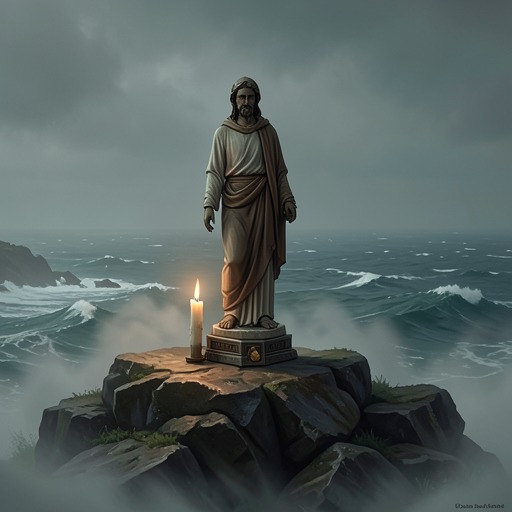
Juan Diego canonization
Blood CanticleJuan Diego canonization is the act by Pope John Paul II that formally recognizes Juan Diego as a saint during the Pope’s visit to Mexico. For Lestat, the event becomes more than a report of a papal journey: Juan Diego’s story gives him a concrete point of comparison for his own frustrated desire to be a saint, while the act of canonization suggests how religious authority can shape public memory and devotional life.
The canonization and Juan Diego’s story
While Lestat is recording an earlier encounter with Pope John Paul II, he briefly pauses the chronology to note that the Pope has since traveled to Toronto, Guatemala, and Mexico. During the Mexican visit, the Pope canonizes Juan Diego; he also canonizes a saint in Guatemala and beatifies two men elsewhere on the trip. Lestat singles out the Mexican canonization because he is especially moved by the story attached to it.
According to that story, the Virgin Mary appeared to Juan Diego in 1531. When he reported the apparition to the local Spanish bishop, the bishop did not believe him. The Virgin then provided red roses growing in snow on Juan Diego’s mountain. When Juan Diego opened his cactus-fiber tilma before the bishop to show the flowers, an image of the Virgin appeared on the garment. In Lestat’s account, the image—with Mary depicted with Indigenous skin—remains on display in Mexico City’s cathedral, where thousands visit it each day.
Papal authority and public belief
Lestat admires the story and the conversion of thousands of Indigenous people to Christianity that followed the reported miracles. He also emphasizes the effort required for Pope John Paul II, then eighty-two and ailing, to travel to Mexico to canonize Juan Diego. The act is presented as a public affirmation of a figure whose story continues to matter to worshippers.
The canonization is contested in the press: critics question whether Juan Diego ever existed. Lestat responds that the inability to prove Juan Diego’s existence does not prove that he did not exist. He then shifts the issue from historical verification to Catholic authority, invoking Christ’s words to Peter about binding on Earth and in Heaven. The passage therefore places historical doubt beside the Church’s power to recognize a saint, without resolving the historical question itself.
A saint’s continuing work
For Lestat, canonization is not only a ceremony or a title. He imagines Juan Diego continuing to serve the faithful after death, listening to petitions from Indigenous people and descendants of colonists, and carrying their appeals to God. In this imagined account, the saint’s work links the Church’s formal recognition to the ongoing needs of those who pray to him.
Lestat notes that Pope John Paul II has canonized 463 saints in his lifetime and admits that he wishes he were among them. His envy makes the episode personal: Juan Diego’s recognition prompts Lestat to acknowledge that his own wish for official sainthood remains unmet. The episode turns a news item into a meditation on the distance between longing to be holy and being recognized as a saint.
Lestat’s imagined sainthood
The desire behind Lestat’s interest also appears in his imagined apparition to the Pope. He pictures himself summoned from the Light to appear before people, as a great saint should, and imagines healing the Pope’s suffering by laying hands on him. In that fantasy, Lestat also hopes to speak about modern life, material abundance, technology, and the spiritual possibilities he sees within them. His vision recasts technological progress as a potential means of charity and social transformation, rather than as a threat to religious life.
The fantasy finally collapses. Alone in the Sistine Chapel, Lestat longs to be a priest and consecrate the host, but recognizes that he is not a saint and has never been canonized. He also acknowledges that the world-saving cures and public acclaim he imagined are not real. He is, instead, a vampire who lives by blood and understands himself as ritually impure. Against that self-judgment, Juan Diego’s canonization stands as a real act of institutional recognition and a continuing focus of devotion—precisely what Lestat desires, but cannot claim.