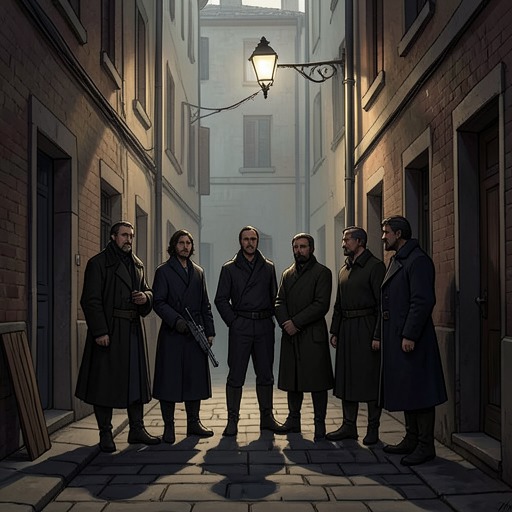
Lestat, Quinn, and Mona's attack on the rogue vampires
Blood CanticleLestat, Quinn, and Mona’s attack on the rogue vampires is a confrontation in which rescue and punishment unfold together: the three vampires find four unconscious children being exploited as blood victims, kill the two perpetrators, and arrange for the children to receive care. The episode tests the new vampires’ power against the vulnerability of human victims, while Lestat’s direction of the attack reflects his unsettled effort to make his supernatural strength serve a moral purpose.
Discovery and Stakes
The party enters a hotel suite quietly, intending to confront two vampires on the fifteenth floor. Inside, a loud Bartók violin concerto accompanies the pair’s dancing. Beyond them, Lestat sees four mortal children on a couch, bruised and unconscious, apparently used as blood victims. The contrast between the performers’ composed spectacle and the children’s helplessness makes the threat immediate: this is not merely a dispute among vampires but an ongoing assault on people who cannot protect themselves.
When one of the vampires lifts a child and drinks from him, Mona screams. The attackers stop and turn toward their visitors; the child is dropped back onto the couch. Lestat has the music stopped, and the sudden quiet clears the way for the confrontation. His decision to intervene follows the sight of the children, while Mona’s reaction makes plain that the scene has shaken her as well.
The Confrontation
Quinn restrains the male vampire as Lestat condemns the pair. The male offers to leave the city, warn other vampires, and testify against them, but Lestat rejects the offer and orders Quinn to drink. Quinn obeys, and the male submits to him. Lestat then tells Mona to take the female. She accepts Mona’s approach and offers her blood, asking to be spared for eternity; Mona feeds on her.
The scene places Quinn and Mona’s new vampirism in direct relation to the choices made by their victims. Lestat gives the orders, but each fledgling must act: Quinn drinks from the male, and Mona feeds on the female. The act is not presented as an uncontrollable reflex alone. Afterward, Lestat asks whether Quinn and Mona recognized the attackers’ free will and knowledge through the blood they drank, challenging them to consider the lives they have ended rather than treating the vampires as mere objects of vengeance.
Judgment and Destruction
Lestat demonstrates what he expects them to remember by unleashing the Fire against the two attackers. The flames destroy them, and he uses the Fire again to eliminate what remains. His instruction to watch and remember makes the act exemplary as well as final: Quinn and Mona are being shown both the extent of Lestat’s power and the consequence he assigns to the attackers’ conduct.
The destruction does not leave Lestat untouched. He draws back from his own power, feels sick, and gathers himself into human form before turning to the children. That recoil complicates the apparent certainty of his judgment. He has acted decisively to stop the attackers, yet the use of lethal supernatural force also confronts him with the darkness he believes resides in his own abilities.
Rescue and Aftermath
Lestat examines all four children gently. They have been beaten and drained of blood, but he finds no head injuries or signs of permanent damage and believes they can survive. He makes the necessary call to arrange their care, telling an astonished clerk what he has found. The rescue therefore includes a practical step beyond defeating the vampires: the children are identified as survivors in need of help, and Lestat ensures that others are notified.
Mona cries in the hallway, and Quinn holds her. As the three leave, Lestat acknowledges that the outcome was not perfect, but the immediate danger is over. Quinn calls the episode magnificent, while Lestat’s attention to the children and his unease at the Fire resist any simple celebration of violence. The ending holds those reactions together: the attackers are gone, the children may live, and the new vampires must reckon with what they have done.
Significance
The attack gives Quinn and Mona an early, consequential role in the use of vampire power. They are not only witnesses to Lestat’s judgment: they participate in killing the attackers, and Lestat makes their participation part of a lesson about free will and responsibility. Their feeding is presented alongside the attackers’ abuse of children, distinguishing the confrontation’s protective aim without erasing its violence.
For Lestat, the episode is a practical test of the moral purpose he seeks for his powers. He calls the attackers condemned and acts without hesitation, yet afterward he recoils from the Fire and responds to the children with careful attention. The contrast between decisive punishment and the vulnerable survivors’ need for care gives the event its central tension: stopping evil does not make the means or the power used morally uncomplicated.