Lucia
Blood CanticleLucia is a visitor to the island who brings Oberon a statue depicting Juan Diego and Our Lady of Guadalupe. Her brief appearance places a small act of devotion inside the violent collapse of the island’s community: she arrives as a guest-bearer, but dies before she can leave.
Arrival and the Statue
Lucia enters the room after Lestat and the Taltos sense a human presence behind the far door. She is a tall, dark-skinned woman, about fifty, carefully dressed in a mauve silk dress, black net stockings, and high heels, with gold jewelry and pronounced makeup. She speaks in heavily accented Spanish and explains that she had searched online for the religious statue, which she had found only after considerable effort.
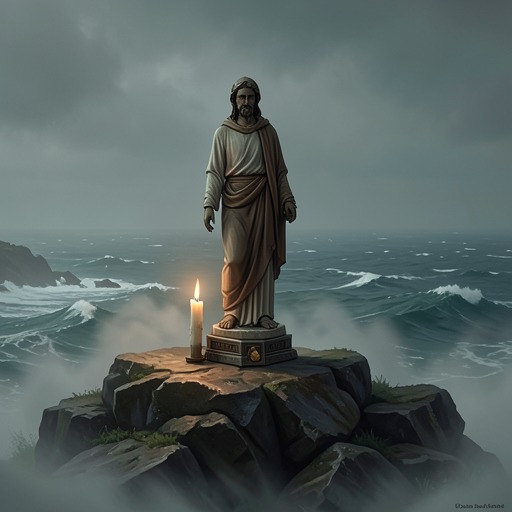
The statue depicts Juan Diego standing with his arms out, the image of Our Lady of Guadalupe on his tilma and roses at his feet. Its image and flowers are imitations, but Lestat recognizes the figure as Juan Diego. Lucia’s gift is not merely a decorative object: Oberon says that the Secret People had visited the Cathedral of Our Lady of Guadalupe in Mexico City, and that the statue recalls that visit.
Encounter with Lestat and Oberon
Lucia greets the visitors as her son’s guests. Lestat offers her a chance to escape the island, warning that everyone there is doomed except the tall people, and directs her toward a boat in the marina. She responds with fearlessness and curiosity, but draws a pistol. Lestat takes it from her and throws it onto the bed, then repeats his offer.
Oberon tells Lucia that Lestat is speaking truthfully: he can sense that death surrounds them and believes the rule of the Drug Merchants has ended. He urges her to leave, but Lucia does not get away. As she watches him, Oberon picks up the pistol and shoots her. He then says that she had been kind to him and insists that the statue is his, refusing to surrender it even if Lestat rescues him.
Significance
Lucia’s scene ties the island’s immediate crisis to the book’s recurring attention to sainthood and religious belief. Elsewhere, Lestat reflects on Juan Diego’s canonization and imagines the saint receiving petitions from the living; Lucia’s statue gives that religious story a concrete presence on the island. Yet the object becomes part of a desperate personal exchange: it is a gift Oberon values, while Lucia’s offer of it ends with her death and his refusal to part with it.
Her brief role also sharpens the contrast between hospitality and danger. Lucia welcomes Lestat’s party as guests, and Lestat gives her a route out, but the collapsing order of the island leaves no safe resolution to the encounter. Oberon’s acknowledgment of her kindness survives as the scene’s final counterpoint to his decision to kill her.