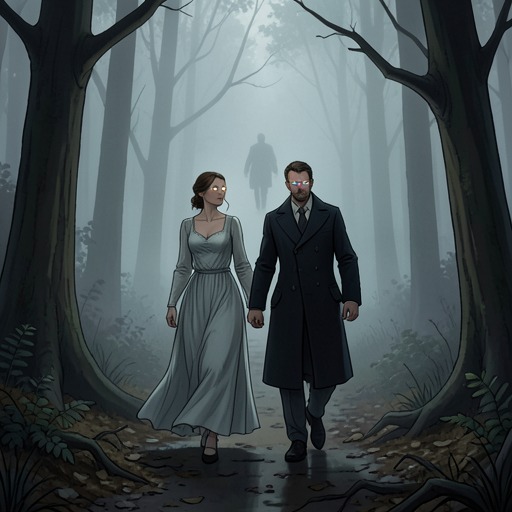
Mona's escape from Mayfair Medical
Blood CanticleMona's escape from Mayfair Medical is a decisive return from prolonged isolation: while dangerously ill, she leaves the hospital by her own initiative and reaches Quinn Blackwood at Blackwood Manor. Her arrival reunites the former lovers, but it also brings her to a life-altering decision. The scene holds together her determination to see Quinn, the limits imposed by her illness, and the question of whether a supernatural transformation can answer suffering that has already taken so much from her.
Flight from the hospital
Mona had been confined to Mayfair Medical for more than two years, too weak even to send Quinn a note or acknowledge the flowers he sent. Quinn, who had loved her before Aunt Queen took him to Europe for what became a three-year trip, returned to find Mona isolated and beyond his reach. After he became a vampire, he stayed away from her, fearing that she would recognize what had happened to him and that his condition would contaminate her.
The reunion begins with Mona acting against expectation. Of her own free will, she takes the family stretch limousine from outside the hospital, where its driver is away from the car. She then goes from florist to florist, using the Mayfair name to obtain large arrangements and loose bouquets. After crossing the long lake bridge, she arrives at Blackwood Manor barefoot and wearing a hospital gown. Though scarcely able to climb the circular staircase, she directs Jasmine, Clem, Allen, and Nash Penfield to carry flowers to Quinn’s room, telling them Quinn has agreed to fill his four-poster bed with them.
Arrival at Blackwood Manor
Nash, Quinn’s former tutor, carries Mona upstairs and lays her among the flowers. She calls the bed her bower and assures him that the roses are thornless. Her arrival unsettles those around her: Tommy, still grieving Aunt Queen, is shaken by the sight of Mona, while Big Ramona remains with her and Jasmine brings a cold diet soda. Mona laughs at Big Ramona’s account of the bed’s history, then chokes from the effort; she survives and insists that she is waiting for Quinn. When he arrives, the purpose of the escape is fulfilled, but the reunion cannot undo her physical suffering.
Mona is about twenty years old, about five feet one, and under seventy pounds. Once known as a beauty, she has been left dangerously frail by a wasting illness that the narrator connects to a traumatic birth, though its cause remains unclear to him. Her red hair and the flowers make the contrast between her former life and her condition especially stark. Even sitting among the bouquets hurts her; pain affects her joints, internal organs, and skin. The narrator recognizes that will and witchcraft helped her secure the car, gather flowers, and obtain assistance, but that force of will cannot relieve the pain now that Quinn is beside her.
The choice to be transformed
Quinn offers Mona the Dark Blood. Lestat takes charge of the conversation, insisting that she has a choice and wondering why Quinn has not told her about the Light, which Quinn has seen. Yet the choice is made under the pressure of years of illness. Lestat recalls the long course of treatment and suffering: injections, medicines, fever, interrupted sleep, and the loss of concentration that left books, films, and letters behind. For Mona, the immediate hope is to feel whole and breathe without pain for even an hour. Lestat doubts that such a decision can be freely weighed against an imagined eternity when her present suffering has so narrowed her life.
Mona reaches for Lestat and agrees to the transformation. Quinn asks him to save her. Lestat tells her that her family is coming, as an ambulance and a limousine approach the house. The escape therefore leads not to a return to ordinary family life but to an irreversible threshold: Mona has come to Quinn, and her agreement makes the Dark Blood her next course.
Later consequences and the unresolved illness
The episode’s implications extend beyond the immediate reunion. When Rowan Mayfair later explains that Taltos milk has curative properties and may cure humans, the narrator recalls that Mona’s birth had been monstrous and that the child was taken from her. The account links the escape’s urgency to an injury whose full nature remains undisclosed at this point. It also sets Mona’s medical history beside the possibility that Taltos milk might heal, without establishing that such a cure was offered to her during the escape.
Mona’s recovery and departure from the hospital do not resolve the family conflict surrounding her. Later, Michael Curry describes Rowan’s work at Mayfair Medical as a vocation that has also become an escape, and recalls Rowan’s mental collapse and her attempt to dig where the remains of Lasher and Emaleth had been. Mona remembers being present when those events occurred. The return to Quinn thus sits within a wider story of illness, secrecy, and family trauma, rather than closing the questions raised by Mona’s long hospitalization.
Significance
Mona’s escape is both practical and emotional: she takes control of her movement when illness and hospitalization have severely restricted her life, and she uses that remaining agency to reach the person from whom she has been separated. The flowers she gathers and the bed she claims transform Quinn’s room into the destination she has chosen, though they cannot make her comfortable or safe from pain.
The scene also makes consent complicated without erasing Mona’s decision. She agrees to the Dark Blood, but she does so after years of suffering and in the hope of immediate relief. The narrative sets her expressed wish alongside Lestat’s recognition of the conditions under which she chooses. Her arrival is therefore not simply a rescue: it reunites her with Quinn and opens a new life, while leaving the medical and familial history behind her only partly understood.