Morrigan
Blood CanticleMorrigan is Mona Mayfair and Michael Curry’s Taltos daughter, whose birth brings the concealed history of the Mayfair family into the present. Born after a dangerous pregnancy and separated from Mona, she later becomes the mother of the Secret People. Her story joins extraordinary biological inheritance to the costs of reproduction and care: Mona’s hope of finding her again survives even after Mona’s own transformation, until the fate of Morrigan is finally disclosed.
Identity and Origins
Morrigan is a Taltos, a distinct mammalian species described as having evolved apart from Homo sapiens on a volcanic island in the North Sea. Taltos resemble humans but tend to be taller and longer-limbed, and their largely cartilaginous bone structure sets them apart. The account places them at roughly forty-five percent genetic similarity to humans. Their birth and rapid development make motherhood physically demanding: a Taltos infant emerges as a small adult and must receive its mother’s milk to develop fully.
Morrigan’s conception is part of the entanglement between Taltos inheritance and the Mayfair family. Mona says that she was already carrying a Taltos child when she and Michael were together during Rowan Mayfair’s absence. She did not know she was pregnant at the time. The family’s Legacy had maintained the Mayfair name and a closely connected clan over generations; each generation had one heiress, who lived in the family house and was expected to be able to bear children. Against that inheritance system, Morrigan’s conception is not simply a private family event: it reveals that the family’s reproductive history has become bound up with the Taltos.
Birth and Separation
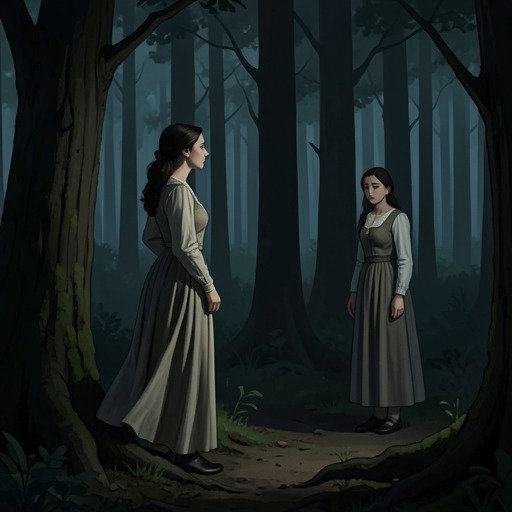
Mona later recounts that, while Rowan and Michael were in Europe investigating corruption within the Talamasca, she realized she was pregnant. The child grew with alarming speed and began speaking to her, identifying herself as Morrigan. Mona was fascinated by the child and overwhelmed by the pregnancy, and she went to the Fontevrault plantation house, where Dolly Jean and Mary Jane Mayfair helped her give birth.
Mona describes the birth as intensely painful and frightening, but says Morrigan was tall, beautiful, and seemed luminous and new. Dolly Jean recalls that the infant already knew a jumble of human things. The contrast is central to Morrigan’s brief presence in the family’s account: she is at once a vulnerable newborn and a being with unusual size, maturity, and knowledge. Her birth does not lead to a life with Mona. Ash Templeton comes to the house, sees Morrigan, and she runs to him; the Mayfairs do not know what became of her after she left with him.
A Mother’s Hope
Morrigan remains a defining absence in Mona’s life. After becoming a vampire, Mona says she had imagined during her long hospitalization that her daughter might be somewhere in the building, and that Morrigan’s milk could be mixed into the drinks Rowan made her take. She connects this fantasy to the Taltos’ unusual biology and to the reported curative properties of their milk. The hope was not evidence that Morrigan was near; Mona herself calls it a fantasy. It shows instead how the unanswered question of her daughter’s whereabouts persisted through illness and treatment.
After her transformation, Mona insists that she still wants to find Morrigan. She reasons that, if Rowan’s account is true and Morrigan is alive, the two of them might now have centuries in which to meet: Mona is no longer human, and the Taltos daughter would also live for centuries. Her hope is bound to a need for the truth from Rowan, but it is also a changed vision of their possible relationship. The distance between them had once been shaped by Mona’s illness and by Morrigan’s unexplained disappearance; now Mona imagines a future in which mother and daughter could face one another as long-lived beings.
The Secret People and Morrigan’s Fate
Morrigan’s later life is disclosed through the account of a Taltos who identifies her as the mother of the entire Secret People. He says she was probably already dead by the time the drug merchants arrived. Before the birth of Miravelle, Morrigan had borne five male children in a short period. The account describes this repeated reproduction as a severe burden: she was gravely ill, her milk had dried up, and poison followed. The speaker says that he loved her, making the revelation both a piece of the Secret People’s history and a personal statement of loss.
The disclosure overturns Mona’s remaining hope. She had held open the possibility that Morrigan was alive and that she might find her; instead, she learns that her daughter had become a mother to a whole community and had likely died before the events that brought the Secret People into view. The news leaves Mona stunned, with tears visible but not falling, while Lestat supports her. Morrigan’s absence is no longer an unresolved separation: it is a confirmed loss, and the details of her later life show that her survival as the mother of a people came at great cost.
Narrative Significance
Morrigan’s story places the Taltos’ reproductive capacities alongside the obligations and dangers imposed on their mothers. The species’ rapid development depends on sustained maternal milk and care, yet Morrigan’s own experience is presented through repeated births, declining health, and the loss of her milk. Her life thus makes reproduction both the means by which the Secret People continue and a source of grave harm to the mother who sustains them.
The novel also uses Morrigan to connect private grief with a much larger history. Her conception exposes the Taltos inheritance within the Mayfair family; her departure with Ash leads toward the later existence of the Secret People; and the final news of her death forces Mona’s long-standing hope into the reality of bereavement. For Lestat, the loss of Mona and Morrigan becomes part of his recognition that his attempt to shape Mona into a perfect vampire was overtaken by forces he did not control. Morrigan remains important not through an extended presence in the narrative, but through the chain of family revelations, biological consequences, and losses gathered around her name.