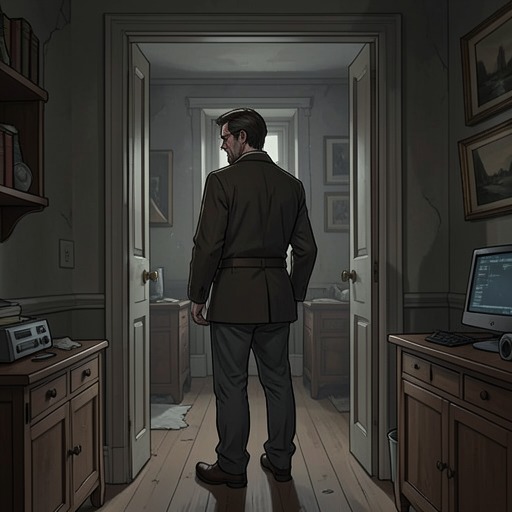
Quinn and Patsy's parent-child relationship
Blood CanticleQuinn Blackwood and Patsy Blackwood are mother and son, a relationship marked by long-standing hostility, distance, and a violent end. Quinn’s killing of Patsy is not treated as an isolated crime: the novel places it against her illness and antagonism toward him, then returns to its consequences through his confession, his remorse, and Lestat’s effort to help Patsy’s spirit pass into the Light.
Identity and Background
Patsy is Quinn’s mother, a country-western singer who, in Lestat’s recollection, had been seriously ill and was dying of AIDS. Her illness had left her unable to resume the flamboyant performing life Lestat remembered: she had once worn fringed leather outfits, high boots, and dramatic makeup, but when he last saw her she was dressed in white nightgowns and resting at home. Big Ramona later emphasizes that Patsy had left her medicines behind when she disappeared, a detail that heightens the household’s alarm about her condition and whereabouts.
The relationship was already burdened by resentment. Lestat describes Patsy as hating Quinn, with a hostility he attributes to a distorted sibling rivalry: she had been sixteen when Quinn was born. His account gives a reason for the bitterness but does not turn it into an excuse or resolve the history between them. The mother-son bond is therefore presented through opposing facts: kinship, Patsy’s vulnerability, and a deep antagonism that Quinn had not discussed with Mona.
Estrangement and the Killing
When Jasmine worries about Patsy and asks after the missing woman, Quinn responds with a blunt confession. He tells her Patsy is dead and that he killed her two nights earlier, then says there is no longer any need to worry about her and instructs Jasmine to discard the medicines. He has not concealed the act in that moment; instead, he gives Jasmine the truth in a way that ends her immediate uncertainty, even though Lestat expects that others will not believe him.
Mona is shocked both by the revelation and by the fact that Patsy was Quinn’s mother. She asks whether Quinn had been telling the truth, and Lestat confirms it. He distinguishes between the killing, which Quinn alone can explain, and Quinn’s decision to confess, which he regards as the sensible course. Lestat stresses that Patsy had hated Quinn, was a hard and merciless woman, and had little time left because of her illness. Those details frame the circumstances without erasing the gravity of Quinn’s action.
The confession also exposes how completely Quinn had kept Patsy outside his relationship with Mona: in all the years Mona had known him, he had never mentioned his mother or answered even one of her questions about her. Once Mona has learned the truth, she confronts Quinn directly and asks why he killed his mother. Quinn appears at a loss and takes her into his arms without answering. The scene makes the gap between confession and explanation explicit: Quinn has named what he did, but he cannot yet give Mona an account of why.
Aftermath and Remorse
Patsy’s death continues to press on Quinn after the immediate crisis. He tells Lestat that people are making inquiries because of the medicine left behind and that he has repeated his confession. Jasmine, he says, laughed and wished she could kill Patsy herself; he believes Cyndy the Nurse may have been the only person who truly loved her. His account presents Patsy as a source of conflict beyond the private mother-son relationship, while also showing that Quinn’s public admission has not ended the practical consequences of her disappearance.
Lestat reflects on the danger of the Sugar Devil Swamp, where Patsy’s body was left, and contrasts her lack of resources with his own past survival. He believes her soul has gone to the Totality of Salvation. Quinn, meanwhile, vows that because he sinned by taking her life, he will give her songs life forever. The vow turns toward a possible act of remembrance: the songs can endure even when the relationship that produced this grief cannot be repaired in life.
Patsy’s Passage into the Light
When Patsy appears after death, Lestat addresses her and urges her toward the Light, promising that Quinn will gather her recorded songs and send them out widely. Quinn’s promise and Lestat’s appeal do not undo the killing; they offer a response to it, one grounded in remembrance and the hope that Patsy can leave the earthly suffering behind. Mona cries out as Lestat and Patsy seem to connect, and Lestat describes a force carrying Patsy away from him.
Afterward, Lestat cannot fully explain what happened. He says that some force may have tried to take him with Patsy because they were connected as she began to rise, but he managed to get away. Quinn says he saw the Light, though he did not see Patsy’s spirit; another witness also reports seeing it. The accounts preserve a difference between witnessing the Light and seeing Patsy herself, while affirming the consequence that matters to Lestat: Patsy has gone on.
Significance of the Relationship
The mother-son relationship is revealed through absence as much as through direct confrontation. Quinn’s silence about Patsy leaves Mona without the context for understanding him, while his confession suddenly makes the hidden family history impossible to ignore. His inability to answer Mona’s question keeps the motive unresolved in the scenes supplied here; Lestat’s description of Patsy’s hatred and illness supplies context, not a definitive explanation.
The aftermath shifts the relationship from an earthly conflict into a question of responsibility and mercy. Quinn acknowledges his act as a sin and makes a promise tied to Patsy’s work; Lestat, who doubts his own capacity for good, nonetheless tries to help her reach the Light. In this way the bond remains morally unsettled: kinship does not prevent violence, remorse does not erase it, and a hoped-for passage into the Light offers no simple reconciliation. Patsy’s songs and the attempt to guide her onward become the surviving forms through which Quinn and Lestat respond to a relationship that Quinn had kept unspoken until it ended in death.