Taltos
Blood CanticleTaltos are a mammalian species that evolved apart from Homo sapiens, with a history and social existence of their own. Their unusual reproductive biology and accelerated growth make them difficult to understand through ordinary human categories, but the story does not treat them as a biological curiosity alone: they are intelligent, telepathic beings with memories, relationships, vulnerabilities, and a claim to safety. Their presence exposes the risks of defining another people chiefly by their difference, their reproductive capacity, or their usefulness to human institutions.
Identity and Origins
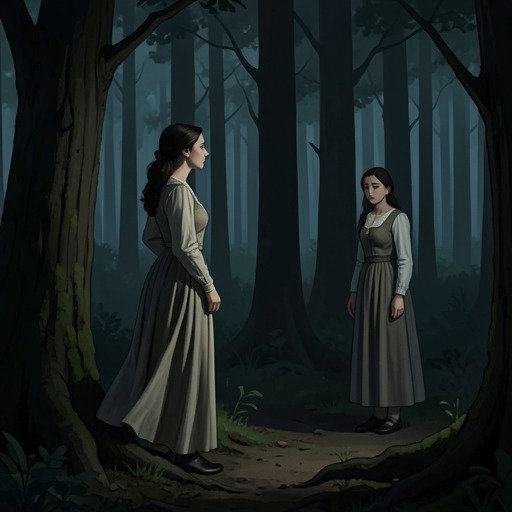
Rowan Mayfair describes Taltos as having evolved independently on a volcanic island in the North Sea thousands of years before humanity. The species shares roughly forty-five percent of its genes with humans. Taltos resemble people, though they tend to be taller and longer-limbed, and their skeletons are largely composed of cartilage. Their appearance is also associated with distinctive physical traits: they are described as very tall, graceful, and often marked by long, dark hair. These descriptions establish a visible difference without making appearance a reliable measure of their intelligence or inner life.
Their island homeland was destroyed by the volcano that had created it. Taltos migrated to the British Isles, where Donnelaith in Scotland became one of their strongholds and perhaps one of the last. Their knowledge of that history is not merely learned from human records: a Taltos is born with extensive knowledge of its species, its lost island continent, and the places to which its people migrated. The species therefore carries its own account of its origins even when human characters must piece that account together from observation and testimony.
Bodies, Birth, and Development
The distinctive Taltos life cycle makes reproduction both a source of remarkable growth and a serious burden. In pure Taltos, the female ovulates on demand, and a fetus develops within minutes or hours. Birth is severely painful; the newborn unfolds as a small adult and begins maturing immediately. The speed of the process does not mean the infant is independent. A newborn needs its mother's milk, and the first hour after birth is especially consequential: without milk, it risks permanent stunting, while milk and the mother's telepathic nurture allow it to reach its full height within that hour. A typical adult reaches six and a half feet, and males may reach seven feet. Nursing can continue for weeks, months, or years, taking a heavy toll on the mother.
The mother's milk is also said to have curative properties for humans, although its possible effects are not fully known. This possibility makes the Taltos body a potential resource in addition to a living subject, sharpening the ethical stakes around care, study, and exploitation. The story links a specific human cost to this reproductive biology through Mona Mayfair: her pregnancy and traumatic birth are associated with the beginning of the illness that leaves her near death. Her child, Morrigan, is taken from her, and Mona's later vision of the birth connects the species' rapid development to a family rupture and lasting physical suffering.
Human and Taltos reproduction do not carry equivalent risks. Michael Curry recounts that, when a human woman conceives by a Taltos male, the pregnancy almost always ends in miscarriage and the woman's death from bleeding. By contrast, a human male's effect on a Taltos female is described as a comparatively slight hemorrhage, though repeated encounters over many years can deplete her eggs. This asymmetry helps explain the fear and hostility surrounding the species, but it also shows how the story's accounts of interbreeding place the costs disproportionately on female bodies.
Intelligence, Temperament, and Vulnerability
Taltos are highly intelligent primates with a large store of knowledge from birth. They are telepathic and curious, and their inherited knowledge includes their species' history. Yet intelligence and rapid reproduction coexist with vulnerabilities: Taltos are characterized as simple and lacking aggression, traits that make them susceptible to others' designs rather than proof that they lack agency. Their sensitivity to rhythm and music can also be used against them; a long rhyme or rhythmic song can nearly paralyze one. The same capacity that gives them a distinctive way of responding to the world can therefore become a means of control.
Their relationships to humans have a long history of conflict. Michael describes human arrival in the British Isles, the struggle between the taller people and more aggressive invaders, and the interbreeding that followed. Rowan admits that she cannot medically explain how the species became mixed with humans. That gap matters: the novel supplies a history of contact and consequence without giving human observers complete knowledge of Taltos origins or biology. The limits of what human medicine can explain remain part of the story, rather than being resolved by the confidence of scientific description.
Kinship, Community, and Human Intervention
Morrigan's story makes the species' reproductive future personal as well as collective. Mona identifies herself to Taltos as Morrigan's mother and asserts that her daughter carries her genes. But another Taltos describes Morrigan as the mother of the Secret People and says she was already dying before the Drug Merchants arrived; after giving birth to five males and then Miravelle in too short a time, she could not withstand the repeated reproductive burden. The contrast between Mona's maternal claim and Morrigan's place within a wider people shows how kinship can be both intimate and communal. It also places the survival of a population beside the physical limits of the individual mother.
The Secret People have not lived outside human power or human ideas of safety. Oberon recalls a childhood in which his parents took him and his siblings to major cities around the world in a private plane, taught them to observe human beings and pretend to be human, and provided a carefully supervised life. His father was strict about caution and prohibited telephones and the Internet. Oberon later reflects that this isolation may have been a fatal error. The memory complicates any simple opposition between a hidden, protected Taltos community and a hostile human world: seclusion could provide care, but it could also leave the young without means to communicate or respond when danger arrived.
Lorkyn's actions reveal another response to that danger. While appearing to serve Rodrigo, Lorkyn diverted money from him into numbered accounts and alerted authorities in Miami Beach to Rodrigo's activities. Lorkyn also tried to discover the legal identities of Father and Mother and determine who owned Secret Isle, but could not do so because the relevant documents had been destroyed years earlier. The financial records and ownership arrangements that might have offered legal leverage were inaccessible, leaving escape dependent on a covert plan rather than secure recourse.
Lorkyn says the plan was to accumulate money, remove Rodrigo and his mother, free Oberon and Miravelle, and get away from the island to Mayfair Medical for help. The aim eventually reaches beyond escape. Lorkyn describes a place for Taltos as an environment, community, and world in which they can live, work, be protected, and thrive. Lorkyn wants to continue studying medicine and become a doctor; Rowan has accepted Lorkyn as a pupil. Oberon and Miravelle, too, are imagined as having opportunities for fruitful work. This proposal frames refuge not simply as keeping Taltos safe from immediate danger, but as creating conditions for education, meaningful activity, and communal life.
Narrative Significance
Taltos unsettle the boundary between human and nonhuman by appearing recognizably people-like while possessing a different evolutionary history, body, and reproductive cycle. Human characters often encounter them through medical descriptions, family genealogies, or questions of danger; the species' own knowledge, kinship, and need for community resist reduction to those frameworks. The novel's emphasis on milk, inherited knowledge, music, and telepathy makes their difference material and specific, while their vulnerability to human violence and control makes that difference politically consequential.
The competing meanings of protection are central to their role. The Secret People's isolation was intended to preserve them, yet it also carried risks; Lorkyn's alternative seeks protection together with study, work, and a viable community. Neither biology nor good intentions erase the costs placed on Taltos mothers, and the possibility that their milk might cure humans raises the prospect that care could become extraction. The species thus brings together questions of survival, bodily autonomy, knowledge, and belonging: a safe future must make room for Taltos as a people, not only manage them as a danger or value them as a resource.