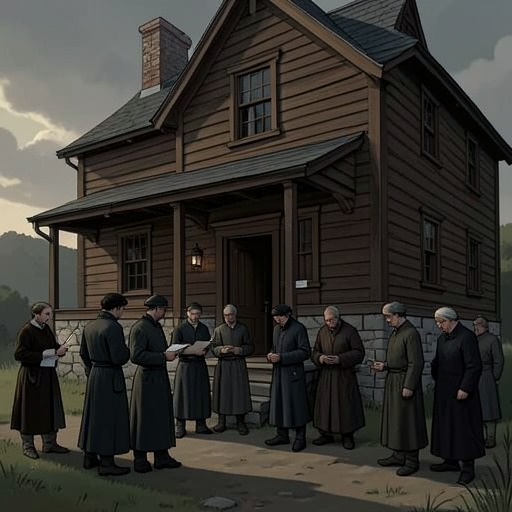
Tante Oscar
Blood CanticleTante Oscar is an exceptionally old Mayfair relative in the French Quarter whose stories link the family’s inheritance customs, its supernatural past, and the later arrival of the Taltos Miravelle and Oberon. Her unusual household and matter-of-fact knowledge of the Blood Children make her both a vivid presence in Rowan’s memories and an unlikely interpreter of events that Rowan only gradually understands.
Identity and Setting
Rowan recalls visiting Tante Oscar with Dolly Jean in the French Quarter, where Tante Oscar lived in a flat three flights up, with a balcony overlooking the river. She was already more than a hundred years old at the time of the visit, and Rowan describes her as still living when she recounts the memory. Her home’s crowded furnishings and accumulated belongings form a domestic world that seems to have its own rules: desks, buffets, tables, carpets, chairs, framed photographs, tea services, and bulging armoires fill the apartment.
Tante Oscar’s appearance is equally distinctive in Rowan’s account. She wears several dresses at once, layered scarves, and a long maroon coat with a fur-trimmed collar; she has a ring on every bony finger, jet-black hair, and large yellow eyes. Years later, Stirling reports seeing her in three or four dresses beneath the same maroon coat, now with a black hat and face veil. The similarity between Rowan’s remembered description and Stirling’s later account presents her as a consistent, recognizable figure across the family’s stories.
Habits and Household
The flat is busy with children who run errands, bring coffee and cake, collect the mail, and fetch newspapers. Rowan remembers many televisions and an overhead fan, while the apartment’s crowded rooms leave little space unoccupied. The children are later described as boys who accompany Tante Oscar to First Street; they discover the swimming pool there and are invited to swim, an experience they apparently have not had before.
One of Tante Oscar’s most memorable habits centers on a telephone kept inside the refrigerator. She calls the refrigerator an ice box, although it is new, and explains that she does not talk on the telephone. When Dolly Jean calls, however, Tante Oscar hears it ring through the refrigerator door because the caller is Dolly Jean, and answers. The detail turns a simple domestic object into a marker of their personal connection: she may avoid the telephone generally, but she recognizes and responds to this relative.
Tante Oscar’s visits are also associated with the Sign of the Cross and rosary beads. When she comes to First Street, she repeatedly makes the sign as she enters, moving her rosary through her right hand. Her observance sits alongside her familiarity with supernatural beings: she can speak about them without treating religious gestures as proof that they are governed by them.
Knowledge of the Blood Children
During Rowan’s visit, Tante Oscar tells her and Dolly Jean that Blood Children have lived in the French Quarter for two hundred years, feeding on people she calls the riffraff. She also says that Merrick Mayfair has become one of them and will live forever. According to her, Merrick’s old relative Oncle Vervain, a respected Voodoo doctor, foresaw this future and confided it to her alone. His foreknowledge had broken his heart, but Tante Oscar presents Merrick’s transformation as something that was meant to happen.
Her account gives the Blood Children a place within Mayfair family memory, not merely within an unfamiliar supernatural world. The family’s history is already organized by the Mayfair Legacy: members must keep the Mayfair name, and each generation has an Heiress who lives in the family house and must be able to bear children. Tante Oscar’s stories add another inherited dimension, in which old predictions and long-lived supernatural communities intersect with the family’s own structures of name, residence, and succession.
Rowan’s Recognition of Lestat
Tante Oscar also helps Rowan identify Lestat before she fully understands what she has recognized. When Rowan describes a black-haired man she has seen walking, Tante Oscar knows him as Louis and says that the Sign of the Cross would drive him away, though it has no power over him; he respects the sign. She warns that the blond-haired one is the one to fear, describing him as someone who talked like a gangster and looked like an angel. Rowan remembers the wording because it seemed strange to her.
Years later, when Jasmine calls the blond visitor Lestat at Blackwood Farm, Rowan recognizes the description from Tante Oscar’s story. She recalls not only the contrast between the black-haired man and the blond one, but also Tante Oscar’s warning that the latter would do terrible things. The remembered phrase becomes a bridge between a childhood or family recollection and Rowan’s present encounter: Tante Oscar has supplied a way to name what Rowan had resisted knowing.
Lestat answers Rowan’s fear by insisting that even vampires and angels can learn and that no one is beyond redemption. Tante Oscar’s warning therefore remains important without determining the final judgment of him. Her story gives Rowan a language for danger; Lestat’s response challenges the idea that a frightening history must fix what someone can become.
First Street and the Taltos
Much later, Dolly Jean arranges for Tante Oscar to come to the First Street house by car. Stirling recounts that she spends the afternoon with Dolly Jean and Michael, telling stories to or about the “Walking Babies,” as he calls Miravelle and Oberon. He and Michael record the gathering, preserving an encounter in which Tante Oscar’s knowledge and the Taltos’ experiences meet. Miravelle is shocked by much of what the two older women say, whereas Oberon finds them hilarious and reacts with unrestrained amusement.
Stirling is captivated by the scene, including Tante Oscar’s arrival with the children and her repeated religious gesture. After a long afternoon of stories about Walking Babies in the swamps, Miravelle and Oberon are ready for a hospital suite. They have spent the morning and early afternoon at First Street with Dolly Jean and Tante Oscar, but the larger effort to oversee their movement into the human world remains controlled: guards surround the house. Their lives with Father and Mother have lasted about five years, Stirling says, while the social arrangement surrounding them has already begun to break apart. Tante Oscar’s storytelling thus occupies a moment when the past is being recorded, the Taltos are meeting the human family, and their protected existence is proving difficult to sustain.
Tante Oscar’s importance rests less on formal authority than on what she remembers and recognizes. She carries accounts of the Blood Children and Lestat into scenes shaped by family inheritance, while her visits make the First Street household a meeting place for old Mayfair relatives and the newly encountered Taltos. Her eccentric customs give those connections a domestic form: the hidden telephone, the crowded apartment, the remembered warning, and the stories told in company all become means by which the family’s supernatural history is passed between generations.