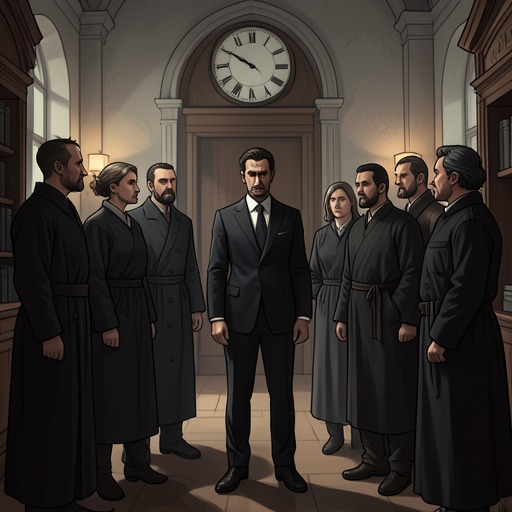
Tartos Care and Activity Restrictions Policy of Mayfair Medical
Blood CanticleThe Mayfair Medical Taltos haven-and-activity policy is Lorkyn’s proposal to make the hospital compound a protected place where Taltos can live, study, and work without being forced into the wider world. Its model combines apartments for residents, opportunities for purposeful work and education, and an expectation that they remain on the compound except when pursuing a predetermined goal. The proposal presents protection as a livable community rather than laboratory confinement, while leaving a tension between safety and restricted movement.
Proposal and Purpose
Lorkyn introduces the policy as an environment, community, and world in which Taltos can function, thrive, and be protected. The distinction matters: when Mona suspects that the Taltos will be studied in cages, Lorkyn answers that she is proposing a place to live, not a human laboratory. Her argument rests on the prospect of a stable social setting where residents can pursue useful work and remain at peace.
The plan also draws on Lorkyn’s own educational and professional ambitions. She has studied medicine and wants to become a doctor; Rowan has accepted her as a pupil. Lorkyn points out that Mona had encountered evidence of her studies on the island, after examining her computer and bringing its hard drive to Rowan. She says she has also given Rowan oral evidence of her knowledge. In the proposed community, her continued study would be part of the residents’ life rather than an externally imposed experiment.
Housing, Work, and Movement
The practical basis of the haven is the set of apartments connected to the hospital for families visiting sick patients. Lorkyn proposes that the Taltos live in these apartments as they study and work. She describes the compound as a self-contained environment where they could be supervised without conspicuous constraints, protected, and left in peace.
The policy nevertheless sets a clear boundary on movement: residents need never leave the compound except when they have a predetermined goal. This condition is presented as a means of making protection workable, but it also makes the haven a managed environment. The proposal does not describe unrestricted travel or independent residence beyond the hospital grounds; safety and access to the outside world are deliberately balanced in favor of containment.
Disagreement and Consent
Mona is the proposal’s sharpest skeptic. She questions whether the offer of sanctuary can be trusted when Rowan has previously rendered a Taltos unconscious with a syringe near her jet, and she fears that the residents will be confined for study. Her objection makes the difference between protection and coercion central to the discussion: a place may be described as a haven without its prospective residents automatically trusting its caretakers.
Lorkyn responds by clarifying the community’s intended purpose and by appealing to the work she has already undertaken. She asks Oberon and Miravelle whether they agree that they need a haven, and states that they cannot simply go out into the world. Miravelle affirms that she does not want to do so. That response supports the need for refuge, though the exchange does not establish that every Taltos has the same preference or that all details of the arrangement have been settled. Oberon considers the proposal rather than immediately accepting it.
Significance
The plan reframes protection as infrastructure and shared life: housing, study, work, and peace are offered together, rather than reducing the Taltos to objects of medical observation. At the same time, the residents’ security depends on a bounded setting, supervision, and controlled departures. The policy’s promise and its limitation therefore arise from the same design. The compound may provide a place to live and develop, but the distinction between a chosen refuge and imposed confinement depends on trust, participation, and the residents’ ability to shape the arrangement.