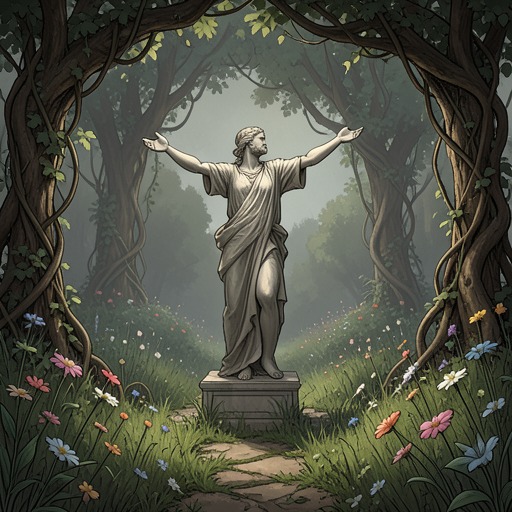
The Savage Garden
Blood Canticle“The Savage Garden” is an expression Lestat uses for the Earth when he believed that aesthetic laws were its only laws. The phrase later returns in a night charged with beauty and horror, and prompts him to describe a different belief: that a Maker assembled the world with love and purpose. It connects his earlier resignation to his developing faith, while Rowan’s defense of her medical work gives the question of belief a practical, human consequence.
The Phrase and Its Earlier Meaning
Lestat recalls using “The Savage Garden” in an earlier period, when he did not believe in anything beyond aesthetic laws. He associates that stance with being young and newly introduced to the Blood, and with expecting further miracles. In retrospect, the phrase belongs to a limit in his understanding: he could register beauty, but did not yet see it as evidence of a purpose beyond itself.
That earlier outlook was not simply a denial of beauty. It made beauty the only law Lestat trusted, leaving the world’s other meanings unsettled. His later return to the phrase therefore carries a contrast within it. The garden can be beautiful without becoming orderly or comprehensible, and beauty alone no longer supplies the whole account of what the world is.
A Phrase Returned in the Night
At the Mayfair house, after Rowan has been subdued and Michael has turned his attention to Mona and Quinn, Lestat sits beside Mona. He hears the night around the concealed backyard and the activity of creatures that he finds loathsome but whose singing is magnificent. In that juxtaposition, he whispers, “The Savage Garden,” then turns away as though he hates them all. The words arise in a setting where beauty and repulsion are present together, not where one cancels the other.
Rowan catches the phrase and asks what he means. Lestat explains that it was his old name for the Earth, from the time when he believed only in aesthetic laws. He also qualifies that earlier confidence: he had been young, newly made, and expecting more miracles than the world could provide. The phrase thus works as a recollection and a self-correction. Its return does not restore the old doctrine; it exposes how much his understanding has changed.
Belief Beyond Aesthetic Resignation
Mona asks what has replaced the old resignation. Lestat answers that he believes in the Maker, who put everything together with love and purpose. Michael responds with the hope that there is someone better than human beings and other creatures, someone capable of compassion. The exchange moves from an abstract claim about the world’s design toward a demand about how people should treat one another.
That demand becomes immediate when Quinn asks Michael whether he will show compassion to them and insists that Mona’s and his own secret be kept. The scene does not leave belief as a private conclusion about creation: compassion and discretion are at stake among people who have entrusted one another with vulnerable knowledge. The old phrase’s beauty-and-horror tension therefore opens onto an ethical question, rather than settling the night into a reassuring picture of harmony.
Rowan’s Work as a Test of Meaning
Rowan describes the institution she built as something that serves people beyond those who have given birth to Taltos, seen ghosts, buried bodies in what she calls a Savage Garden, or encountered Blood Children. She stresses that it helps and embraces many kinds of people, and that it is real to them. Her insistence is grounded in responsibility: she could not retreat into nightmares or private writing, or fail her interns, residents, laboratory assistants, and research teams. As a neurosurgeon and scientist, she brought a personal approach to the institution’s different parts.
Her speech breaks off as she insists she cannot fail or be absent. Lestat tells her he is listening. In this exchange, the phrase “Savage Garden” also appears in Rowan’s account of people who have buried bodies, linking the remembered expression to a world marked by extraordinary and painful experience. Rowan’s work does not erase that world; it gives her a means of remaining engaged with people within it. The phrase’s significance consequently lies in its altered reach: what began as Lestat’s aesthetic description becomes part of a conversation about purpose, compassion, and sustained responsibility.
The Larger Vision of a Transformed World
The phrase resonates with Lestat’s wider argument to Pope John Paul II about modernity. In the papal quarters, Lestat heals the Pope’s suffering and reflects on how deprivation, Communism, and the Second World War shaped the Pope’s spiritual life. He sees a gulf between that formation and the possibility of charity arising from the security and abundance of prosperous societies. This reflection frames the problem that his later address attempts to answer: how can material life and spiritual purpose meet?
Lestat argues that Modernism and Materialism are still in their infancy and that their sacramental possibilities are only beginning to emerge. He imagines technological development distributing goods and services, communications reducing division, education and medical advances changing social conditions, and scientific knowledge of sexuality and procreation opening new possibilities. He calls for the courage to embrace science in the name of the Lord. These claims enlarge the contrast implicit in “The Savage Garden”: the world is not only an object of aesthetic attention or a scene of disorder, but a place whose material conditions may be reshaped through human action.
The expression does not itself prove Lestat’s new belief, and the evidence leaves its grand predictions as hopes rather than demonstrated outcomes. Its narrative force is more intimate: the phrase returns at a moment when he sees magnificence and horror together, and the conversation that follows tests his changed outlook against compassion, secrecy, and Rowan’s refusal to abandon those who depend on her. The garden remains savage, but no longer stands for a world in which beauty is the only meaning available.