British Broadcasting Corporation
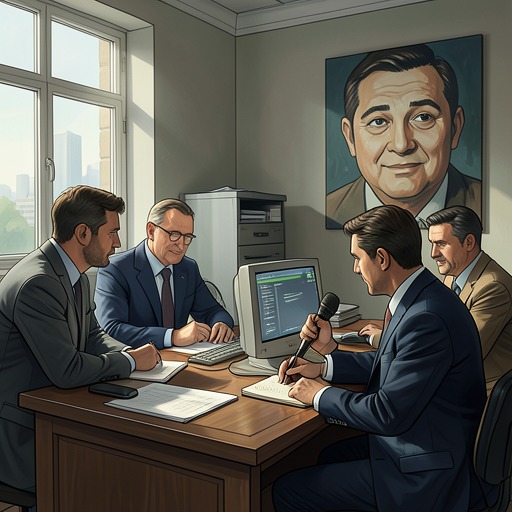
Blow OutThe British Broadcasting Corporation enters the investigation as a public platform where official statements are tested against questions about the ricin attacks and a missing child. Its BBC Breakfast interview with Helen Gates turns the investigation’s limited disclosures into a visible institutional problem: Gates is pressed to account for the lack of arrests and public information, while Joanne Stuart is absent from a moment when she believes she should have helped prepare the response.
The BBC Breakfast Interview
The broadcast occurs while Jo is asleep after the previous night and has not read a text message from Gates. Nick Carter tells her that Gates has been questioned about Operation Alecto on BBC Breakfast. Jo immediately suspects the message may have been a request for her to do the interview or, at minimum, brief Gates beforehand. The missed message makes the broadcast consequential not only as news coverage but as a point of strain in Jo’s working relationship with her senior colleague.
Gates gives the familiar assurances that investigations are ongoing, several lines of enquiry are being followed, and the police hope for a speedy resolution. The presenters do not accept those general statements as sufficient. They ask why no one has been arrested, why so little information has been made public, whether a random attacker is using ricin-laced pellets, whether Counter Terrorism Command is involved, and what the public can do to protect itself. The interview brings questions of public danger and police accountability directly into the investigation’s story.
The Missing Child and Institutional Boundaries
The presenters also ask whether the abduction of a missing twelve-year-old girl is connected with the shootings. Gates can only say that the National Crime Agency is handling that operation and that enquiries should be directed there. Jo observes that this is not strictly true; when that limitation is pointed out, Gates ends the interview and walks off, with a technician having to intervene as her throat microphone catches on her blouse.
The exchange makes the boundary between operations part of the public controversy. Referring inquiries elsewhere offers Gates little protection from the impression that the answer is a cop-out, particularly when the relationship between the incidents remains a matter of public interest. The programme therefore brings pressure not just to disclose more, but to explain which agency is responsible and what can properly be said about connected investigations.
Consequences for the Investigation
Nick recounts the interview to Jo while they are discussing investigative decisions. Jo reacts with alarm, then recognizes that Gates may have expected her to provide support or preparation. She grimaces at the thought that Gates’s anger is directed at her and says that Gates will never forgive her. The broadcast thus carries a private consequence within the police team: public scrutiny magnifies an omission between colleagues, and Jo’s regret is sharpened by realizing she had not even read the message that might have prepared her for the morning.
The account reaches the reader through Nick’s report rather than through a full transcript of the broadcast. Its effect is conveyed through the questions he remembers, his description of Gates’s response, and Jo’s reaction. In that form, the BBC is less a separate institutional portrait than the setting for a collision between official caution and persistent questioning. The interview makes the investigation’s communication problem concrete: the police must manage uncertainty, agency boundaries, and public concern at once, while the people leading the case remain answerable to pressures beyond the evidence-gathering operation.