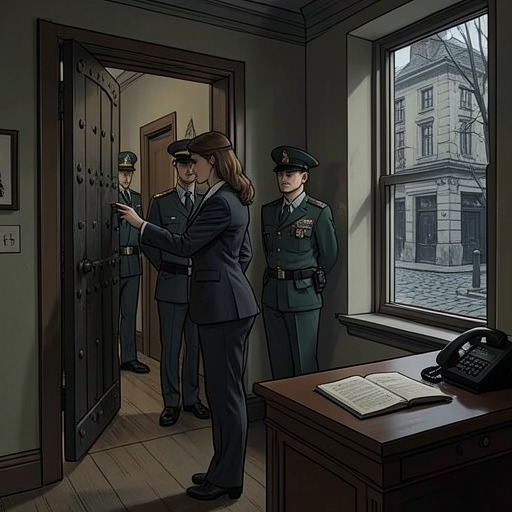
Gordon Holmes
Blow OutGordon Holmes is a Detective Chief Inspector whose experience and practical support help carry the investigation into Ronnie O’Neill’s death from its opening stages through its aftermath. He recognizes O’Neill as a powerful former gang leader, then gives way to Joanne Stuart when she is appointed to lead the case, combining institutional authority with an evident willingness to back a colleague rather than compete with her.
Identity and Introduction
Holmes is introduced as the senior detective told to attend Manchester Royal Infirmary to investigate the suspicious death of Ronnie O’Neill. He remembers O’Neill as a ruthless gang leader and is surprised to learn that the man has been released from Belmarsh on parole. The news that someone appears to have been waiting for O’Neill immediately suggests the danger of investigating his death: the killing may provoke repercussions well beyond the victim himself.
Holmes’s understanding of O’Neill is grounded in the man’s criminal reputation. As the team drives to the hospital, Holmes asks Nick Carter to brief Carly Whittle on what is known: O’Neill had long headed a South Manchester crime syndicate and was suspected of involvement in an extensive range of serious crimes, though he had only been convicted once. Holmes thus enters the case with a clear sense of the threat and complexity surrounding its central figure, even as the investigation must distinguish established information from suspicion.
Handing Over the Investigation
Holmes initially leads the response, but the investigation’s command changes when Helen Gates arranges for Joanne Stuart to be seconded to the Greater Manchester Police to head the murder inquiry. Holmes is assigned instead to take over an unrelated series of shootings. Gates says he is comfortable with the arrangement; his later conduct shows that this is more than a formal assurance.
When Stuart arrives at the major incident room, Holmes is already speaking with Ged. He welcomes her into the room and makes clear that he does not intend to interfere with her authority. Before leaving, he plans to explain his departure to the team and tell them to give Stuart their full support. The gesture helps turn an awkward change of command into a workable handover: Holmes uses his standing with the team to establish her authority rather than preserve his own position.
Experience and Investigative Practice
Holmes’s experience is visible in the practical knowledge he passes on. Nick reveals that Holmes had kept a compact digest of the Murder Investigation Manual close at hand, a set of laminated checklists and diagrams covering key elements of investigative strategy. Nick had wondered how Holmes became so well prepared when DCI Caton left; the manual offers a concrete explanation. Holmes’s expertise is not presented as mystique but as accumulated familiarity with procedure and a tool he has retained and used.
The digest is useful to Stuart as she organizes the inquiry. She consults it to check the investigation’s principal requirements, including the crime scene, forensic opportunities, tissue samples taken at the hospital, and the timing of the post-mortem. Holmes’s method therefore continues to influence the case even after he has handed command to her: his procedural resource helps keep essential lines of work in view.
Stuart adopts an open information-sharing approach for Operation Alecto, telling the team that everyone should have access to the same information and that no one, including herself, is a prima donna. Holmes is not the speaker, but his earlier support for the new commander helps establish the team environment in which this approach can operate. The investigation proceeds through shared updates and the coordination of evidence rather than dependence on one person’s private store of knowledge.
Colleague, Adviser, and Continuing Presence
Holmes remains connected to the investigation after his departure from its leadership. When a development arises, he enters the incident room to tell Stuart and Nick that DCI Fox has asked him to pass on the news. His reappearance is practical rather than ceremonial: he serves as a link between the inquiry and developments elsewhere in the police operation.
His colleagues also continue to draw on his judgment. Later, Holmes comments that DI Sarah Weston has taken advice to keep out of view at a hotel, though she did not tell her colleagues where she was. His remark combines concern with mild exasperation at the uncertainty her silence caused. In the same exchange, he says he will give her an earful when they next meet. The moment portrays a working relationship in which professional worry can coexist with familiar, direct criticism.
Change, Aftermath, and Narrative Role
Holmes’s role shifts from initial case leader to supporter, procedural resource, and participant in the wider response. That change is important to the investigation’s structure: leadership passes to Stuart, but expertise and cooperation remain in circulation. Holmes’s conduct makes the transfer feel like a continuity of police work rather than a contest over command.
The inquiry’s aftermath brings a different institutional responsibility. After a man dies during a police operation, the Independent Police Complaints Commission is already involved, an internal review must be prepared, and a press release needs agreement. Holmes is present in the debriefing process as Helen Gates calls the room to order. The case is therefore not finished when the immediate operation ends; it also requires formal scrutiny and public communication.
Holmes’s significance lies in this dependable, largely practical form of seniority. He recognizes the gravity of O’Neill’s history, hands over command without undermining Stuart, and contributes both procedural knowledge and continuing assistance. In the final stages, the work turns from pursuit and investigation toward review and accountability, and Holmes remains part of the team carrying those responsibilities forward.