Joanne Stuart
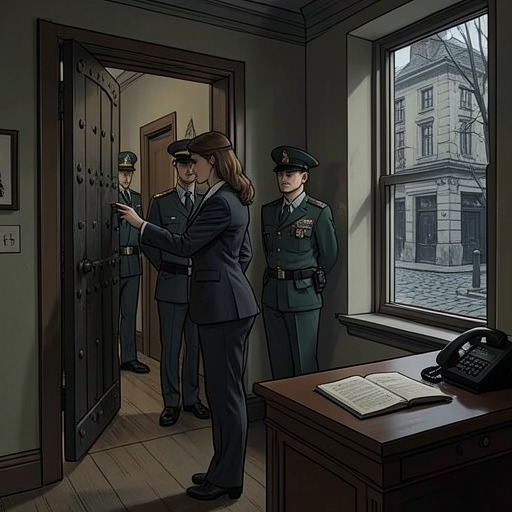
Blow OutJoanne Stuart, usually called Jo, is a senior investigator with the National Crime Agency who is seconded to Greater Manchester Police to lead the investigation into Ronnie O’Neill’s murder. Her decisive significance lies in how she turns method into a form of leadership: she works from the Murder Investigation Manual, keeps the team equally informed, and distinguishes a compelling theory from evidence capable of proving it. The investigation’s pursuit of Darren Clements ultimately brings her into command of a dangerous operation, whose fatal ending leaves her facing both formal scrutiny and lasting personal unease.
Identity and Return to Greater Manchester
At the beginning of the investigation, Jo’s boss, Harry Stone, interrupts her after a gym session and sends her to Manchester Royal Infirmary, where police need help with a suspicious death. She expects Max Nailor to join her, but Stone has assigned him and the rest of the team to another operation. Jo is initially to work alone, with National Crime Agency resources available to her. The assignment soon becomes more substantial: Helen Gates tells her that the Director of Investigations has agreed to second Jo to Greater Manchester Police to head the murder inquiry, while Gordon Holmes is reassigned to investigate a separate series of shootings.
Jo returns to a team that knows her from earlier work. When Gordon announces the reassignment and introduces her as the investigator seconded to lead the new case, the room applauds. The welcome matters to her, though she finds the attention embarrassing. The scene establishes both her authority and her connection to the local force: she is an experienced investigator returning to familiar colleagues, but she must still earn their confidence in the new investigation.
Investigative Method and Team Leadership
Jo treats procedure as a working structure rather than a formality. During an early review, she uses laminated sheets containing a condensed version of the Murder Investigation Manual, which Gordon had kept close. She works through the checklist of investigative-strategy elements, checking that the crime scene is being handled, asking about the post-mortem, and tracking hospital tissue-sample results. The manual gives the team a practical sequence for testing whether essential lines of inquiry have been covered; Jo knows that an omission in the review would have consequences for her leadership.
She also makes access to information part of her method. Jo asks for a crime-scene update to be put on the screen so everyone can hear it directly, rather than relying on her to relay it. She explains that every team member should have the same information regardless of individual role, because any person may notice the missing piece. She explicitly includes herself among those who will not be exempt from the rule against prima donnas. Nick Carter responds approvingly, and the team receives the approach with evident appreciation.
At a briefing with the Mayor and Chief Constable, Jo is careful not to overstate what the evidence establishes. Investigators have compiled separate lists of people who might hold grudges against the two victims, but no name appears on both lists. At the Manchester crime scene, they have recovered partial boot prints and a piece of fabric, and they are reviewing hours of passive media, particularly footage from fixed-speed and ANPR cameras. These are active lines of work, not a named suspect or a solved case. When asked about the unusual poison, Jo does not let its distinctiveness stand in for proof.
Leads, Limits, and Judgment
As the inquiry continues, Jo resists allowing debate to consume time. When the team questions why a missing person has not contacted the police or family, she redirects the discussion toward contacting the specialist Anti-Kidnap and Extortion Unit. She explains that it is an NCA specialist service, on standby around the clock to support law enforcement in the UK, the EU, and internationally, and modelled on its FBI equivalent. The decision shows her willingness to bring in specialist support when a case demands it, even when a colleague is unfamiliar with the unit.
The investigation also requires Jo to rule people out, not simply pursue the most dramatic possibility. After speaking with a man whose routine appears to have potential independent witnesses, she senses that the team may have been wasting its time. Even so, she recognizes that they had no choice but to establish definitively whether he was involved. She then asks when he last saw his son, a question that catches him by surprise. The sequence illustrates the difference between an interview’s apparent yield and its investigative necessity: an unproductive lead still has to be tested before it can be set aside.
Jo explains these evidentiary limits to Carly Whittle after the team considers taking a rifle for comparison with recovered pellets. They had no warrant, though Jo acknowledges she could have asked for the weapon voluntarily. She doubts a comparison would have yielded a sufficiently reliable match: a pellet has less contact with the barrel than a conventional bullet, making distinctive marks harder to establish, especially to a standard that would stand up in court. She adds that a weak alibi would have changed her decision and sent her back to collect the rifle. Her answer neither treats the absence of a warrant as the only reason nor mistakes a possible forensic comparison for conclusive evidence.
As the case develops, Jo and Nick identify Darren Clements as a strong suspect. Nick points to Clements’s possible motive and his fraudulent acquisition of a vehicle seen near several crime scenes. Jo agrees that the combination is suspicious, but stresses that belief is not proof. The team also does not know for certain whether Ronnie O’Neill or any of the other attack victims had supplied or dealt the drugs connected with Clements’s sister’s death. Jo regrets that the original investigation did not pursue the source of those drugs more thoroughly. The unresolved history is a crucial gap: motive and opportunity may align, yet the connection between the victims and the sister’s death remains unestablished.
Command, Crisis, and Aftermath
During an operation searching for the suspect, Jo reports to Helen Gates in the Gold and Bronze command structure. The initial searches are negative: there is no sign of the suspect, and dog handlers find no weapons, drugs, or the specific substance under investigation. Jo is preparing to send in a biohazard forensics team when Gates questions whether that is necessary after the dogs have already searched. The exchange shows Jo continuing to weigh the demands of a hazardous investigation against the choices and checks built into operational command.
Later, Jo realizes that the urgency of finding Clements has narrowed her attention. After an instruction is carried out, she strikes the steering wheel and admits to Nick that she has been so desperate to find him that she has taken her eye off the ball. The admission marks a moment of self-correction within the investigation: determination has been a source of drive, but it can also distort what the team needs to notice. Jo’s willingness to name that error makes the moment part of her command rather than a private feeling detached from the work.
At the final confrontation, Jo uses the police radio to summon the firearms commander after a girl leaves a vehicle, crosses the parking lot, and runs toward the grassy area where Clements has moved out of sight. When Clements takes his granddaughter Françoise, Jo addresses him with her arms held out and urges him to let the girl go. She stresses that Françoise is innocent, offers to talk about what brought him to this point, and asks him to put down his gun. The exchange places Jo’s investigative understanding and crisis negotiation side by side: she acknowledges Clements’s grievance without excusing the danger or losing sight of the hostage.
Clements dies during the police operation. Jo is haunted by his expression at the end and by her understanding that he had been trying to escape; a brief turn toward the shouts slowed him and contributed to the fatal outcome. The debrief begins while the Independent Police Complaints Commission is already involved because a man has died during a police operation. An internal review and a press release also have to be prepared. Jo switches off her vibrating phone when she sees that Agata Kowalski is calling, putting the immediate demands of the debrief ahead of a personal conversation. Her professional accountability continues even as the outcome follows her beyond the operation.
Narrative Role and Significance
Jo’s investigation is shaped by a recurring tension between urgency and verification. The case offers apparent patterns—an unusual poison, a possible grudge, a vehicle near several scenes, and a suspect with a plausible grievance—but Jo repeatedly separates those patterns from established facts. Her caution about the rifle comparison, her insistence on ruling a lead in or out, and her recognition that the connection between the victims and the sister’s death is unproven all make the process of investigation part of the story’s substance.
Her leadership is similarly practical rather than ceremonial. The checklist makes omissions visible; shared briefings prevent information from being confined to senior staff; specialist support widens the team’s capabilities. Yet procedure cannot guarantee a safe ending. The operation’s fatal conclusion brings scrutiny from outside the force and leaves Jo replaying the moment Clements turned toward the shouts. The contrast gives her arc its weight: she can organize a disciplined inquiry and still confront the limits of command, evidence, and hindsight.