Manish Jindal
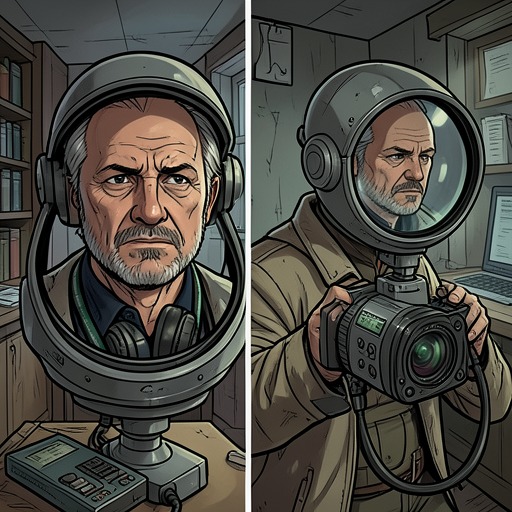
Blow OutManish Jindal is a forensic firearms expert whose analysis gives Jo Stuart’s investigation a practical way to interpret the precision air-rifle attack on Ronnie O’Neill. He measures the likely firing sector and distance, explains the timing and skill required, and later helps make sense of the pellet’s physical construction. His scenes show forensic expertise at work: not as a shortcut to certainty, but as a method for narrowing possibilities and testing what the evidence can actually support.
Identity and Introduction
Jindal appears as a specialist consulted in the investigation of Ronnie O’Neill’s death. At Worsley Golf Course, Jo Stuart, Jack Benson, and Carly Whittle gather around him while he studies footage from a camera mounted on a buggy. The team’s question is not merely where the shot came from, but how its position and timing can be reconstructed from the recorded scene and the post-mortem material.
He approaches the footage alongside photographs of the victim’s injuries, using them to estimate the likely direction of fire. His role is collaborative: he offers an initial technical interpretation to guide the search, while reserving a more accurate assessment for analysis back at the laboratory. That distinction establishes the careful, provisional quality of his expertise from the outset.
Reconstructing the Shot
Jindal concludes that the shot could only have come from a section of trees to the right of the tees. He marks the sector with his arms, defining a search area of roughly twenty degrees rather than claiming to know the precise firing point. The beech, oak, and sycamore bordering the rough become a bounded investigative space: the footage and victim’s position help direct attention there, but further examination is still needed.
To estimate the distance, he uses a blue-and-black laser rangefinder. He explains that this model is suitable for golfers and hunters and gives accuracy within fifty yards at distances up to fifteen hundred yards; a military version available back at the laboratory can work at far greater range. Scanning the identified trees, he places the shooter between 120 and 129 yards away, while emphasizing that the figure depends on how far back in the woods the shooter stood. The measurement converts Jo’s rough estimate of about a hundred yards into a more specific, but still qualified, range.
The video also bears on the difficulty of the shot. On slow-motion replay, Jindal identifies less than half a second in which the golf professional’s neck was exposed. A shooter would have had to anticipate the timing and trajectory, account for the crosswind, and know how long the pellet would take to reach its target. He discusses possible pellet speeds, distinguishing the faster figures associated with lighter pellets from the lower speed expected for an eighteen-grain pellet. His conclusion is that the act required an experienced shooter, particularly one familiar with air rifles; the brief opportunity and the distance make a chance shot an inadequate explanation.
When Jack Benson asks what kind of rifle could have been used, Jindal does not claim that the available evidence identifies a particular model. Instead, he describes the type of equipment consistent with a relatively quiet, accurate shot and names professional-grade examples, including the Ruger Yukon Air Rifle and the Black Opps Tactical Sniper Air Rifle. The exchange underscores both the apparent sophistication of the attack and the limits of what can be inferred from the shot alone: a plausible class of weapon is not the same as identification of the weapon actually used.
Technical Evidence and the Investigation
Jindal’s contribution sits within a larger investigation in which the team must keep competing explanations open. Jo considers whether Ronnie O’Neill could have arranged retaliation from prison, despite the possible alibi that his imprisonment might appear to provide. That is an investigative possibility, not a conclusion supplied by Jindal’s ballistics work. His reconstruction bears on the shooter’s position and ability; it does not, by itself, establish who commissioned or carried out the attack.
The investigation later examines the pellet’s construction in detail. Photographs show a standard lead pellet containing a small amount of antimony to increase hardness and reduce oxidation. Its head has nine small holes, each three millimetres deep and half a millimetre wide. In three holes, analysts find subcutaneous tissue, soil, powdered ricin residue, and honey; two other holes contain undisturbed ricin powder beneath beeswax. This evidence describes a deliberate method of preparing the pellet, with the wax sealing the holes before firing and softening at body temperature. The account does not identify Jindal as the examiner who reports these laboratory findings, but the results extend the material picture of the same weapon and attack that his firearms analysis helps reconstruct.
That distinction matters to the case’s evidentiary logic. Range, angle, timing, pellet speed, and construction can establish how an attack may have been carried out and what capabilities it demanded. None independently names the assailant. Jindal’s technical reasoning therefore advances the search without collapsing suspicion into proof.
From Suspect Theory to Proof
Later, Jo and Andy Swift discuss two possible explanations for the attacks: a slow-burn revenge killer and a professional hitman. Swift cautions that the case against Darren Clements rests, at that point, on a hypothesis that he stole a former acquaintance’s identity to buy a car subsequently seen near two crime scenes. Jo points to Clements’s apparent motive, the lack of anyone who can verify his whereabouts, and the possibility that he has sanitised his home and removed incriminating material. Swift accepts these as grounds for reasonable suspicion but stresses that they remain far from evidential.
Jindal is not present in this exchange, and the passage does not attribute Swift’s assessment to him. Its relevance to Jindal’s part in the story is the contrast it clarifies: forensic reconstruction can make the required skill and method more concrete, but a technically compelling account of the attack cannot substitute for proof connecting a particular person to it. The narrative gives his expertise substantial investigative force while preserving the uncertainty that the wider case must resolve.
Narrative Role and Significance
Jindal’s appearances anchor the investigation in measurable particulars. A camera’s short glimpse, a sector among trees, a rangefinder’s reading, and the narrow window in which a target was exposed become steps in a reasoned reconstruction. These details sharpen the team’s understanding of the attack without pretending that measurement alone provides a complete answer.
His function is thus both practical and epistemic. He helps explain why the shot points toward an experienced air-rifle user, and his method makes clear which parts of that conclusion are estimates, which depend on later laboratory analysis, and which remain unknown. In a case shaped by motive, suspicion, and incomplete information, Jindal’s technical work advances the investigation precisely by defining what the evidence can establish—and where it stops.