Nick Carter
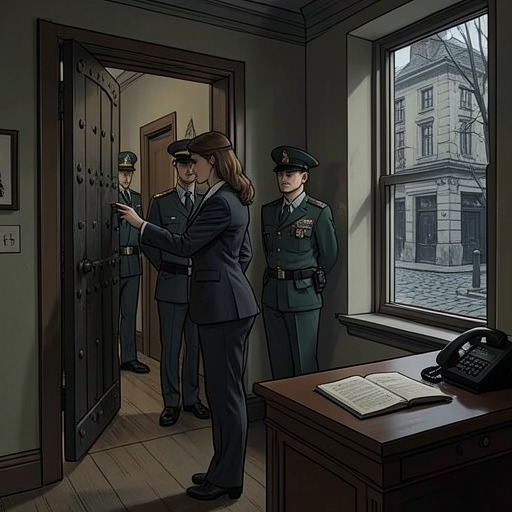
Blow OutNick Carter is a detective who serves as Jo Stuart’s deputy during the investigation into the poison-pellet attacks and the disappearance of Melissa Walsh. He is a hands-on colleague whose work ranges from briefing the team and pursuing leads to responding at scenes and supporting Jo through uncertainty. The evidence presents him as both a practical investigator and a trusted partner: he can challenge a direction, acknowledge when he has been out of line, and show personal concern when Jo is unreachable.
Identity and Position
When the investigation is assigned to Jo, Helen Gates names Detective Sergeant Carter as her deputy and places them with Syndicate One at Nexus House, the home of the major incident and serious crime units. The arrangement gives Carter a central operational role in a case considered potentially significant beyond the local force. It also places him alongside Jo as the inquiry navigates stretched police resources and pressure to prevent a wider gang conflict.
Carter’s presence in the investigation room is active rather than ceremonial. When Jo arrives, he waves her over immediately; later, confronted with a list of names, he drops the folder onto a desk and calls the task a needle in a haystack. The moment conveys the scale of the work without making the frustration an excuse to abandon it: the team must turn a mass of possible identities into useful leads.
Investigative Work and Judgment
Carter contributes to the early investigation of Ronnie O’Neill’s death, being asked to tell Detective Constable Whittle what is known about O’Neill. The medical uncertainty around the toxin limits what investigators can conclude about the precise course of the poisoning. The consultant’s assessment is nevertheless stark: whoever administered it likely intended not only to kill O’Neill but to prolong his suffering. Carter’s role in briefing the team places him at the point where evidence and specialist interpretation must be made usable for the inquiry.
As the case widens, Carter works through leads that connect suspects, vehicles, and crime scenes. When a burned-out van matching one of the suspect vehicles is found on waste ground in Wythenshawe, the initial report offers no sign of Melissa or her captors. Investigators are looking for CCTV that might show a vehicle change, while forensic work attempts to identify the van; the working assessment is that it was probably stolen for the abduction. Carter is part of the investigative team dealing with this dead end, where the absence of an immediate breakthrough sharpens the need to follow indirect evidence.
A later discussion shows Carter making a direct connection between Darren Clements and a car fraudulently obtained by Clements. Carter argues that Clements is the likely suspect, while allowing for the possibility that the car might have been sold to someone else. His reasoning rests on the convergence of motive and a vehicle seen near several crime scenes, not on certainty alone. That qualification matters: Carter advances a strong investigative inference while recognizing that the evidence still admits an alternative.
The firearms evidence further refines the inquiry. After Heather Rand is given the all-clear, although kept in hospital for a few days as a precaution, Carter relays the forensic assessment: the recovered pellets show no rifling marks or gunpowder residue, and the noise expected from a suppressed powder-fired rifle would have been more apparent. The experts therefore favor either a standard air rifle or a target air pistol. Carter’s report captures the case’s movement from an initial possibility toward a narrower, evidence-led understanding of the weapon.
Partnership with Jo Stuart
The professional partnership is formally established when Gates appoints Carter deputy to Jo, but its texture emerges through their repeated exchanges. Carter is attentive to Jo’s arrival and asks what she will be doing, keeping close to the decisions that organize the work. When a disagreement threatens to consume time, Jo ends the argument and says she will contact the Anti-Kidnap and Extortion Unit. The scene shows the practical rhythm of their collaboration: debate gives way to action when the case demands it.
Carter’s conduct is not always faultless. After an earlier incident involving Detective Constable Whittle, he comes to Jo and apologizes, saying he does not know what came over him. The apology acknowledges that his behavior has fallen short without shifting blame onto Jo or Whittle. In a pressured workplace, this willingness to return and account for himself helps preserve the trust required of a deputy and close colleague.
His concern also becomes personal when Jo does not answer. On finally reaching her, Carter forgets that Whittle can hear and says he is grateful she is safe; he had begun to think she had come to harm. The unguarded response reveals how the professional bond has acquired an emotional dimension, while the presence of Whittle on the call makes that concern briefly visible to someone else.
Pressure, Consequences, and Narrative Role
Carter’s work unfolds inside a force under strain. Following the Manchester Arena bombing, detectives have been transferred to serious and organized crime and counter-terrorism work; Gates warns that the inquiry must be handled firmly but carefully, amid press attention and political pressure. She also fears a return to the violence associated with Gunchester. Carter’s role as deputy therefore belongs to a larger institutional problem: the investigation has national implications, but must be advanced with limited local capacity and without inflaming the conflict it is meant to contain.
The story repeatedly sets investigative urgency against procedural limits. Jo considers contacting the Anti-Kidnap and Extortion Unit rather than spending more time arguing, while a later assessment establishes that the circumstances do not meet the formal definition of an emergency because they do not substantially challenge the police’s ability to carry out their functions. Jo knows that contesting the determination would waste time. These pressures frame the work Carter shares with her: decisions are made not in an abstract space of unlimited resources, but amid constrained authority, practical deadlines, and uncertain evidence.
At the end of the pursuit, Carter reminds the people present that a pellet may be toxin-laced. Jo is haunted by Darren Clements’s expression just before his death and by the realization that he had been trying to escape when he turned toward the shouts. Carter’s reminder returns attention to the danger that remains even after the central confrontation. His narrative function is thus not limited to supplying investigative facts: as Jo’s deputy, he helps maintain the team’s focus on evidence and risk while serving as a steady point of human concern within an inquiry marked by pressure and loss.