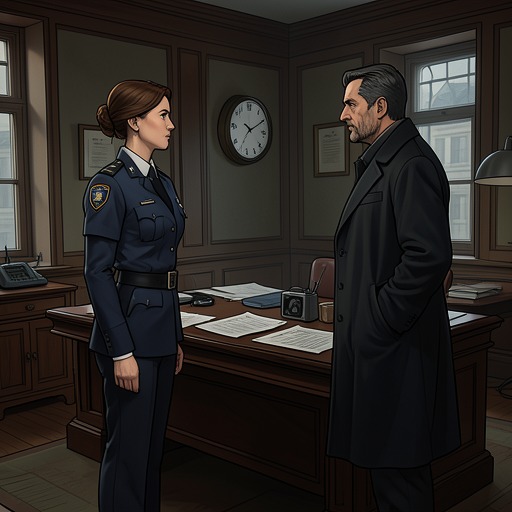
Police raid on Darren Clements’s home
Blow OutThe raid on Darren Clements’s home is a failed search that turns an apparent breakthrough into an urgent assessment of danger. Jo Stuart’s team finds the house empty, its contents rearranged and its surfaces cleaned; the evidence suggests Clements has prepared to disappear. The operation yields no suspect, but it changes the investigation’s priorities: Jo recognizes that Clements may now hasten his attacks, making the protection of his remaining possible targets as urgent as finding him.
Investigative context
The raid belongs to an investigation whose procedures and information-sharing have been carefully established. Jo consults a digest of the Murder Investigation Manual, including laminated checklists and diagrams, to make sure the team addresses the key elements of investigative strategy after the Fast Track menu. The manual turns procedure into a practical safeguard: missing a central step could jeopardize her work as the officer leading the review.
Jo also insists that the investigation operate as a shared effort. She asks for a crime-scene update to be displayed so the team can hear it together, explaining that every member should have equal access to information and that any person might notice the missing piece. She explicitly rejects prima donnas, including herself. This approach frames the raid not as an isolated act of force but as one step in a collective investigation, where decisions and observations are meant to be visible to the team.
The search takes place against a difficult evidential background. Jo has an exhaustive list of people who might hold a grudge against either of the victims, but no names appear on both lists. The investigation has partial boot prints and a piece of fabric from the Manchester crime scene, alongside hours of passive media to examine, principally from fixed-speed and ANPR cameras. These lines of inquiry are still being worked when the team moves against Clements’s address; the raid is an operational response under uncertainty, not the culmination of a complete identification of the suspect.
The operation and its result
Before the entry, the surveillance team has seen no movement for an hour. A plain-clothes female officer makes the initial approach, reflecting Jo’s hope of keeping the operation low-key in case the team has the wrong address. When there is no response and no sign of life, Jo authorizes the search team to go in.
The arrival makes clear how far the operation extends beyond that quiet first approach. A lead van, a Land Rover Defender, a sedan, Jo’s party, a marked Forensics van, a dog unit and an unmarked van form the convoy. The first and last vans block the road, while three officers in riot gear run up the drive. Four armed officers take positions in the yard, covering the windows; more armed officers, wearing respirators beneath their masks, enter after the door is forced. Nick Carter’s dry remark that this is no longer a softly, softly approach captures the contrast between the intended low profile and the forceful execution.
The house is empty, as is the yard. The firearms commander reports that Clements has apparently fled. The initial searches find no weapons, drugs or suspected substance, according to the dog handlers, and Jo reports the negative results to Helen Gates over the radio. She nevertheless prepares to send in a biohazard Forensics team. The choice preserves caution even after the dogs have found no trace of the substance: a negative initial search does not settle whether the premises are safe or what evidence may remain.
A house that has been cleared
The search leader’s senior CSI officer, Jack Benson, says the premises are safe to enter and, if pressed, that he would describe them as sanitized. Jo presses him for a professional opinion; he confirms that someone has sanitized the house. The conclusion is then borne out by the contrast with the team’s earlier visit. The surfaces have been dusted, the paperbacks once on the dining-room table have disappeared, the vinyl records have been placed in a wicker basket beside the turntable, and the kitchen looks professionally cleaned.
The changes are not limited to tidiness. Under the stairs, Jo sees that the bicycle and the black-and-red windcheater previously hanging on a hook are gone. She regrets not having photographed the upstairs, a concrete reminder that the investigative value of an earlier visit depends on what was recorded before the scene changed. In the loft study, Carly Whittle is standing by the desk holding two black power leads. The search therefore encounters not simply an empty property but a place whose objects and surfaces have been altered, making the absence of items as important as what remains.
The evidence of departure points to a practical problem. Clements could not have taken his laptop, printer, shoes, clothes and other necessities away on a bicycle. Jo directs the door-to-door team to seek all available CCTV, including dashcam footage, and to ask witnesses whether Clements had been seen driving or getting into any vehicle. If someone saw him, she wants the make and colour, the time, and a description of any other occupants. The sanitized house and missing bicycle thus lead directly to a broader search for his means of escape.
The threat beyond the house
Jo’s response shifts from tracking Clements’s departure to anticipating what he might do next. After briefing the search team, she suddenly thumps the steering wheel and admits that her determination to find him has made her take her eye off the ball. She reasons that if he has been systematically working through a list of people he blames, directly or indirectly, for his sister’s death, then other names may remain on it.
Nick argues that pressure may make Clements more visible and more likely to make mistakes. Jo does not treat that possibility as reassurance. The raid has spooked him, and she fears that he may speed up his mission before police can stop him. Her immediate priority becomes identifying and warning the remaining possible targets: their lives, she says, depend on it. The operation therefore produces a reversal in the investigation’s immediate objective. Finding the fugitive remains necessary, but preventing his next attack becomes the more pressing consequence of having driven him from the house.
Aftermath and significance
The raid’s result is not an arrest or a decisive physical clue. It establishes instead that Clements has had time to prepare the premises for departure, that the address contains no immediate trace of the suspected substance or weapons found by the dogs, and that his route away from the house must be reconstructed through witnesses and recordings. The apparent cleanliness of the property does not resolve the case; it sharpens the question of what has been removed and where Clements has gone.
The search also leads into formal accountability. Because a man later dies during a police operation, the Independent Police Complaints Commission is already involved when the first debriefing begins. An internal review and an agreed press release are also immediately required. Jo is haunted by Clements’s expression just before he died: she understands that he was trying to get away, and that his brief turn toward the shouts slowed him enough to bring him down. The raid is not itself that fatal encounter, but its failed search and forced change of focus belong to the chain of decisions that follows Clements’s flight. Its significance lies in that uneasy double result: police uncover a deliberate erasure of traces, yet their intervention also leaves Jo confronting the danger that the man they have driven out may act faster, and the consequences of the pursuit will later demand both personal reckoning and institutional scrutiny.