Central London Hatchery and Conditioning Center
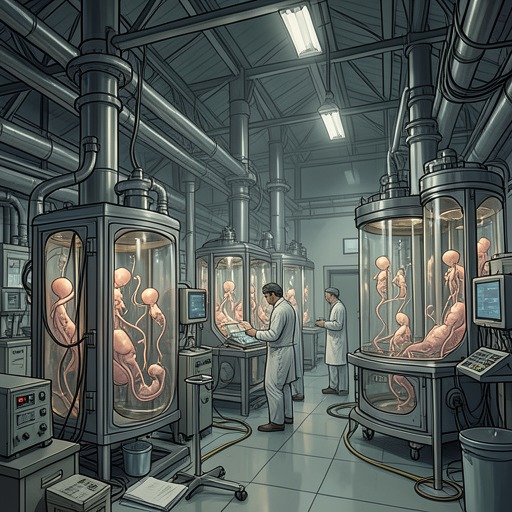
Brave New WorldThe Central London Hatchery and Conditioning Centre is the World State’s institutional machinery for making people and preparing them for assigned social roles. In its numbered incubators, work tables, and card-index rooms, human reproduction is managed as production; upstairs, infant nurseries carry that management into conditioning. Its defining significance lies in the continuity between the two: bodies are manufactured, classified, and directed within one administrative system.
Building and Setting
The Centre is introduced as a squat grey building of thirty-four stories. Above its main entrance, the institution’s name appears alongside the World State motto, “COMMUNITY, IDENTITY, STABILITY.” The motto makes the building more than a laboratory: it announces the political purpose that organizes its work, linking biological production to social order.
The ground-floor Fertilizing Room contrasts its tropical heat with a cold, north-facing light. Glass, nickel, and shining porcelain dominate the laboratory, while workers in white overalls handle instruments with pale rubber-gloved hands. The imagery gives the institution a carefully controlled, clinical appearance, in which the living material under examination is processed amid standardized equipment. A tour led by the Director of Hatcheries and Conditioning makes the building’s work legible to new students, whose notebooks record his explanations.
Reproduction as Industrial Process
In the incubator rooms, ova are kept at blood heat, while male gametes are stored at thirty-five rather than thirty-seven degrees, since full blood heat sterilizes them. The Director presents these details as routine technical knowledge. He also explains that the operation by which ovaries are removed is undertaken voluntarily for society’s benefit and carries a bonus of six months’ salary. The Centre’s reproductive system thus joins biological procedure to institutional incentives.
At the work tables, workers draw liquid from test-tubes drop by drop onto warmed microscope slides, inspect eggs for abnormalities, count them, and transfer them into porous receptacles. The eggs are immersed in a warm bouillon containing at least one hundred thousand spermatozoa per cubic centimetre. After ten minutes, the receptacles are lifted out and examined again; any eggs still unfertilized are immersed once more, if necessary repeatedly. Fertilized ova return to the incubators. Alphas and Betas remain there until they are bottled, whereas Gammas, Deltas, and Epsilons are brought out after thirty-six hours for Bokanovsky’s Process.
These stages show that the Centre does not treat successful fertilization as the end of its task. The process sorts embryos by caste and applies a different production route to the lower castes. Reproduction becomes a planned means of supplying society with people in predetermined categories, rather than an individual or familial event.
Bottling, Identification, and Social Assignment
In the Bottling Room, the work proceeds along an orderly production line. Bottle-liners insert and smooth down pieces of sow’s peritoneum, while the containers move onward to the Matriculators. Eggs are transferred from test-tubes into larger containers; the lining is slit, the morula placed inside, and saline solution poured in. Labellers then transfer heredity, fertilization date, and Bokanovsky Group membership from test-tube to bottle. The procession marks a change from anonymous biological material to identified units in a system of production.
The bottles pass through an opening into the Social Predestination Room, where an eighty-eight-cubic-metre card index holds relevant information, updated every morning and coordinated every afternoon. Its calculations determine how many individuals of each quality are required and establish the optimum decanting rate at any given moment. The Director describes unforeseen wastage as something to be promptly made good; one staff member recalls working overtime after the last Japanese earthquake. Even disaster enters the institution’s account as a disruption in supply to be corrected.
The Centre therefore links laboratory procedures to population planning. Embryos are not merely preserved and identified: their records feed calculations about social quantities and qualities. Its production line carries the bottle directly from biological handling into administrative prediction, making classification part of the process from the outset.
Infant Conditioning and Institutional Purpose
The Centre’s work continues above the production rooms. A notice identifies the fifth-floor department as “INFANT NURSERIES. NEO-PAVLOVIAN CONDITIONING ROOMS,” where the Director and his students arrive after leaving the Decanting Room. In a large, bright nursery, nurses in regulation white uniforms arrange bowls of roses in a row across the floor. The scene places infancy and conditioning within the same institution that fertilizes and bottles embryos.
The juxtaposition establishes the Centre’s broad function without reducing it to a single laboratory procedure. It oversees a sequence from controlled reproduction and caste classification to the early conditioning of children. The sterile precision of the production rooms and the ordered nursery belong to one continuous design: the World State’s population is prepared both biologically and socially, so that its members enter society already shaped for the roles planned for them.