Conditioning
Brave New WorldConditioning in the World State is not a single lesson but a continuous system for making people suited to their assigned places and willing to accept the limits those places impose. It joins reproductive planning, class instruction, emotional management, and restrictions on solitude into a social order that presents stability as both a collective necessity and an individual good.
Identity and Social Predestination
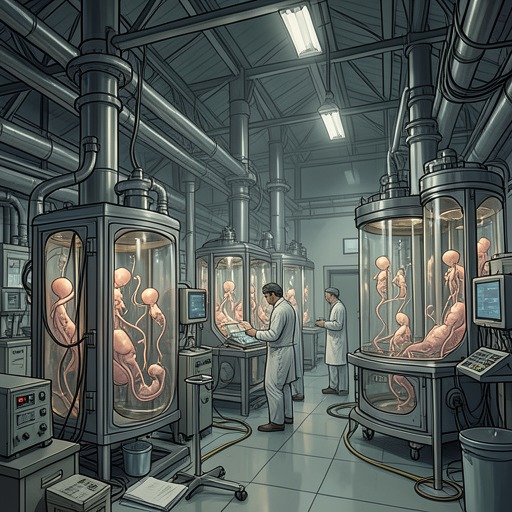
The process is visible before a child is born. At the Central London Hatchery and Conditioning Centre, eggs are transferred from test tubes to larger containers, where information such as heredity, fertilization date, and Bokanovsky Group is recorded on each bottle. The identified embryos then pass to the Social Predestination Room, where their details are organized and used to calculate how many individuals of particular qualities society will need.
The system links those calculations to production: Predestinators send their figures to the Fertilizers, who provide the requested embryos. The bottles are then predestined in detail before being sent to the Embryo Store. In this arrangement, social roles are not merely assigned after birth; population requirements shape the production and classification of future people in advance.
The Director describes conditioning as the accumulation of suggestions until they constitute a person’s mind, including the mind that judges, desires, and decides. Because those suggestions come from the State, what feels like private conviction is also the outcome of public instruction. His image of repeated suggestions adhering like sealing wax emphasizes that the process works through continual repetition rather than a single command.
Class Lessons and the Formation of Consent
A sleep-teaching lesson makes the class hierarchy sound like a child’s own preference. The recorded voice identifies clothing colors with caste, depicts Epsilons as incapable of reading or writing, and has a Beta child express relief at not having to work as hard as an Alpha. It also teaches contempt for lower-caste children. The hierarchy is therefore transmitted not only as information about social divisions but as an emotional ranking of them.
The Director explains that the lesson’s effect extends beyond childhood: suggestions become the basis on which adults judge and choose throughout their lives. Conditioning’s power lies partly in this conversion of imposed social standards into apparent common sense. People can experience the resulting distinctions as their own attitudes, even when those attitudes reproduce the State’s needs.
The Controller describes social stability as dependent on individual stability, and individual stability as necessary to keep society’s productive machinery running. His account makes the political purpose of conditioning explicit: people must be made steady and content enough to tend the system. In this logic, emotional ease is not incidental to social control; it is one of the conditions that sustains it.
Desire, Work, and Emotional Management
The Controller explains the regulation of desire through the image of water under pressure. Pierce a pipe once, he says, and the pressure produces a forceful jet; pierce it repeatedly, and the flow is dispersed into many lesser fountains. The analogy presents the prevention of intense attachment as a means of avoiding disruptive feeling. The novel’s account of emotional restraint likewise contrasts an unchecked current of passion with desire directed into channels that end in calm well-being.
The same principle appears in the reduction of the interval between desire and satisfaction. The text connects the embryo’s continuously turning blood-surrogate pump with the prompt feeding of a newly decanted infant, then identifies the time between wanting and getting as the place where feeling can arise. By shortening that interval, the social system seeks to prevent powerful emotions from developing. The Controller describes the result as lives made emotionally easy and, as far as possible, lives protected from having emotions at all.
Conditioning also makes prescribed work and leisure appear acceptable. Mustapha Mond argues that an Alpha would be distressed by Epsilon work, while an Epsilon’s conditioning makes the same work a path of least resistance rather than a sacrifice. He compares each person’s limitations to an invisible bottle: the boundaries differ by caste, but no one lives wholly outside them. Lower-caste workers, he says, accept seven and a half hours of mild labor followed by soma, games, unrestricted sex, and feelies. A four-hour workday imposed on Ireland produced unrest and increased soma consumption, he recounts, rather than happiness. Conditioning thus works alongside controlled schedules and rewards to shape what people want from their lives.
Solitude, Resistance, and Significance
Conditioning reaches beyond work and class into the conditions under which people understand themselves. Mustapha Mond says the State makes people hate solitude and arranges their lives so that being alone is nearly impossible. John contrasts his experiences in Malpais and London: in the pueblo he suffered because he was excluded from communal activity; in London he suffers because he cannot escape it. The contrast exposes how a system organized around social participation can make both exclusion and enforced belonging painful.
John’s attachment to Linda offers a different example of how early experience can complicate expected responses. Bernard records that John refuses soma, is distressed by Linda’s permanent holiday, and continues to visit her despite her age and appearance. He treats this attachment as evidence that early conditioning can modify, and even oppose, an expected impulse to recoil. The episode shows that conditioning can produce habits and loyalties that do not neatly serve the society in which they are later judged.
As a concept, conditioning explains how the World State joins biological planning to the making of consent. It assigns limits before birth, teaches people to repeat caste judgments, manages the development of emotion, and directs the use of leisure and pleasure. Yet the experiences of John and Linda also reveal that social shaping does not guarantee that every attachment or response will align with the order that designed it.