Consumerism
Brave New WorldConsumerism in the World State is not merely a preference for possessions but an economic and political program that shapes what people want, how they spend their time, and how society remains stable. The system suppresses desires judged unproductive, redirects behavior toward purchases and organized recreation, and treats both labor and leisure as instruments for keeping production in motion.
Economic Design and Social Predestination
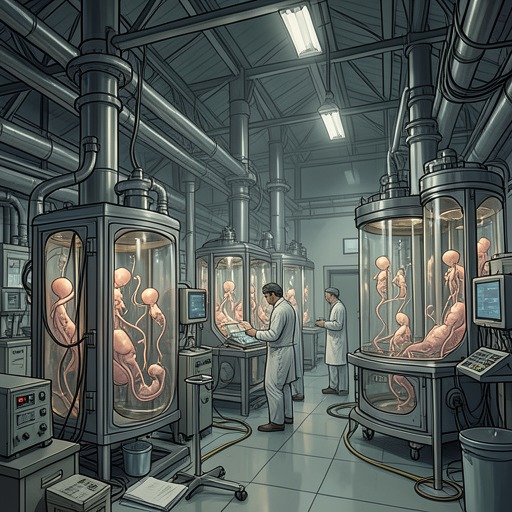
Consumerism begins in the design of the population itself. In the Central London Hatchery and Conditioning Centre, workers transfer each embryo’s heredity, fertilization date, and Bokanovsky Group membership onto its bottle. An eighty-eight-cubic-metre card index is updated daily and coordinated with production calculations: predestinators send figures to the Fertilizers, who supply the requested embryos, while planning determines the quantities and qualities of people needed and the optimum rate of decanting. The arrangement links human production to anticipated economic demand, with unforeseen losses promptly replaced.
This planning makes consumption a requirement of the system rather than an accidental result of personal preference. The state wants people to travel and buy, but it also decides which attractions are useful. The outcome is a population trained to participate in markets and industries on terms set in advance.
Conditioning Desire Toward Spending
The conditioning of lower-caste children illustrates how consumer demand is manufactured. The Director explains that earlier generations were taught to enjoy flowers and the countryside, encouraging trips that consumed transport but generated little further business. Because primroses and landscapes cost nothing and keep no factories working, the state abolished lower-caste love of nature while retaining the desire to travel. Children were instead conditioned to dislike the country and to enjoy country sports that required elaborate equipment. Electric shocks thus support a policy that converts recreation into sales of manufactured goods as well as transport use.
The same economic logic governs games. Watching children play Centrifugal Bumble-puppy, the Director contrasts its specialized apparatus with older games played using only a ball, sticks, or netting. Controllers will approve a new game only if it requires at least as much equipment as the most complicated existing games. Innovation is welcome when it enlarges consumption; a pastime that provides pleasure without requiring purchases is treated as economically irrational.
The lesson is reinforced through repeated messages and ordinary habits. A recorded class-consciousness lesson teaches children to associate caste identities with clothing and supposedly innate abilities, while the Director describes state suggestions as becoming the child’s mind and continuing to shape adult judgment and desire. Elsewhere, the maxim against repairing old clothes presents replacement as normal. Together, conditioning and slogans make consumption feel less like an imposed economic policy than common sense.
Stability, Work, and Managed Leisure
The Controller presents social stability as dependent on steady individuals and continuously turning economic wheels. In his account, industrial society needs obedient workers whose contentment is reliable; intense feeling and interrupted desire threaten that smooth operation. The state therefore seeks to shorten the interval between desire and satisfaction, limiting the frustrations that might become passion or unrest. Consumer satisfaction belongs to this larger management of emotion: people are kept comfortable while their habits sustain the system.
Consumption is also imposed directly. The Controller cites the conscription of consumption, under which every man, woman, and child must consume a prescribed amount each year in the interests of industry. This is not simply encouragement to shop. It is an obligation folded into the organization of government, with economic demand treated as a condition of social order.
Managed leisure extends the same policy beyond work. A typical evening for Lenina Crowne and Henry Foster includes a meal, soma with coffee, and a visit to the Westminster Abbey Cabaret, where synthetic music and a crowded dance floor offer standardized entertainment. Their leisure is abundant, but it remains organized around commodities, drugs, and commercially produced stimulation. The arrangement shows how the system connects work, emotional relief, recreation, and repeated consumption rather than allowing free time to become an independent sphere.
Welfare as Economic Control
Mustapha Mond argues that reducing lower-caste working hours would not necessarily make workers happier. He points to an experiment in which all of Ireland received a four-hour workday: the additional leisure brought unrest and increased soma consumption, rather than contentment. The state, he says, could technically reduce working hours, but it avoids doing so because excessive leisure would be cruel to workers as the authorities understand them.
The same reasoning shapes production. The state could synthesize all its food, yet keeps a third of the population working the land because agricultural production takes longer than factory production. It also restrains the application of labor-saving inventions and treats scientific discovery as a potential threat to stability. These choices reveal that the system does not pursue maximum efficiency or abundance in isolation. It preserves forms of work and consumption that keep people occupied, economically integrated, and governable.
Significance
Consumerism in the World State joins economic planning to the formation of desire. Statistical allocation determines the population required; conditioning directs that population toward transport, equipment, and replacement purchases; compulsory consumption secures industrial demand; and entertainment and soma help make the resulting routine acceptable. The system’s power lies partly in how thoroughly its rules are internalized: people learn to experience economically useful habits as natural preferences and ordinary happiness.
The novel’s examples also expose the limits of describing this order as simple prosperity. Its apparent abundance depends on engineered wants, restricted choices, and the deliberate preservation of labor and consumption patterns in the name of stability. Happiness is offered, but it is organized so that private satisfaction continually feeds the collective machinery.