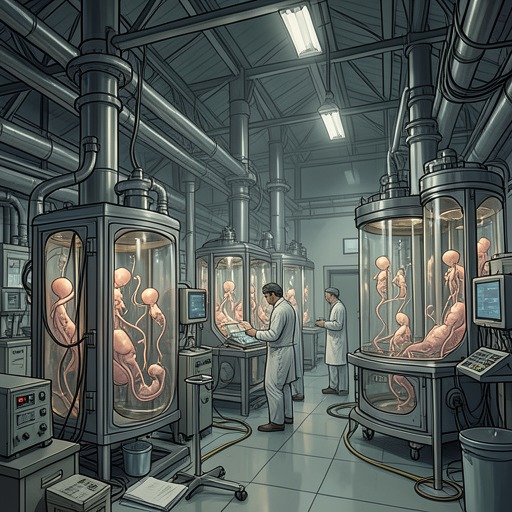
Delta babies' electric-shock conditioning against books and flowers
Brave New WorldDelta babies' electric-shock conditioning against books and flowers is a demonstration of how the World State manufactures aversion through controlled association. The Director first invites the infants toward attractive books and flowers, then subjects them to alarms and electric shocks; when the objects return, the babies shrink away. His lesson turns a temporary response into a program for lifelong reflexes, exposing social conditioning as an engineered alternative to spontaneous preference.
The demonstration
The Director orders the infants turned toward books and flowers. At first, they crawl toward the objects, reaching for the roses and the bright pictures on the pages. The scene establishes the very attraction the experiment intends to extinguish: the babies respond to the books and flowers with pleasure before anyone has taught them to fear them.
Once all the infants are occupied, the Director signals the Head Nurse to activate the apparatus. A sudden explosion, a shrill siren, and ringing alarm bells interrupt the children's approach. The Director then announces that the lesson will be reinforced with a mild electric shock, and the nurse presses a second lever. The experiment deliberately joins the desirable objects to frightening stimuli, converting the children's initial interest into a conditioned association.
After the alarms stop and the babies have settled, the Director orders the nurses to offer the flowers and books again. The infants now shrink away at the sight of them, and their howling grows louder. That reversal is the demonstration's immediate result: the objects have not changed, but the babies' response has. The Director presents their fear as proof that the association has taken hold.
Repetition and lasting aversion
The Director describes the response as an early link between books and loud noises, and between flowers and electric shocks. He says that repeating the same or a similar lesson two hundred times will make those connections indissoluble. The number gives the policy its methodical scale: the first demonstration produces recoil, while repetition is intended to turn that recoil into an enduring reflex.
He predicts that the children will grow up with an instinctive hatred of books and flowers and will remain protected from both books and botany. In this account, the purpose of conditioning is not simply to teach the infants how to behave in a particular moment. It is to make certain attractions difficult or impossible for them to experience at all. The Director's confidence in the result presents manufactured response as something that can overrule what he calls nature.
Social purpose and unresolved question
The exchange afterward makes clear that this training is tied to caste policy. A student can understand why lower-caste people should not spend the Community's time reading books, and why reading might unsettle their conditioned reflexes. The Director's lesson thus makes aversion to books part of a broader effort to restrict the habits and interests of the lower castes.
The student does not find the same explanation sufficient for flowers. His question draws attention to a distinction the demonstration itself leaves exposed: books may be feared because they could lead to reading and changed thought, but the reason to suppress the pleasure of flowers is less evident to him. The Director's method is presented with technical certainty, yet the student's incomprehension shows that the purpose of conditioning is not self-explanatory even to its observers.
Significance
The sequence moves from attraction, through imposed fear, to demonstrated avoidance. Its structure makes the flowers and books more than passive props: their return tests whether the children's responses have been altered, and their unchanged appearance throws the engineered change in the infants into relief. What looks like a spontaneous dislike has been produced by a controlled lesson and is meant to survive long after the apparatus is out of sight.
The demonstration also sets the World State's social priorities against the infants' initial curiosity. Instead of educating them to read or enjoy the natural world, the Director seeks to prevent those interests from taking root. The procedure makes social control intimate: the state does not merely forbid certain choices but aims to shape the reflexes from which choice might begin. Its promised success is therefore measured by the absence of desire, not by the children's understanding of why the objects should be avoided.