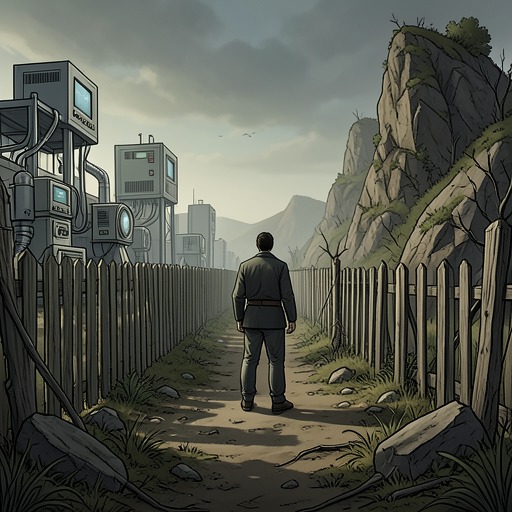
Family and motherhood as taboo
Brave New WorldFamily and motherhood as taboo is a defining feature of the World State’s social order. Natural birth and parental bonds are recast as embarrassing historical facts, while artificial reproduction, class production, and lessons repeated from childhood present the state as the proper source of identity and belonging.
Historical Shame and Natural Birth
When the Director asks students what a parent is, their silence and embarrassment reveal how thoroughly the old vocabulary has become taboo. One student can only explain that human beings used to be viviparous; the Director supplies the terms father and mother, treating them as unpleasant but necessary historical knowledge. The students’ discomfort turns ordinary kinship into something resembling obscenity, while the Director’s lesson frames the family as a feature of a superseded reproductive system.
The contrast is reinforced by the World State’s actual means of reproduction. Embryos are developed in bottles, and the Bokanovsky process can multiply a single egg into as many as ninety-six embryos. The Director presents this mass production as an instrument of social stability: standardized batches can supply workers for an entire factory. What the old order assigned to parents and households, the new order assigns to laboratories and planned populations.
Reproduction as State Production
The technical account of embryo development makes the displacement of motherhood concrete. Artificial circulation and other interventions sustain the bottled embryo, while movement is introduced through scheduled shaking to prepare it for the shock of decanting. Sex is tested and recorded; most female embryos are made sterile, with only a controlled proportion allowed to develop normally. Reproduction is therefore not simply detached from the family: it is divided into procedures that regulate population, fertility, and future social roles.
The Director’s historical lesson also describes children once being raised by their parents rather than in State Conditioning Centres. That comparison identifies the institutional consequence of abolishing family life: care and education move from private kinship into state-administered settings. The taboo helps make that transfer seem not like a loss, but like progress away from an allegedly irrational and unstable past.
Conditioning Belonging
In the nurseries, recorded lessons teach children to rank themselves and others by caste. A child’s voice declares pride in being a Beta, contrasts Betas with Alphas, and disparages Gammas, Deltas, and Epsilons through their assigned clothing and abilities. The lesson makes social identity feel intimate and self-evident even as it is organized by the state. In place of the family as a child’s first community, the World State installs a hierarchy learned through repetition.
The Director describes these repeated suggestions as accumulating until they become the child’s mind, shaping the adult’s judgments and desires as well. Their authority comes from being absorbed early and continually, not from open argument. In this way, the state does more than replace parents as caregivers: it claims the power to form the attachments and assumptions through which a person understands belonging.
From Exclusive Bonds to Universal Availability
The taboo extends beyond parenthood to the exclusive relationships associated with family life. Mustapha Mond names husbands, wives, lovers, monogamy, and romance as features of the old social order, describing exclusiveness as a narrow channeling of impulse and energy. Against that model, he invokes the hypnopaedic maxim that everyone belongs to everyone else. Students accept the principle after repeated lessons, while Lenina’s concern that she has been seeing Henry for only about four months shows how the norm enters ordinary personal conversation.
The prohibition on family thus belongs to a broader design: private, lasting bonds are treated as threats to a society organized around stability and managed desire. The World State replaces kinship with collective belonging, but that belonging is itself engineered, taught, and bounded by caste. Its promise of social order rests on suppressing the distinct claims that parents, children, and exclusive partners might make upon one another.
The Cost of the Taboo
Mustapha Mond’s account of the old home exposes the emotional intensity the new order seeks to exclude. He describes family life as crowded with powerful attachments, and the students react with discomfort to the image of a mother’s devotion to her child. The episode presents those bonds not as neutral private arrangements but as forces the World State regards as dangerous because they concentrate feeling and loyalty outside its institutions.
The resulting contrast is central to the society’s logic. Standardized embryos, controlled fertility, caste conditioning, and slogans of universal availability all weaken the possibility that identity should originate in a particular family or be shaped by exclusive obligations. The taboo makes that replacement legible as civilized order, while its persistent discomfort around the words father and mother betrays the human history the system must keep at a distance.