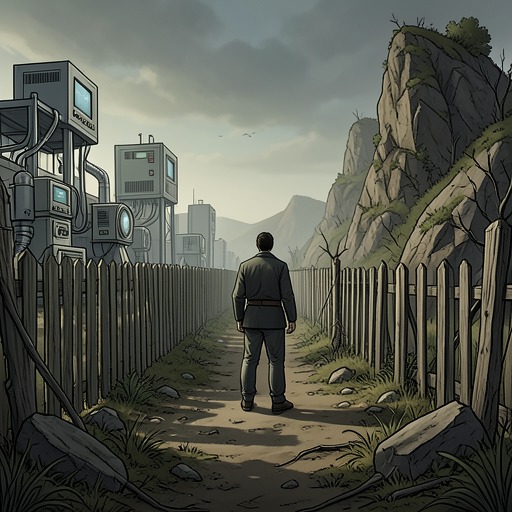
Isolation of the Savage Reservation from the World State
Brave New WorldThe Isolation of the Savage Reservation from the World State is a physical barrier and a political arrangement: a high-voltage fence confines the Reservation’s inhabitants, while official policy leaves them cut off from communication with the society beyond it. The boundary is presented to visitors as an absolute defense against escape, but its scale and the history behind it also reveal how the World State’s stability was built through coercion, social engineering, and the selective suppression of alternatives.
The boundary and its enforcement
The Reservation covers 560,000 square kilometres divided into four Sub-Reservations, according to the Warden, and more than 5,000 kilometres of fencing surround it. The wire carries 60,000 volts, supplied by current from the Grand Canyon hydro-electric station. The Warden makes the consequence plain: touching the fence means instant death, and, in his formulation, there is no escape from the Reservation. Those born inside it are destined to die there.
The aerial approach makes this infrastructure visible as more than a line on a map. As Bernard and Lenina cross the frontier by plane, the fence runs over deserts, through forests and canyons, and across peaks and mesas. Its straight, geometric course is described as a sign of human purpose, but the remains below complicate that triumphal image: bones and unrotted carcasses mark where deer, cattle, predators, and even scavenging birds have come too close to the wires. The pilot treats the dead animals as a joke about their failure to learn; the fence, however, makes the cost of the boundary unmistakable.
A society kept apart
The Warden describes roughly 60,000 Indigenous people and people of mixed ancestry living within the Reservation. He says inspectors visit occasionally, but that otherwise there is no communication with the civilized world. His account catalogues marriage and family life, the absence of conditioning, religious practices, extinct languages including Zuni, Spanish, and Athapascan, and local animals and diseases. The details establish that the separation is not simply geographical: the World State presents the Reservation as a sealed social and cultural order, while its own official voice reduces that order to a catalogue of repulsive customs and hazards.
The visit itself shows how visitors experience this distance. Lenina takes soma while the Warden speaks, sitting with an appearance of attention while serenely not listening; Bernard grows impatient as the Warden’s lecture delays their departure. When the Warden repeats that there is no escape, Bernard half rises as if to leave, but the permit still needs the Warden’s countersignature. Even at the threshold, the World State’s representatives are subject to the authority that administers the barrier.
The history of managed stability
The Reservation’s isolation belongs to a wider history of crisis and political consolidation. Mustapha Mond dates the Nine Years’ War to A.F. 141 and connects it with the Great Economic Collapse. He describes the ensuing choice as one between World Control and destruction, between stability and its alternative. The war and collapse are not merely distant background: they provide the stated justification for making social order the overriding political aim.
Mond also describes a change in method. In the end, the Controllers recognized that force was ineffective and turned to ectogenesis, Neo-Pavlovian conditioning, and hypnopaedia. The movement from direct coercion to the slower work of conditioning and reproduction management helps explain the larger system surrounding the Reservation: the World State does not rely on a fence alone to secure its order. The fence controls movement at the boundary; conditioning and engineered reproduction organize life within the society it protects.
The official lesson that history is bunk sharpens the contradiction. Mond invokes Ford’s saying while gesturing away ancient civilizations, religious traditions, and works of art as if they were dust. Yet he himself narrates the wars and political decisions that made the present order. The account of the Reservation’s isolation thus depends on a history that the regime’s slogan tells its citizens to dismiss.
Separation as policy and warning
Mond explains that mass production required a shift away from truth and beauty toward comfort and happiness: universal happiness, he says, keeps the wheels turning, whereas truth and beauty do not. In his account, unrestricted scientific research began to be controlled after the Nine Years’ War, when people accepted the management of their appetites in exchange for a quiet life. Science has helped produce stability, he argues, but is consequently restricted from pursuing questions that could unsettle it.
The Reservation’s boundary gives this political bargain a stark physical form. Its inhabitants are held in place by lethal infrastructure and treated as evidence of a life the World State claims to have surpassed; visitors, meanwhile, cross into that space under official permits and a guide’s supervision. The arrangement exposes the cost hidden inside the regime’s language of universal happiness: a stable society is maintained not only through comfort and conditioning, but also through enforced separation and the denial of free movement.