John
Brave New WorldJohn is the son of Linda and the Director, but his life places him on the margins of both the Reservation and the World State. He experiences love, rejection, and bereavement through relationships and rituals the World State has made taboo or obsolete, while its system of mass-produced, conditioned people appears to him as a dehumanizing alternative. The novel’s central opposition between engineered stability and individual freedom takes personal form in John: he seeks a life with pain, responsibility, and meaning, even when that choice leaves him isolated and unable to reconcile his ideals with the world around him.
Identity and Formation
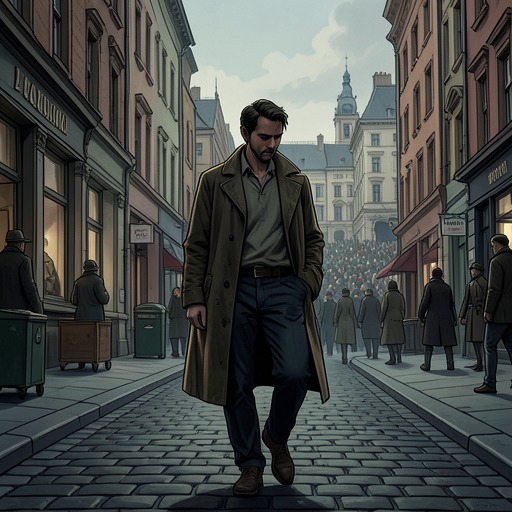
John grows up on the Reservation, where his social position is marked by exclusion. At sixteen, he watches Kiakime’s marriage ceremony and is devastated by the recognition that his love for her can no longer lead to a shared future. Old Mitsima’s declaration that the marriage is finished repeats in his mind; his loss is not simply romantic disappointment but one more occasion on which he is left outside the life he wants to enter.
His exclusion becomes unmistakable when the boys descend into the Antelope Kiva for the passage into manhood. A man pulls John from the group, and the others reject him because of his white hair and his parentage. Driven away, John is left alone while the ceremony continues without him. The memory links solitude with the possibility of death: in the narrative’s account of that night, he recognizes Time, Death, and God. The episode establishes a lasting pattern: the community’s refusal to admit him makes his difference a lived condition, not an identity he has chosen.
The World State and Its Human Product
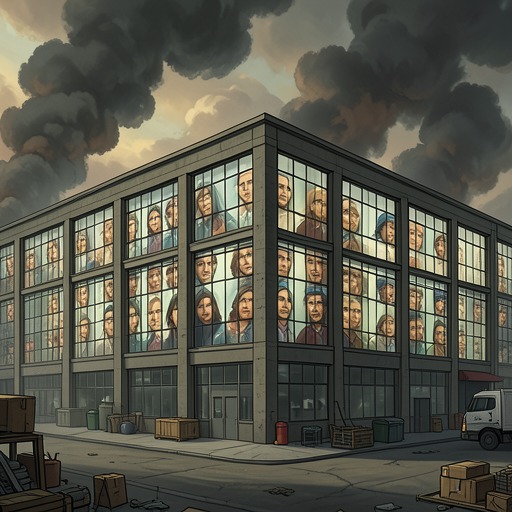
The World State’s methods make the contrast with John’s life concrete. Bokanovsky’s Process takes one fertilized egg and makes it divide into as many as ninety-six buds, each developing into an adult; seventy-two identical individuals is described as a good average. The Director presents the process as a major instrument of social stability because it produces standard people in uniform batches, even a small factory’s workforce from a single egg. What the state calls progress is therefore also the deliberate reduction of human difference to a tool of planned production.
That production is supported by extensive manipulation before birth. Embryos are moved through artificial systems of nourishment and circulation, shaken in preparation for movement, and sex-labelled; many female embryos are made sterile through hormone treatment. The process does not end at the bottle: the World State also predestines and conditions people for their assigned social roles. Against this system, John’s question to Mustapha Mond is pointed: if people can be obtained from bottles, why not make everyone an Alpha Double Plus? Mond answers that a society made entirely of Alphas would be unstable and miserable. His reply confirms the governing logic John objects to: the state allocates human capacities and limitations in the name of collective order.
Family, Recognition, and Belonging
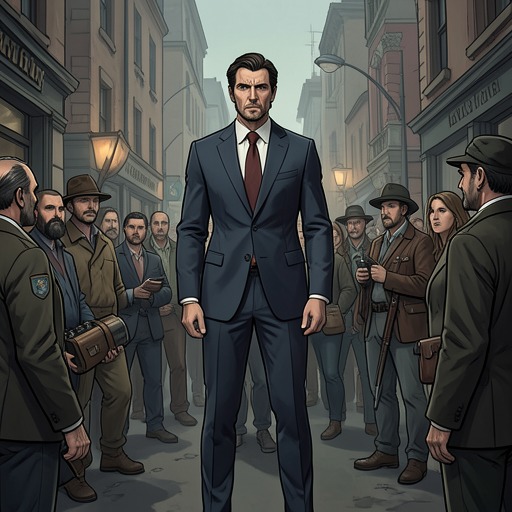
John’s parentage becomes public in a scene that exposes the gulf between his history and the World State’s conventions. Linda identifies the Director as Tomakin and speaks of having borne a child; John enters, kneels before him, and calls him his father. The revelation forces the Director’s private past into public view. The crowd responds with laughter, turning the word “father” into a spectacle and the family relationship into an embarrassment. For John, however, the word names a relationship that has shaped his life even though the World State regards parenthood as indecent.
His connection to Linda also carries the weight of a life formed across two incompatible social worlds. She is his mother, a fact he does not treat as an abstraction: when the World State’s practices and people become unbearable, he remembers the rows of identical twins, the crowds around Linda’s deathbed, and the repeatedly appearing faces of those who have attacked him. These images connect the state’s mass sameness to his personal grief. The same society that rejects the meanings of kinship has become the setting in which he loses Linda.
Revolt Against Manufactured Happiness
John’s moral conflict reaches its clearest statement in his exchange with Mustapha Mond. Mond describes the Violent Passion Surrogate, a monthly treatment that supplies the bodily effects of fear and rage without their attendant dangers. John rejects the exchange of genuine experience for a controlled substitute. He says that he wants God, poetry, real danger, freedom, goodness, and sin; Mond identifies the implication as a claim to the right to be unhappy. John accepts that description and insists on the right, including the painful conditions Mond lists: aging, illness, hunger, uncertainty, and suffering.
The declaration is not a request for suffering as an end in itself so much as a refusal to let comfort define the limits of human life. John’s objection is directed at a system that equates a managed emotional state with happiness and removes the risks through which experience acquires consequence. His position also exposes the cost of his own ideal: he chooses a demanding freedom, but it does not offer him a community in which that freedom can easily be lived.
Reversal and Narrative Significance
John’s invocation of “O brave new world” changes in meaning as he watches the society around him. At first, the words carry the possibility of transforming even a nightmare into something fine and noble; they become a call to action rather than merely a phrase of hope. Yet the novel places that aspiration beside John’s memories of the World State’s identical crowds and his revulsion at the Bokanovsky Groups. The discrepancy between ideal and reality gives the phrase its force: wonder does not disappear, but it is forced to confront the human costs of the society it names.
That tension continues after the crowd’s frenzy at the lighthouse. When the last helicopters leave after midnight, John is asleep, stupefied by soma and exhausted. He wakes in daylight, remembers what has happened, and covers his eyes. The episode shows that his insistence on moral independence has not kept him outside the society’s collective pressures. His position remains tragic in the specific sense that the desire for a life governed by conscience and difficulty meets a social order that absorbs even resistance into spectacle; the aftermath offers neither simple victory nor reconciliation.