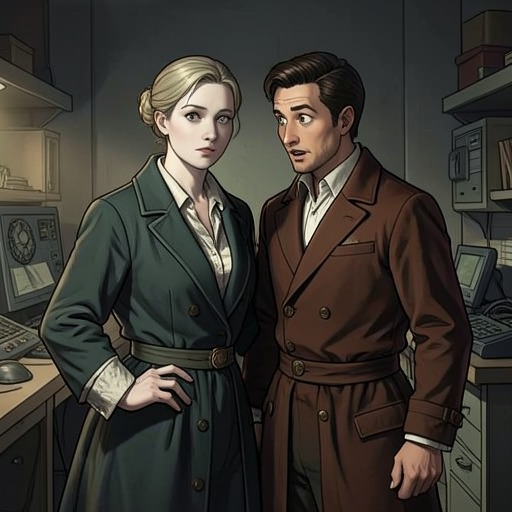
John and Lenina’s Meeting and Mutual Attraction
Brave New WorldJohn and Lenina’s meeting in Malpais brings attraction into view before either can understand the other’s world. He approaches them dressed as an Indian young man, yet marked by pale eyes, fair hair, and bronzed white skin; she first meets his grief at a distance, then looks at him with benevolent interest. Their brief exchange turns on a decisive difference: John wants to share a painful rite for his community, while Lenina’s reflex is to wish for soma. The mutual attraction begins not in agreement but in the surprise of seeing and being seen across that divide.
The Encounter in Malpais
John steps onto the terrace in Indian dress, with plaited straw-colored hair, pale-blue eyes, and bronzed white skin. He addresses Bernard and Lenina in faultless but peculiar English, asking whether they come from the Other Place beyond the Reservation. The question identifies him as someone who has grown up between places: he belongs to Malpais by birth and experience, yet recognizes the visitors as representatives of a world beyond it.
His attention is initially fixed on the bloodstains left in the square. He calls the person associated with them an unhappy man and says he should have been there too, wishing he could have taken part in the sacrifice. Lenina remains apart with her face in her hands, and answers mechanically that a gramme is better than a damn and that she wishes she had her soma. The exchange sets their responses side by side: his involvement in the pueblo’s rite and her learned recourse to a drug that promises relief.
Ritual, Exclusion, and the First Shift
John explains that he wanted to endure the ordeal for the sake of the pueblo, to help bring rain and a good corn crop, and to please Pookong and Jesus. He also wanted to prove that he could bear pain without crying out and thereby show that he was a man. His account makes the rite more than an abstract custom: it joins communal hopes, religious observance, personal endurance, and a test of adult standing.
He was not allowed to participate. The people of Malpais disliked him because of his complexion, he says, and this exclusion is presented as a recurring experience rather than a single slight. His grief and shame are visible in his faltering voice and his turning away. Yet the account of exclusion also changes the encounter. Astonishment makes Lenina uncover her face and look directly at him; she asks whether he really wanted to be struck with the whip. Her attention has shifted from withdrawal to curiosity, though she is still trying to make sense of a motive at odds with the habits of her own society.
Mutual Attraction and Unequal Expectations
As John confirms that he wanted to take part, his voice gains resonance and he squares his shoulders with defiant pride. Then he notices Lenina’s face for the first time. Her cheeks and permanently waved auburn hair are unlike those of the girls he knows in Malpais, and her expression is one of benevolent interest. The scene’s attraction begins through an abrupt reversal: while he has been speaking about the community that rejects him, Lenina’s attention makes him newly conscious of an individual who appears welcoming.
Lenina thinks that John is nice-looking and has a beautiful body. John, overwhelmed by her smile, drops his eyes and can only look at her briefly before turning away and pretending to inspect something across the square. His desire to see her smile draws him toward her, but makes direct attention difficult. The attraction is therefore mutual without being expressed as a shared understanding: Lenina’s interest is an immediate response to his appearance, while John’s embarrassment is bound up with the unfamiliar warmth of her regard.
The Divide Beneath the Attraction
The encounter leaves the two characters facing one another across different systems of value. John describes pain as something he hoped to endure for the pueblo, for religious purposes, and to establish his adulthood; Lenina’s first response invokes soma as relief. Her question shows that she has noticed the difference, but the passage does not show her adopting his beliefs or him translating them into her social language.
Their first attraction thus carries the shape of a cultural encounter rather than a simple romantic recognition. John’s mixed appearance and his upbringing in Malpais distinguish him from both the local community that excludes him and the visitors from the Other Place. Lenina’s smile offers a brief exception to his familiar rejection, while his account of that rejection reveals how much separates them even in the moment of approach. The scene establishes attraction as real, but leaves its future meaning unsettled.