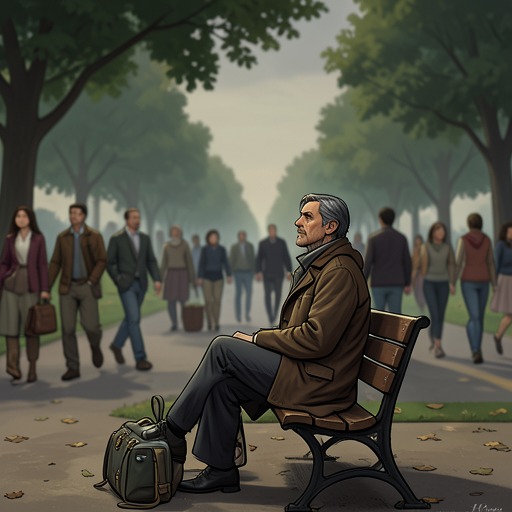
John's self-punishment at the lighthouse is discovered by the media
Brave New WorldJohn's self-punishment at the lighthouse is discovered by the media, turning a refuge chosen for solitude into a spectacle for the society he sought to escape. His penance begins as a private effort to become pure and make amends, but the appearance of reporters converts his self-discipline into news and draws further attention to the lighthouse.
Choosing a Hermitage
The event takes place amid a changing aerial landscape. Following serious accidents where two flight routes ran close together, the upline was diverted west; the old Portsmouth-to-London road was marked by four abandoned air-lighthouses between Grayshott and Tongham. John chose a different abandoned lighthouse, on the hill between Puttenham and Elstead, as his hermitage. Helicopters now hummed over other places, while the sky above the disused route was silent and deserted.
The lighthouse was made of ferro-concrete and remained in excellent condition. Its comfort troubled John: he regarded it as too luxurious for a place of penance. To quiet his conscience, he promised himself stricter discipline and more complete purification. The retreat was therefore not simply an escape from other people. John made it a setting in which he could test himself through deliberate hardship.
Private Penance
On his first night there, John deliberately stayed awake. He prayed in several religious traditions, addressing the Christian God, Awonawilona, Jesus, Pookong, and his guardian eagle. At intervals he stretched out his arms as if on a cross and held them there, repeating a plea for forgiveness, purity, and help in becoming good. The vigil made physical endurance part of his attempt to atone, while the varied objects of his prayer reflected the different religious worlds he carried with him.
John’s later self-punishment continues that resolve. Three Delta-Minus landworkers from a Puttenham Bokanovsky Group, driving toward Elstead, saw him outside the lighthouse, stripped to the waist and striking himself with a knotted-cord whip. They watched him count the strokes. After the eighth, he stopped to be sick, then resumed. The witnesses interpreted what they saw through their own culture, whispering “Ford!” and calling out “Fordey!” Their response makes the gap between John’s penitential purpose and the World State’s assumptions immediately visible.
Reporters at the Lighthouse
Three days after the landworkers’ discovery, reporters arrived. The first, a representative of The Hourly Radio, approached John while he was making arrows from hazel sticks. He asked for an explanation of John’s departure from London, the whip, and his views on civilization, preparing a microphone and transmitter built into his aluminum hat. The reporter’s apparatus and practiced questions carried the machinery of mass publicity directly into the private refuge.
John answered with a brief phrase in Zuni and then kicked the reporter. Eight minutes later, a new edition of The Hourly Radio announced the assault in a headline identifying a “MYSTERY SAVAGE” and reporting a “SENSATION IN SURREY.” The reporter returned to his work with a painful bruise, but the incident had already been made into news. John’s refusal to explain himself did not keep the public away; it gave the papers a sensational account in place of the account he had withheld.
Four more reporters arrived that afternoon, representing the New York Times, the Frankfurt Four-Dimensional Continuum, The Fordian Science Monitor, and The Delta Mirror. Their receptions grew more violent. One called John a fool and asked why he did not take soma; John ordered him away and advanced with a hazel switch. Afterward, helicopters hovered inquisitively around the tower. John shot an arrow into the nearest one, piercing the cabin floor and sending the aircraft sharply upward. The others kept their distance, and the intrusions eventually ceased.
Solitude and Public Spectacle
Once the helicopters withdrew, John returned to work on a garden. The empty sky gave him intervals of quiet, but his solitude remained vulnerable to outside attention. The sequence—from the landworkers’ accidental sighting, to the first broadcast reporter, to the newspaper headline and the later visits—shows how rapidly an act intended as private penance could be absorbed into the World State’s appetite for sensation.
The discovery also establishes the conditions of John’s retreat: he wants isolation, purification, and a means of making amends, yet the lighthouse cannot secure the separation he seeks. His self-punishment is first witnessed and interpreted by people who mistake it for an unfamiliar spectacle, then reported as entertainment. The event thus marks the collision between John’s effort to impose a private moral discipline and a public culture that turns even his refusal of publicity into publicity.