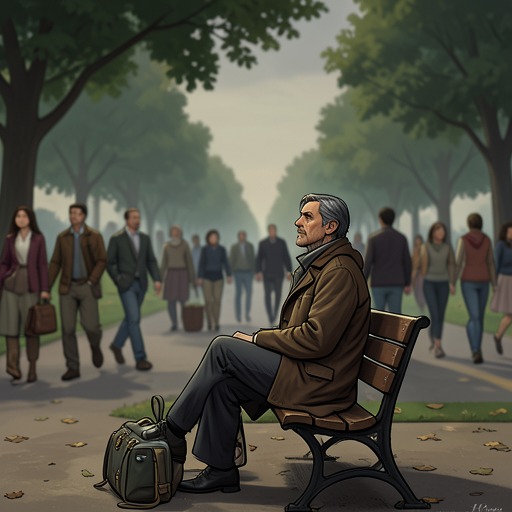
John’s Isolation
Brave New WorldJohn’s isolation is both a wound inflicted by exclusion and the condition he tries to reclaim as a way of life. At Malpais he is shut out of communal rites and left alone with the experience of rejection; in London, Mustapha Mond explains, solitude has been deliberately engineered out of ordinary life. John’s attempt to escape that system leads him to a Surrey lighthouse, where he briefly finds the quiet he wants before crowds discover him and turn his refuge into a spectacle.
Exclusion and the discovery of solitude
John’s sense of isolation takes shape at Malpais through concrete acts of exclusion. After being driven away from a communal ceremony, he is left alone outside the pueblo. The rejection matters more to him than his physical discomfort: he sobs because he has been shut out and abandoned. Sitting at the edge of the mesa, he confronts death and reflects on time and God. His solitude is therefore not merely the absence of company; it is the painful setting in which questions about existence become unavoidable.
His exclusion extends beyond that night. When the other boys are sent into the mountains for a rite involving a night alone and a dream of a sacred animal, they do not allow John to join them or share its secrets. He undertakes the ordeal by himself, fasting for five days before going into the mountains. He also describes standing with his arms out against a rock in the summer sun to learn what crucifixion felt like. These solitary acts show him seeking experiences the community has denied him, while his account to Bernard makes their shared sense of difference briefly recognizable to both of them.
Solitude in a society organized against it
John carries his need for solitude from Malpais into London, but the conditions there reverse the form of his earlier suffering. Mustapha Mond says the World State makes people hate solitude and arranges life so that it is almost impossible to be alone. John recognizes the contrast directly: at Malpais he suffered because he was excluded from the pueblo’s communal life; in London he suffers because he cannot get away from communal activity. Isolation is not simply a personal preference in this account. Its meaning changes with the surrounding society: forced separation hurts him at Malpais, while enforced sociability deprives him of the privacy he seeks in London.
The conversation also links solitude to religious belief and reflection on death. John argues that belief in God can feel natural when a person is quite alone at night, thinking about death. Mond answers that the World State prevents such solitude. John’s position is grounded in experience rather than in an abstract argument: the circumstances that once left him abandoned at Malpais also gave him space to confront mortality and religious questions. In London, a society designed to prevent aloneness restricts that kind of reflection along with private retreat.
The choice to withdraw
When John learns that Mustapha Mond would not let him join an experiment, he refuses to continue living as its subject. He says he will leave the next day, and when asked where he will go, answers that he does not care, so long as he can be alone. The declaration makes solitude an explicit objective: he is not looking for a new community or a specified destination, but for distance from the people who have treated his life as an experiment.
He chooses an old lighthouse on a hill between Puttenham and Elstead. Though it is only a short flight from the Charing-T Tower, the surrounding Surrey heath is largely deserted. Woods, open heather, gorse, firs, ponds, birch trees, water lilies, and rushes make the landscape appealing to John, whose accustomed point of comparison is the arid desert. The nearby settlements offer no attraction to the crowds looking for organized recreation, and for a time he lives there alone and undisturbed. The distance is thus both physical and social: he has found a place near London that its usual traffic does not seek out.
John equips himself for a life apart. He buys blankets, rope, tools, matches, cooking pots, seeds, and wheat flour, and hopes the money left after these purchases will last through winter. He expects a garden to make him independent by spring and plans to supplement it with game. The provisions give practical form to his wish to withdraw: rather than merely declare his rejection of the World State, he prepares to sustain himself outside its ordinary patterns of communal life and consumption.
Refuge breached and isolation destroyed
John’s solitude does not survive public discovery. While he is digging in his garden and thinking about death and the death of Linda, machines arrive over the heath and land around the lighthouse. Their passengers gather in a widening circle, laughing, taking photographs, and throwing things toward him. John retreats to the lighthouse wall, speechless and horrified. The arrival converts a place selected precisely for its quiet into a public attraction; the crowd approaches him not as someone seeking privacy but as a spectacle to watch.
The episode is reported in the newspapers, and the following evening an even greater swarm of helicopters arrives. Their visit follows the published account of the previous night’s gathering, making the violation of John’s retreat self-reinforcing: publicity brings more visitors, whose presence produces further attention. The refuge that had kept people away because it offered no conventional entertainment is now sought out because John has become its attraction.
After the visitors leave, John wakes in the heather, stupefied by soma and exhausted by the crowd’s prolonged frenzy. He remembers what happened and cries out in distress. The next evening, visitors enter the lighthouse and find John dead, hanging beneath an archway. His effort to secure solitude ends not in an independent life beyond the World State but in a final discovery by the public. The contrast between the empty landscape he chose and the crowd that finally occupies it makes his isolation a measure of the society’s refusal to leave him alone.