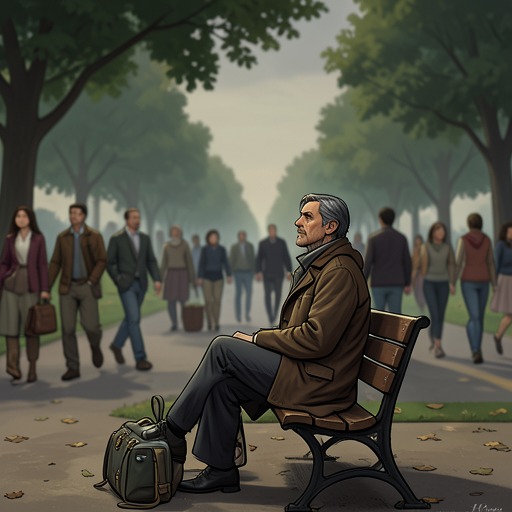
John’s exclusion from the Antelope Kiva initiation
Brave New WorldJohn’s exclusion from the Antelope Kiva initiation turns a hoped-for passage into manhood into a public rejection. Barred from joining the other boys, he is cast out of the community’s ceremony and left alone on the mesa; the episode crystallizes his outsider status and brings time, death, and God into his awareness.
Preparation and Expectation
Before the initiation, John has found purpose and pleasure in learning practical skills. At fifteen, old Mitsima begins teaching him to work clay beside the river. John takes intense satisfaction in shaping the material and feeling his hands grow more capable; while he works, he sings fragments of conditioning lessons, while Mitsima sings a song about killing a bear. Mitsima says he will teach John to make a bow the following winter. Their shared work offers a rare experience of instruction and companionship.
The prospect of initiation carries a different promise. At the full moon, the boys are to enter the Antelope Kiva and return as men. They are afraid but impatient, and John goes with them when the appointed night arrives. The ritual represents the communal recognition his everyday life has not given him. Its threshold, however, becomes the place where that exclusion is made explicit.
Rejection at the Kiva
As the boys begin to descend the ladder into the red-lit kiva, a man pulls John out of the line. John breaks free and tries to take his place again, but the men stop him and order him to leave, calling attention to his white hair and his mother. The other boys laugh. The men then throw stones, and John runs into the darkness while the singing continues inside and the last of the boys descend.
The rejection is not a failed test that John can overcome by demonstrating courage or skill. The men deny him entry before he can take part in the rite, and the group proceeds without him. The ceremony thus confirms the boundary separating John from the community: he is close enough to approach its threshold, but is not permitted to cross it.
Isolation and Its Consequences
John ends up alone outside the pueblo, on the mesa above the valley. The pain of being driven away is less important than the loneliness of being left out; at the edge of a precipice, he looks into the darkness below and considers the possibility of jumping. He watches blood drip from a cut on his wrist and repeats, in thought, the word “Finished,” connecting the end of his love for Kiakime with the initiation’s completion without him. He is sixteen.
In this solitude, John discovers what he describes as Time, Death, and God. His repeated sense of being alone becomes a defining statement of his experience, and Bernard responds that he, too, is terribly alone. The moment makes an unexpected connection between the two men, even as it shows how differently they have arrived at isolation.
Significance
The episode reverses the initiation’s promised movement from boyhood to recognized adulthood. John reaches the ceremony with the other boys, but exclusion prevents the communal transition the ritual is meant to confer. His earlier apprenticeship with Mitsima shows that he can learn and take pleasure in skilled work; the rejection therefore cannot be reduced to an inability to participate. It exposes the social boundary imposed on him.
The scene also joins a concrete act of exclusion to John’s emerging spiritual and existential awareness. Outside the kiva, the shared singing continues without him; alone on the mesa, he confronts mortality and gives shape to his sense of abandonment. The initiation does not incorporate John into the group, but its refusal becomes a lasting point of separation from which his understanding of belonging, death, and God develops.