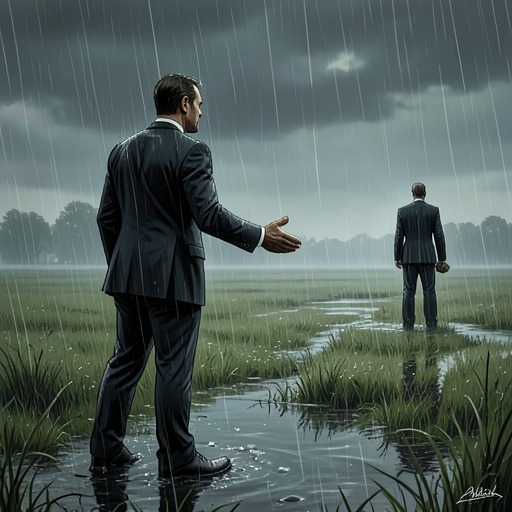
Linda–Thomas (D.H.C.) Past Affair
Brave New WorldLinda and Thomas Tomakin’s past affair links an intimate relationship to the World State’s effort to regulate reproduction and erase family ties. Thomas remembers a woman disappearing during their New Mexico holiday; later, John identifies his mother as Linda and names Tomakin as the man who accompanied her. The two accounts disclose that the Director of the Hatchery is John’s father, while also showing how a relationship treated as an ordinary holiday attachment in the World State becomes, through its consequences, an enduring family bond.
Identity and Background
Thomas Tomakin, known in the present as the Director of the Hatchery, once travelled to New Mexico on a holiday with a woman he describes as a Beta-Minus. Years later, while speaking to Bernard, he recalls that the woman had yellow hair, though he is not certain of the detail, and says that he wanted to see the people of the Reservation. His account places the affair within the World State’s conventions: the woman is referred to as the girl he was “having at the moment,” a phrasing that treats companionship as temporary and interchangeable rather than as the beginning of a family.
The woman is not named in Thomas’s recollection. The connection becomes clear when John explains that his mother, Linda, came from the Other Place long before his birth with a man who was his father. John names the man Tomakin; Bernard recognizes that Thomas is the Director’s first name. Linda’s history and Thomas’s memory thus converge, establishing a past relationship that neither account initially presents in the same terms.
The New Mexico Holiday and Separation
Thomas recalls that he and the woman rode horses while visiting the Reservation. Near the end of his leave, after they had gone riding in the mountains and stopped to rest, she went walking alone. A severe thunderstorm began while Thomas was asleep. The horses ran off, and Thomas hurt his knee while trying to catch them. He searched for the woman, then made his way back toward the rest-house, delayed by his injury and the loss of his soma.
The woman was not at the rest-house. A search the next day found no trace of her, and Thomas could only guess that she had fallen into a gully or been killed by a mountain lion. The cause of her disappearance remains uncertain in his recollection; the important outcome is that the pair were separated and he returned without her. He says the loss upset him more than he believed it should, and admits that he still sometimes dreams of the thunderstorm and of searching for her. His usual consolation—that the social body persists even when individual cells change—does not quiet the memory.
Linda, Thomas, and John
John gives the other account of the separation. Linda had gone walking in the mountains to the north, fallen down a steep place, and injured her head. Hunters from Malpais found her and brought her to the pueblo. She never saw the man who had brought her from the Other Place again. John understands his father’s departure as abandonment: he believes Tomakin flew back without Linda and describes him as unkind and unnatural. Linda remained in Malpais, where John was born and raised.
The accounts share the central fact of a woman lost in the New Mexico mountains and a man who did not return to her, but they differ in perspective and knowledge. Thomas remembers a vanished companion and an unsuccessful search; John knows that companion as his mother and remembers the absent man through the story she left him. The novel confirms the identity between the two men through Thomas’s first name, but does not supply a reunion between Thomas and Linda or a later direct explanation from either of them to the other.
Consequences and Significance
The affair’s consequence is not merely separation. Linda’s pregnancy and John’s birth make visible a form of parenthood that the World State’s norms suppress. In the Hatchery, human reproduction is organized through bottles, controlled development, and social predestination; fertility is described as a nuisance, with most female embryos made sterile. Against this engineered system, John’s existence records the biological and familial consequences of Thomas and Linda’s relationship. John’s question about why everyone cannot be made an Alpha Double Plus further exposes the logic behind standardized reproduction: the World State maintains distinct human types because it regards stability, rather than individual choice, as the governing purpose of social organization.
The delayed disclosure also turns Thomas’s private recollection into a public threat to his identity and authority. His account shows that even a conventional Director can be troubled by an attachment and loss that the World State’s doctrines tell him should matter little. John’s account supplies what Thomas’s memory cannot: the woman’s name, her survival, and the son left behind. The past affair therefore binds together private grief, involuntary parenthood, and the social order’s attempt to make both disappear.