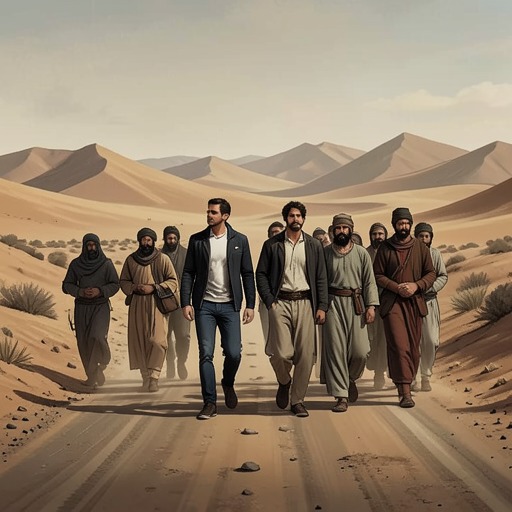
Malpais snake dance and Palowhtiwa's whipping ritual
Brave New WorldThe snake dance and Palowhtiwa’s whipping ritual at Malpais present ceremony as a collective act in which rhythm, sacred symbols, and a young man’s ordeal bind the gathered community. For Lenina, who initially compares the performance to a lower-caste Community Sing, its escalation becomes unbearable. Set beside the World State’s synthetic Solidarity Service, the scene also contrasts two forms of collective ritual: one aims to dissolve individual identities through manufactured sensation; the other places a participant within a tradition whose meaning Lenina cannot accept and whose belonging John himself has been denied.
The Dance and Its Transformation
The performance begins with masked or painted dancers emerging from chambers beneath the square. They move in a limping circle, singing as the drums quicken, while the crowd joins in and cries rise among the spectators. The escalating pace changes Lenina’s impression of the event: what first seemed familiar to her as a kind of Community Sing becomes a ritual whose actions she does not understand and whose violence she cannot dismiss.
The leader breaks from the dancers and opens a large wooden chest, taking out black snakes and then more snakes of different colours and patterns to distribute among the crowd. The dancers resume their circling, carrying the snakes with an undulating movement. At a signal they cast them into the square’s centre. An old man sprinkles the heap with corn meal; a woman arriving through another hatchway pours water over it from a black jar. The sequence turns the central space into the focus of a communal rite, ordered by signals, repeated movement, and shared attention.
Sacred Images and the Ordeal
After the old man raises his hand, the drums stop and the square falls silent. From separate openings beneath the ground, images of an eagle and a naked man nailed to a cross rise into view. The contrast between the halted crowd and the suspended figures gives the next actions a ceremonial gravity. The old man then gestures for a boy of about eighteen to come forward. Dressed in a white cotton breech-cloth, the boy stands with his head bowed and his hands crossed over his chest; the old man makes the sign of the cross over him before turning away.
The boy circles the heap of snakes. During his second circuit, a masked dancer wearing a coyote mask approaches with a plaited leather whip and begins striking him. The boy continues walking without speaking as the crowd responds to each blow with gasps and groans. The ritual’s pattern is repetition: he circles again and again while the dancer continues, and the gathering remains focused on the ordeal. When the boy finally falls, the old man touches his back with a long white feather and holds it up for the people to see before shaking it over the snakes. The drums start again; the crowd rushes away with the snakes, leaving the boy behind. Three older women carry him indoors, while the eagle and cross-bearing images are lowered out of sight.
Lenina’s Response
Lenina’s response makes the performance’s emotional cost explicit. As the whipping continues, she covers her face and begs for it to stop. After the crowd disperses, she remains distressed by what she has witnessed and wishes she had soma. Her reaction is not a change in the ritual itself but a measure of the distance between her conditioning and the community’s ceremony: she recognizes the suffering, yet has no framework for the practices or symbols surrounding it.
That distance is sharpened by her earlier comparison with the World State’s communal entertainment. The Solidarity Service gathers twelve people in a carefully arranged circle, uses synthetic music and soma, and repeats hymns that imagine their separate identities melting into a greater being. At Malpais, too, music and synchronized movement intensify collective feeling. But the snake dance is grounded in physical objects, inherited rites, and an ordeal that Lenina finds appalling, rather than in the World State’s manufactured promise of union. The parallel makes communal ecstasy visible in both settings without making their purposes or costs interchangeable.
John and the Boundary of Belonging
The ceremony also resonates with John’s earlier experience of exclusion from the Antelope Kiva initiation. When he tries to join the boys going down into the kiva, the men pull him out of line and reject him because he is white-haired and the son of a woman they condemn. The other boys laugh as the men drive him away with stones. He is left alone outside the pueblo while the initiation proceeds without him.
The two episodes reveal different positions within Malpais’s ritual life. At the snake dance, the community assembles around the boy’s ordeal; in the initiation, John is barred from the passage through which the other boys enter adulthood. His exclusion gives special weight to the scene’s collective structure: participation depends on recognition by the community, and John is denied it even though he longs to share the others’ experience. The ritual’s ordered circle thus offers belonging to some while exposing the boundary that keeps him outside.
Narrative Significance
The dance brings together recurring contrasts in the novel: collective unity and individual suffering, ritual belonging and social exclusion, and the World State’s artificial consolations against practices it regards as strange. Its steadily changing rhythms guide the scene from spectacle into solemnity, then back into motion after the boy falls. Lenina’s distress and John’s remembered isolation keep the ceremony from serving as a simple emblem of communal harmony. It is simultaneously a shared act, an ordeal borne by an individual, and a scene through which the limits of who can belong become visible.