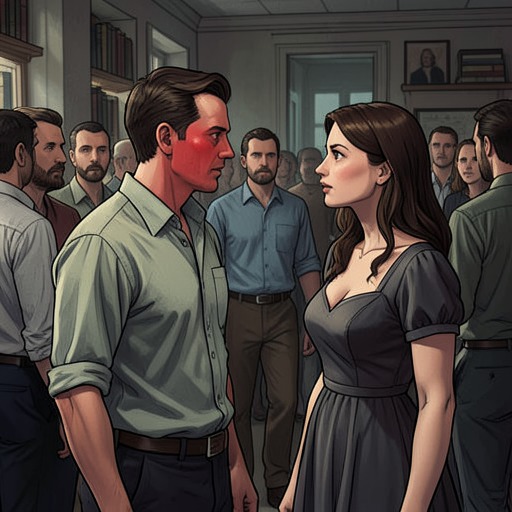
Promiscuity norm (“Everyone belongs to everyone else”)
Brave New WorldThe Promiscuity norm (“Everyone belongs to everyone else”) is the World State’s expectation that sexual relationships remain nonexclusive and that no one should form an exclusive attachment. Enforced through conditioning and social judgment, it presents availability as normal and deep personal bonds as dangerous to stability. Its costs become visible when private grief and care collide with the rule: the Director tries to recast a lost lover as a trivial episode, while John’s plea for recognition cannot reach Linda through her drug-induced understanding of their relationship.
Definition and Social Function
The norm compresses a social policy into a maxim: “Everyone belongs to everyone else”. Mustapha Mond explains its political logic by arguing that lasting civilization requires pleasant vices and that people must not be allowed to love anyone too much. Intense attachment could create divided loyalties or passions that destabilize society; the World State instead uses conditioning to encourage people to follow approved behavior and offers soma to quiet distress when unpleasant events occur.
This account makes sexual nonexclusivity part of a broader system of social management, not merely a personal custom. The community’s apparent freedom of access is paired with a limit on emotional independence: attachment that might resist the social order is treated as a danger, while conformity is described as healthy and normal.
The Director’s Lost Companion
The Director recounts that, before Bernard’s visit, he had traveled to New Mexico with a woman he was seeing. During the trip she disappeared after they rode into the mountains; a storm began, the horses ran off, and the Director injured his knee while trying to catch them. He searched for her and struggled back to the rest-house, arriving after midnight. A search the next day found no trace of her, and he guessed that she might have fallen into a gully or been killed by a mountain lion.
Although he calls the disappearance an accident and invokes the idea that society continues when individual members change, the memory still troubles him. He admits that he sometimes dreams of the thunder waking him and of searching for the woman beneath the trees. His distress sits uneasily beside the norm’s insistence that relationships should remain emotionally undemanding: the Director’s own recollection reveals an attachment that the official language cannot fully contain.
When Bernard says the experience must have been a terrible shock, the Director abruptly recognizes that he has revealed too much. He insists that the relationship was neither emotional nor prolonged, calls it healthy and normal, and hands Bernard the travel permit. His defensive denial shows the norm operating as a standard of respectability as well as a sexual rule: even a private memory of grief prompts him to recast the lost woman as no more than a temporary partner.
Linda, John, and the Rule’s Human Cost
After returning to civilization, Linda’s life centers on increasingly frequent soma holidays. She takes as much as twenty grammes a day, and Dr. Shaw tells Bernard that the amount will probably kill her within a month or two by paralyzing her respiratory center. The people around her find her conveniently out of the way while she is on soma; John is the one who objects to the shortening of her life. The contrast exposes a social order that treats her comfort and disappearance from public view as more important than the consequences of the drug.
At Linda’s bedside, she calls for Pope, and John responds by insisting that he is her son. She recognizes him, but her soma-shaped dream leads her to interpret him as an intruder interrupting her imagined time with Pope. She repeats the norm’s familiar claim that everyone belongs to everyone else, then loses the ability to continue speaking. The maxim persists at the moment when John seeks a particular bond and Linda can no longer meet him within it.
Public Enforcement and Significance
The norm’s reach is also apparent in the public reaction to John. When a young woman reaches toward him and the crowd demands the whip, John attacks her with it; she retreats and calls for Henry, who hides behind a helicopter. The crowd’s demand and the woman’s advance place John’s refusal of the expected sexual availability inside a public spectacle, where desire, punishment, and entertainment converge. His violent response does not restore a private boundary; it makes the conflict more visible.
Across these episodes, the rule works through ordinary assumptions as well as explicit conditioning. The Director edits his grief into an acceptable anecdote; Linda’s surroundings accommodate her drug use instead of protecting her life; John’s appeal to the singular relationship between mother and son goes unheard. The norm’s promise of universal belonging thus carries an irony: by discouraging exclusive attachment, it weakens the forms of loyalty and care that might make one person answerable to another.