Social conditioning
Brave New WorldSocial conditioning is the World State’s system for making people suited to their assigned social destinies and content to remain within them. It operates before birth as well as through childhood and adult life: institutions organize populations by predicted role, train bodies and minds to fit those roles, and regulate pleasure and leisure so that stability appears not merely compulsory but desirable.
Planning People for Social Roles
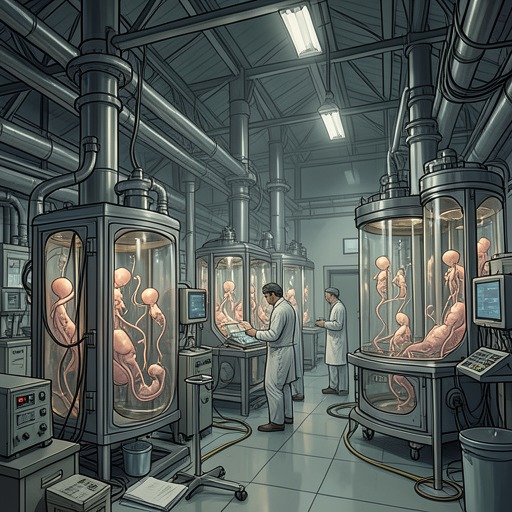
Conditioning begins with bureaucratic allocation. In the Hatchery, eggs are transferred from test-tubes into lined bottles, and labels record heredity, fertilization date, and Bokanovsky Group membership. Once identified, each bottle proceeds to the Social Predestination Room, where card-index records are updated and coordinated to calculate how many people of each quality are needed and the optimum rate of decanting. Predestinators send their figures to the Fertilizers, who provide the embryos requested; the bottles are then predestined in detail before entering the Embryo Store. Social conditioning is thus connected to a system that treats population as something to be counted, forecast, and supplied.
The system also shapes physical capacities to match expected work. In heat conditioning, hot and cool tunnels alternate, while coolness is paired with discomfort from hard X-rays. By decanting, embryos have acquired a horror of cold and are destined for tropical work such as mining, acetate-silk spinning, and steelworking. Later training is intended to make their minds endorse what their bodies have been prepared to do. The Director describes the governing aim as making people like their inescapable social destiny: bodily adaptation and learned preference reinforce one another.
The limits of this planning are visible in the discussion of an experiment at Mombasa. It produced people who matured sexually at four and were fully grown at six and a half, but they were socially useless because they were too unintelligent even for Epsilon work. The process could not be adjusted to produce an intermediate result: it either failed to modify development or modified it all the way. The unresolved search for a compromise between adults of twenty and adults of six shows that social predestination is ambitious but not omnipotent; it depends on technical control that remains imperfect.
Training Associations and Desires
Childhood conditioning converts repeated experience into durable reflex. In one demonstration, Delta infants are exposed to books and flowers alongside loud noises and electric shocks. After repeated lessons, these stimuli become linked in their minds, producing a lasting aversion to books and botany. The purpose is not simply to teach a particular response in the moment, but to make the association endure into adulthood, where it helps keep lower-caste citizens away from pursuits the State considers unproductive or disruptive.
The rejection of nature is designed around economic calculation. Primroses and landscapes are considered undesirable because they can be enjoyed without purchasing anything, while affection for the countryside does not keep factories busy. The State therefore conditions the masses to dislike the country but to enjoy country sports that require elaborate equipment. People still travel, consuming transport, and their recreation also generates demand for manufactured goods. The lesson in aversion is paired with an approved alternative, turning a psychological response into a predictable pattern of consumption.
Sleep teaching extends conditioning beyond the nursery. The Director explains that repeated suggestions become the child’s mind and continue to shape the adult’s judging, desiring, and deciding. These ideas are presented as suggestions from the State: institutional doctrines are absorbed until they can be experienced as one’s own settled outlook. Social conditioning therefore works not only through visible instruction or physical intervention, but through the gradual installation of assumptions that guide choices without requiring a fresh command.
Stability, Pleasure, and Managed Feeling
The social rationale behind conditioning is the maintenance of stability. The Controller presents individual stability as a precondition of social stability, comparing society to machinery whose wheels must keep turning and whose workers must be steady, obedient, and content. In this account, strong or prolonged impulses are potential sources of disturbance. His image of water under pressure suggests that releasing a single concentrated impulse can produce one powerful jet, whereas dividing it among many outlets yields weaker flows. The preferred social arrangement channels feeling into safe, predictable forms rather than allowing it to gather force.
The same principle shapes emotional life from infancy onward. The narrative describes an embryo’s blood-surrogate pump turning eight hundred times a minute and a nurse answering a decanted infant’s cry with a bottle of external secretion. By shortening the interval between desire and satisfaction, the system reduces the space in which frustrated desire might develop into intense feeling. The Controller says that no pains have been spared to make citizens’ lives emotionally easy and, as far as possible, to protect them from having emotions at all. Conditioning thus seeks not simply happiness as a private state, but a population less likely to experience the passions that could unsettle its assigned routines.
Adult life continues the same pattern through scheduled work, soma, games, unrestricted sexual access, and feelies. The Controller argues that lower-caste workers do not find their work awful: their seven-and-a-half-hour shifts are mild and unexhausting, and prescribed pleasures follow them. He cites an experiment in which the whole of Ireland was given a four-hour working day. The extra leisure brought unrest and a sharp increase in soma consumption rather than greater happiness. On this reasoning, shorter hours and labour-saving inventions are withheld not because they are technically impossible, but because excess leisure might expose citizens to dissatisfaction or destabilizing forms of reflection.
Conditioning and the Limits of Change
Economic planning and psychological conditioning are mutually reinforcing. The State keeps a third of the population in agriculture because obtaining food from the land takes longer than producing it in a factory, even though synthetic food would be possible. Inventions that could reduce labour are likewise held back: the Controller calls excessive leisure a cruelty to workers and describes every change as a menace to stability. Social conditioning therefore operates within a wider policy that manages not only what people learn to want, but also the work, consumption, and available choices that organize their lives.
The system’s confidence in stability also extends to knowledge itself. The Controller says that pure science can be subversive and must sometimes be treated as an enemy, kept under control along with other forces that might disturb the established order. The logic is continuous: citizens are trained to love their destinies, leisure is arranged to direct desire, and potentially transformative discoveries are restricted. Social conditioning is consequently more than a set of educational techniques. It is the human-facing part of a governing system that plans populations, manufactures preferences, and limits change so that social order can reproduce itself as apparent contentment.