Social predestination
Brave New WorldSocial predestination is the World State’s system for deciding, before birth, how many people of each kind it needs and shaping embryos to fill those places. It turns reproduction into population planning: people are classified, assigned a social function, and prepared for it before they can choose for themselves. The system’s promise of stability rests not on making everyone equal, but on producing differences in a controlled and supposedly useful form.
Definition and purpose
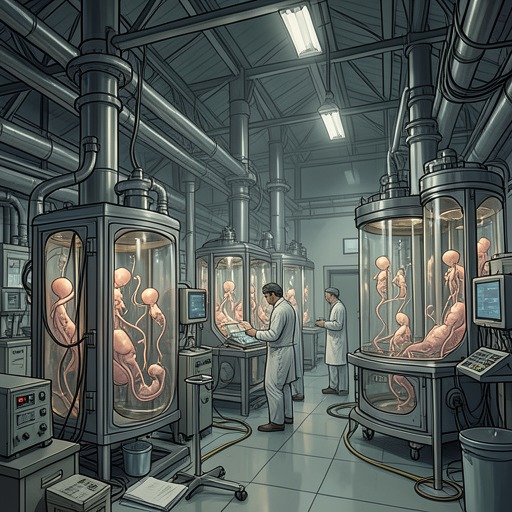
The Director presents the mass division of embryos as one of the chief instruments of social stability. Bokanovsky’s Process makes a single fertilized egg bud into as many as ninety-six embryos, with seventy-two described as a good average. The resulting batches of identical individuals can supply the workforce of a small factory, linking biological replication directly to standardized labor.
The process is designed to meet immediate population needs rather than allow people to mature over generations. Podsnap’s Technique can produce at least 150 mature eggs within two years; multiplying them by seventy-two yields nearly 11,000 same-age individuals in 150 batches. The Director also cites exceptional ovaries capable of yielding more than 15,000 adults. Such numbers make the goal explicit: the population is treated as a supply to be adjusted to present requirements.
From records to assigned lives
Predestination is administered through a continuous chain of laboratory work and recordkeeping. After embryos are transferred from test tubes into larger bottles, staff record heredity, fertilization date, and Bokanovsky Group membership. The bottles proceed to the Social Predestination Room, where an extensive card index is updated daily and coordinated with production calculations each afternoon.
Those records translate population targets into orders. Predestinators calculate how many individuals of particular qualities will be required and at what rate they should be decanted; Fertilizers then provide the embryos requested. Bottles are predestined in detail before entering the Embryo Store. The system thus joins classification to supply: each individual becomes identifiable in a database and countable as part of a planned workforce.
Biological preparation and class assignment
The plan reaches into the conditions of embryonic development. Staff regulate the embryos’ nourishment and circulation, test for sex, and mark bottles with symbols identifying males, females, and future freemartins. Since the society requires very few fertile ovaries, most female embryos receive hormone treatment and develop as sterile freemartins; only a limited portion are allowed to develop normally.
The same principle governs the production of class differences. Embryos are not merely brought to birth but predestined and conditioned for social roles, from Alphas to Epsilons and from future directors to sewage workers. A technician can reduce the speed of a blood-surrogate pump so that an embryo receives less oxygen, deliberately keeping it below par. Biological variation is therefore not an accident the system must accommodate: it is a means by which occupational hierarchy is made in advance.
Stability, contentment, and the limits of choice
The Controller explains the political logic behind this arrangement through a contrast between a regulated population and an imagined society composed entirely of Alphas. A workforce of people with similar capacities and room to make choices would, in his account, become unstable and miserable. The caste system is defended as a way to ensure that people fit the roles required to keep society operating, rather than as an equal distribution of opportunity.
That fit is maintained beyond the laboratory. The Controller describes lower-caste labor as simple and unstrained, followed by soma, games, and entertainment, and argues that extra leisure would not make workers happier. He cites an experiment that placed Ireland on a four-hour workday: unrest and increased soma consumption followed, so the policy was abandoned. He also says that labor-saving inventions remain unused and that a third of the population is kept in agriculture, where food takes longer to produce, because rapid change and excessive leisure threaten stability.
The system’s ideal is a smooth passage from assigned need to satisfied desire. The Controller likens uncontrolled feeling to pressure accumulating behind barriers; shorten the interval between wanting something and obtaining it, and emotion is less likely to become disruptive. The embryo’s carefully regulated development, the adult’s managed work and leisure, and the repeated assurance that everyone is happy are parts of the same governing logic: minimize dissatisfaction while ensuring that the social machinery continues to turn.
Significance and challenge
Social predestination makes the World State’s hierarchy look like a product of technical expertise and administrative necessity. Laboratory procedures, labels, production forecasts, and population figures present political choices as measurable problems with efficient solutions. The very precision of the process obscures its central decision: people are made different so that they can be assigned unequal functions.
John’s response exposes the human cost that this managerial language excludes. Recalling repeated lines of identical twins, including the crowds around Linda’s deathbed, he recoils from the Bokanovsky Groups. When he asks why the society does not make everyone an Alpha, Mustapha Mond answers that an all-Alpha workforce would be unstable and miserable. Their exchange reveals the system’s defining contradiction: it calls its imposed limits happiness and stability, while treating independent capacity and choice as dangers to be managed.