Social stability
Brave New WorldSocial stability is the World State’s governing objective and the rationale that joins its reproductive technologies, caste assignments, conditioning, leisure, and restrictions on innovation. Its promise of orderly, contented lives depends on making people and their desires fit the needs of a system designed to keep turning.
The principle and its machinery
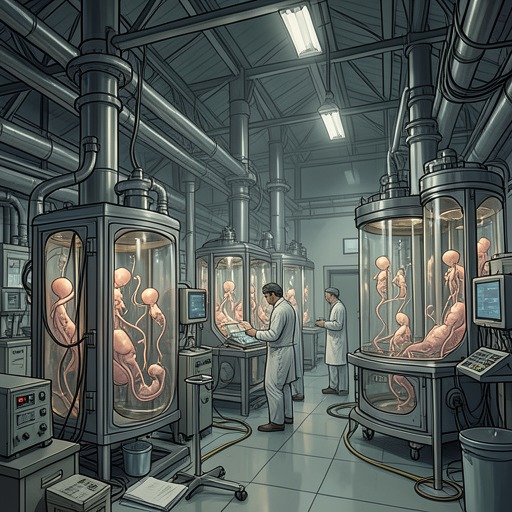
The Director calls Bokanovsky’s Process a major instrument of stability. By producing standard people in uniform batches, the process applies mass production to biology: a single factory can be staffed by identical workers, and the ideal is multiplied Gammas, Deltas, and Epsilons. The point is not merely efficient reproduction. Standardized people, the Director argues, make the social order easier to organize and maintain.
That principle continues in the Bottling Room and the Social Predestination Room. As eggs pass from test-tubes into larger containers, workers record heredity, fertilization date, and Bokanovsky Group on each bottle. The resulting records are gathered into an eighty-eight-cubic-metre card index, updated each morning and coordinated each afternoon. Predestinators calculate the quantity and quality of individuals required; Fertilizers supply the embryos requested, and predicted needs determine the rate at which people are decanted. Even unforeseen wastage is made good. Stability is thus pursued through an administrative chain that turns human reproduction into a continuously updated problem of information, allocation, and replacement.
Conditioning stability into common sense
The system also seeks to shape how people understand their place in it. A recorded lesson teaches children to rank castes through clothing, work, and supposed intelligence: the speaker is glad to be a Beta, regards Alphas as cleverer and harder-working, and describes lower castes as inferior. Repetition makes this hierarchy sound like a child’s own settled judgment rather than an official instruction.
The Director describes the process through the image of drops of sealing wax accumulating until the rock beneath is covered. Suggestions from the State, repeated throughout childhood, become the adult mind that judges, desires, and decides. The method’s political force lies in this passage from instruction to conviction: the state’s preferred judgments are internalized as personal common sense.
The same logic governs intimate conduct. The Controller sets exclusiveness, family, and romance against the maxim “every one belongs to every one else,” which students accept after more than sixty-two thousand repetitions in the dark. Fanny applies that norm in ordinary conversation, urging Lenina to see that remaining with Henry for months is improper and that she should make an effort to be more promiscuous. Lenina admits she has not recently felt keen on doing so, but ultimately repeats the maxim and agrees to try. The episode shows stability working not only through formal instruction but through social correction and self-management.
Desire, work, and emotional ease
The Controller explains stability as a condition of civilization: individual stability keeps society functioning, while disruption threatens the whole. His account links the steady motion of the social machine to dependable, obedient workers. Pain, grief, and intense attachment are dangerous in this framework because they can interrupt the regularity on which collective life depends.
The policy therefore aims to shorten the interval between desire and satisfaction. The Controller compares unrestrained impulse to water under pressure: divided among many outlets, it loses force; directed through one, it becomes a powerful jet. The society instead channels desire into routine satisfactions and tries to prevent the accumulated feeling that might become passion or madness. Biological maintenance follows the same schedule-bound logic: the embryo’s blood-surrogate pump turns eight hundred times a minute, and a decanted infant is promptly given a bottle. The Controller presents the resulting emotional ease as care, while also describing it as protection from having emotions at all.
Work and recreation are calibrated to preserve this contentment. Mustapha Mond says lower-caste workers perform seven and a half hours of mild labour, followed by a soma ration, games, unrestricted sexual access, and feelies. A four-hour working day was tried across Ireland, he explains, but the extra leisure brought unrest and increased soma consumption rather than greater happiness. The state could reduce working hours, yet Mond argues that doing so would expose people to a kind of freedom they do not know how to use. Welfare is measured by predictable satisfaction, not by expanded choice.
The cost of preserving the order
The Controller’s account makes clear that stability is not simply a natural result of prosperity. It is maintained by organizing production and pleasure, suppressing disruptive attachments, and limiting changes that could alter the population’s expectations. Mond says that every change menaces stability; even labour-saving inventions are withheld when their adoption might unsettle work and social arrangements. He also argues that keeping a third of the population in agriculture serves the system, since obtaining food from land takes longer than producing it in a factory.
The same constraint applies to knowledge. Mond calls discoveries in pure science potentially subversive and says science must be kept under control. Stability consequently defines both what the society encourages and what it refuses to pursue: innovations are judged not only by what they can accomplish, but by whether their consequences could disturb the existing order.
In daily life, the system’s assurances arrive as familiar phrases. Lenina and Henry take soma with coffee before going to the Westminster Abbey Cabaret, where a popular song celebrates a little bottle. The scene places managed pleasure within an ordinary evening, rather than setting it apart as an emergency measure. Social stability endures because its techniques are made to feel like convenience, entertainment, and happiness. Its central contradiction is that this comfort is secured by narrowing the range of lives, desires, and discoveries the society will permit.